
Senior citizens can apply for a Mudra loan for senior citizens under the Pradhan Mantri Mudra Yojana (PMMY). This article explains the eligibility criteria, benefits, and common myths about Mudra Loans for seniors.
Key Takeaways
- Senior citizens are eligible to apply for Mudra Loans under the Pradhan Mantri Mudra Yojana, with no official age restrictions.
- A strong business plan, proof of income, and possibly a co-applicant are crucial for enhancing the likelihood of loan approval for senior citizens.
- Various financial institutions, including regional rural banks and microfinance institutions, offer tailored services and favorable lending criteria for senior applicants.
Introduction
The Pradhan Mantri Mudra Yojana (PMMY) scheme, launched by the government, is designed to support micro and small manufacturing units with accessible credit. It caters to the manufacturing, trading, and service sectors, providing loans up to Rs 10 lakh. However, a common assumption is that these loans are primarily for the youth or working individuals.
Can senior citizens or retired persons get it? Contrary to popular belief, they can indeed avail Mudra Loans, provided they meet certain criteria.
This guide will explore the eligibility, benefits, and myths related to senior citizens availing Mudra Loans. Even if you are unsure about approval chances, you can understand common rejection reasons in our guide on Mudra loan rejection and how to fix it.
Can Senior Citizens Get Mudra Loan?
Yes, senior citizens and retired persons can apply for Mudra Loans under PMMY. There is no age limit. Approval depends on business plan, income proof (like pension), and repayment capacity.
| Category | Loan Amount | Best For |
|---|---|---|
| Shishu | Up to ₹50,000 | Small start (low risk) |
| Kishore | ₹50,001 – ₹5 lakh | Growing business |
| Tarun | ₹5 lakh – ₹10 lakh | Expansion |
| Tarun Plus | ₹10 lakh – ₹20 lakh | Advanced scaling |
Can Senior Citizens Apply for a Mudra Loan?

A prevalent misconception is that Mudra Loans are restricted to younger entrepreneurs. The guidelines of the Pradhan Mantri Mudra Yojana (PMMY) clarify that there is no official age bar for applicants. What truly matters is having a viable business plan and demonstrating repayment capacity.
Banks providing loans under the Mudra scheme may review income proof, pension statements, or the possibility of a guarantor to assess the financial stability of senior applicants. This means that as long as senior citizens can present a solid business plan and prove their ability to repay the loan, they are eligible to apply for Mudra Loans.
Mudra Loan for Senior Citizens – Eligibility, Benefits & How to Apply
The Pradhan Mantri Mudra Yojana (PMMY) is a transformative initiative providing easy access to capital for entrepreneurship, making it particularly beneficial for senior citizens looking to start their own businesses. Despite prevailing myths, Mudra Loans are not just for young entrepreneurs; retired persons are equally eligible.
These myths often deter senior citizens from applying. Yet, Mudra Loans under the PMMY scheme are available for all, emphasizing inclusivity and financial empowerment for every age group. By debunking these misconceptions, we can open doors for more senior citizens to explore entrepreneurial ventures.
If you already have a regular income source, you can also refer to Mudra loan for salaried person. If you don’t have a strong credit profile, you can also explore options like Mudra loan without CIBIL score.
No Age Barriers in PMMY
One of the most significant aspects of the Mudra Loan scheme is its accessibility across all age groups. The guidelines of the PMMY explicitly state that there are no age restrictions. This means senior citizens can apply for Mudra Loans without facing any age-related barriers.
This inclusive approach was envisioned by the hon’ble prime minister, ensuring that every aspiring entrepreneur, regardless of age, can pursue their business dreams. The absence of age barriers is a testament to the scheme’s commitment to fostering entrepreneurship at every stage of life.
Types of Businesses Eligible for Senior Citizens
With Mudra Loans, senior citizens can venture into various business domains. The scheme supports a broad spectrum of enterprises, including:
- Consultancy services
- Tutoring
- Food services
- Online reselling.
Additionally, the following are also eligible under this scheme:
- Personal care services
- Retail outlets
- Handicrafts
- Agri-allied activities
This flexibility allows senior citizens to choose a business that aligns with their skills and interests, making the entrepreneurial journey both fulfilling and financially rewarding.
Senior citizens can also start small ventures from home. Explore options like Mudra loan for home business.
Eligibility Criteria for Senior Citizens
Accessing Mudra Loans involves meeting specific eligibility criteria designed to ensure that applicants can manage and repay the loan successfully. Senior citizens must provide valid identification, proof of income, and bank statements to support their loan application.
Proper documentation, co-applicant support, and strong planning help demonstrate eligibility and financial stability. Additionally, a history of loan defaults or bankruptcy disqualifies applicants, emphasizing the importance of a clean financial record.
Viable Business Plan and Repayment Capacity
A solid business plan increases the likelihood of Mudra Loan approval. Senior citizens should present a well-structured plan outlining business requirements and sustainable income potential. Additionally, maintaining a strong credit score significantly enhances approval chances.
Lenders assess repayment capacity based on credit score. A score above 700 is favorable, with 750 or higher being excellent. To counteract age-related biases, senior citizens must showcase a robust repayment plan.
Co-Applicant Requirements
If a senior citizen’s income is low, involving a co-applicant can be beneficial. A co-applicant shares the responsibility of loan repayment, thereby strengthening the application.
The primary consideration for a co-applicant is their income level, which can significantly impact the loan approval process. By including a co-applicant, senior citizens can demonstrate enhanced financial stability and repayment capacity.
No Default or Bankruptcy Record
Senior citizens must have no history of loan defaults or bankruptcy to qualify for a Mudra Loan. Maintaining a clean financial record is imperative for meeting the eligibility criteria and securing funding.
Required Documents for Mudra Loan Application
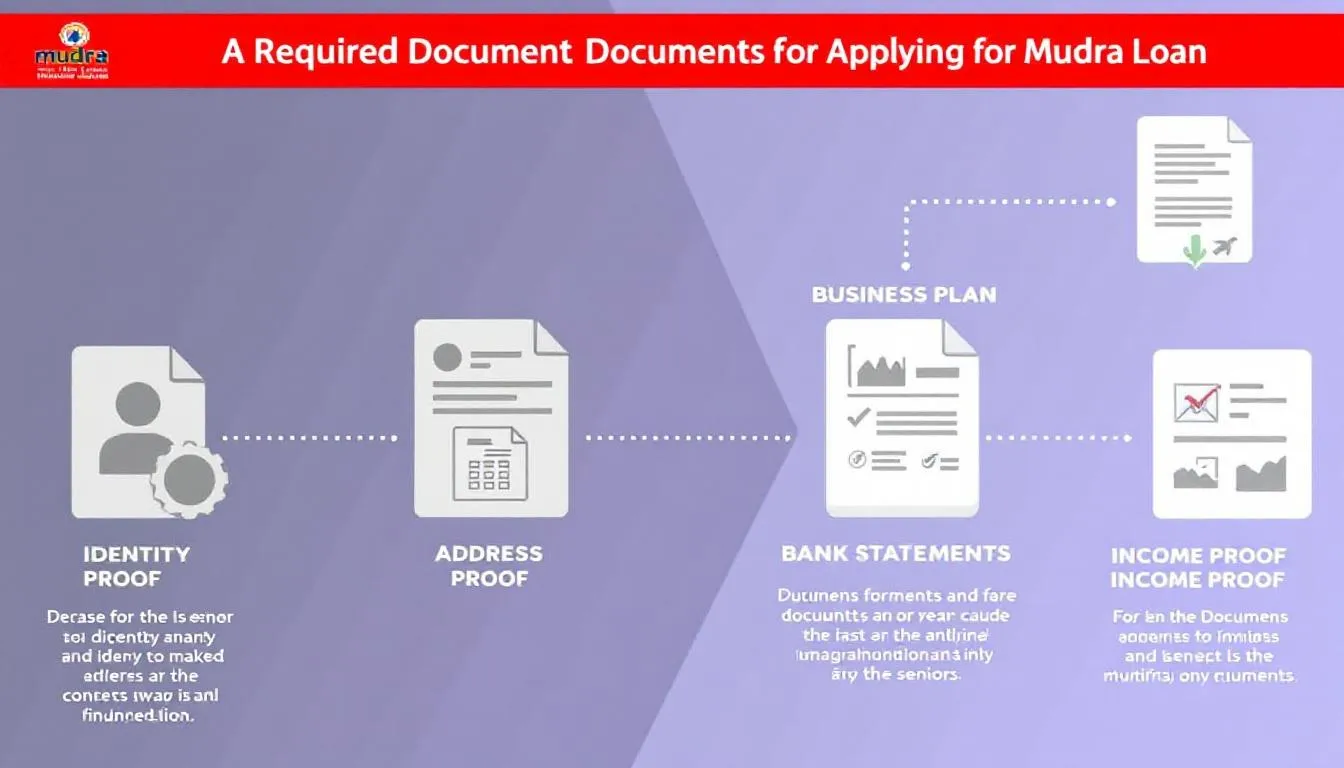
Applicants must provide a comprehensive set of documents to support their Mudra Loan request. Essential documents include:
- A valid photo ID
- Proof of retirement
- Pension statements
- A detailed business plan
- Proof of business location
These documents are vital for verifying the applicant’s identity, financial stability, and the viability of the proposed business. Proper documentation ensures a smooth application process and enhances the chances of loan approval, including the documents required for submission.
Personal Identification and Proof of Retirement
Applicants must submit the following documents:
- Aadhaar and PAN cards for personal identification
- Proof of retirement, such as a pension statement, to validate financial stability
- Proof of age to demonstrate eligibility for Mudra Loans
These documents collectively ensure that senior citizens meet the required criteria for loan approval.
If you do not have a PAN card, check how you can apply for a Mudra loan without PAN card.
Business-Related Documents
A well-structured business plan is crucial for a successful Mudra Loan application. Applicants must also provide proof of business location, such as a lease agreement or utility bill. These documents verify the operational aspects of the business and demonstrate its viability to lenders.
Submitting comprehensive business-related documents is key to securing the loan with collateral security in the correct form.
Co-Applicant Documentation
If a co-applicant is involved, their identification and financial documents, including Aadhaar and PAN cards, must also be provided. These additional documents ensure the verification of both parties involved in the loan application.
Common Challenges and Solutions
Senior citizens often face challenges such as banks’ hesitance due to age and lack of income. To mitigate these issues, consider the following:
- Present a strong business plan
- Involve a co-applicant
- Maintain a good credit score
- Provide comprehensive documentation These steps are crucial for overcoming these obstacles.
By addressing these concerns, senior citizens can improve their chances of loan approval.
Banks’ Hesitance Due to Age
Some financial institutions may hesitate to lend to senior citizens based on age-related concerns. To counteract this bias, applicants can provide a detailed repayment plan and consider including a co-signer. While lenders cannot legally deny loans based solely on age, a solid repayment plan can alleviate their concerns for the borrower.
This proactive approach can enhance the chances of loan approval.
Lack of Income
Insufficient income is a common challenge for senior citizens applying for Mudra Loans. To strengthen the application and improve approval chances, consider the following:
- Involve a co-applicant with a stable income.
- Regularly monitor your credit score.
- Address any discrepancies in your credit report to secure better loan terms and increase the likelihood of approval.
By demonstrating financial stability, senior citizens can overcome income-related challenges.
Best Financial Institutions for Senior Applicants
Several financial institutions cater specifically to the needs of senior citizens seeking Mudra Loans. These include regional rural banks, cooperative banks, and microfinance institutions. They offer personalized services and more flexible lending criteria, making them ideal for senior applicants.
Choosing the right financial institution can significantly impact the approval and terms of the loan.
Regional Rural Banks
Regional Rural Banks (RRBs) play a crucial role in providing credit and supporting the rural economy in both rural and urban areas. They often offer lower interest rates and more flexible lending criteria, beneficial for senior citizens.
RRBs provide personalized banking services, fostering a trusted relationship between the bank and the borrowers. This supportive environment is particularly advantageous for senior citizens seeking Mudra Loans, especially when managing their bank account.
Cooperative Banks and Microfinance Institutions
Cooperative banks often have lower interest rates and are more willing to lend to seniors. Microfinance institutions focus on providing financial assistance to those underserved by traditional banks, making them ideal for senior entrepreneurs.
Both types of institutions aim to empower senior citizens by offering tailored financial products. This support can make a significant difference in the success of their entrepreneurial ventures.
Example:
For example, a retired government employee receiving ₹25,000 monthly pension can start a small tiffin service using a ₹50,000 Shishu Mudra Loan and gradually expand into catering.
Success Stories of Senior Citizen Borrowers
The transformative power of Mudra Loans is best illustrated through the success stories of senior citizens who have embraced entrepreneurship in their golden years. Firozkhan Baghban, for instance, successfully launched a tuition service, showcasing how retired professionals can continue to contribute to society while earning a sustainable income.
Similarly, another inspiring example is a senior citizen who established a thriving home-based food business, enabling them to generate income and maintain a connection with the local community.
These stories highlight the incredible potential for senior citizens to pursue entrepreneurship, demonstrating that age is not a barrier to success.
Case Study: Retired Teacher Starting a Tuition Service
Consider the case of a retired teacher who took a Mudra Loan of Rs 195,000 to start a tuition service. Initially, the teacher conducted computer classes for 10-12 students, providing valuable education and bridging the digital divide.
As the business grew, the teacher employed 7-8 individuals, including teaching staff and a marketing executive, to expand the services offered in response to the growing demand. This case study exemplifies how a well-planned business venture can achieve remarkable success with the right financial support.
Case Study: Home-Based Food Business
Another success story is that of Budhram God, who started a vegetable shop with the disbursement of a Shishu Mudra Loan. Raju Das Bairagi also established a thriving fast food center using a Mudra Loan, demonstrating the scheme’s potential to empower senior entrepreneurs.
These examples illustrate how Mudra Loans can enable senior citizens to pursue entrepreneurial ventures, fostering financial independence and community engagement. By leveraging the scheme’s benefits, they have successfully created sustainable businesses that contribute to their local economies.
Tips for Improving Approval Chances
Improving the chances of Mudra Loan approval involves several strategic steps. A well-structured business plan showcases the financial viability and potential of the proposed venture. Additionally, maintaining a good credit score is crucial for enhancing loan eligibility despite limited income.
Applying for smaller loans initially, such as Shishu loans, can significantly increase the likelihood of approval due to lower financial risks. Furthermore, demonstrating a reliable source of income, such as pensions, and approaching flexible financial institutions can also boost approval chances.
A properly prepared DPR can increase approval chances. Learn how to create a Mudra loan project report.
Applying for Small Shishu Loans
Starting with Shishu loans, designed for smaller funding needs requests, can significantly increase approval rates. These loans, typically loan upto rs 50,000, are less risky for lenders and thus more likely to be approved, allowing borrowers to access a maximum loan more easily.
By opting for smaller loan amounts initially, senior citizens can build a positive credit history and gradually qualify for larger loans as their business grows. This approach not only mitigates financial risk but also establishes a track record of successful loan repayment.
Approaching Flexible Financial Institutions
Choosing the right financial institution can significantly impact the approval and terms of a Mudra Loan. Private banks and microfinance institutions are often more flexible in their lending criteria, making them a viable option for senior citizens.
Microfinance institutions are known for their support of smaller businesses and are typically more accommodating to senior citizens. Cooperative banks also offer personalized service and understanding of community needs, while regional rural banks focus on accessibility and support for local entrepreneurs.
Maintaining Good Credit Score
Maintaining a strong credit profile, including a good CIBIL score, is essential for seniors to qualify for loans. A positive credit score can significantly improve chances of loan approval and help secure more favorable terms.
Summary
The Mudra Loan scheme under the Pradhan Mantri Mudra Yojana is a powerful tool for senior citizens and retired individuals to achieve financial independence and pursue entrepreneurial dreams. There are no age barriers in the PMMY guidelines, making the scheme accessible to all who have a viable business plan and repayment capacity.
By understanding the eligibility criteria, gathering the required documents, and addressing common challenges, senior citizens can significantly improve their chances of loan approval. Success stories of senior borrowers exemplify the scheme’s potential to transform lives and foster financial empowerment. So, take that leap of faith and harness the opportunities presented by Mudra Loans to turn your entrepreneurial dreams into reality.

Milk Powder Manufacturing Plant Project Report (DPR) for Bank Loan
Key Takeaways A bankable milk powder manufacturing plant project report must weave together technology selection, raw milk procurement strategy, project cost estimation, financial projections and
Milk Powder Project ROI, IRR & Sensitivity Analysis
A milk powder manufacturing plant can look remarkably profitable in a base-case financial projection. Revenue grows with capacity ramp-up, margins appear healthy, and payback seems
Milk Powder Project Term Loan Assessment: Eligibility, Bank Appraisal and Loan Calculation
Key Takeaways Introduction: Why Term-Loan Assessment Matters for a Milk Powder Manufacturing Plant Setting up a milk powder manufacturing plant in India involves land acquisition,

Milk Powder Plant Bank Loan & Project Finance in India
Key Takeaways Introduction: Milk Powder Plant Bank Loan – Where Does the Money Really Come From? A milk powder manufacturing plant is among the most

Milk Powder Plant Feasibility Study & Project Viability in India
Key Takeaways Introduction: Why Milk Powder Plant Viability Needs Rigorous Evaluation A milk powder manufacturing plant in India is a capital-intensive manufacturing project. Depending on

Milk Powder Plant Break-Even Analysis: Cost, Capacity Utilisation and Profitability
Key Takeaways Introduction: Why Break-Even Analysis Is Critical Before Setting Up a Milk Powder Plant A milk powder manufacturing plant is one of the most