

3. Market Demand & Business Opportunity
Zinc Deficiency in Indian Soil
A large portion of Indian agricultural soil suffers from zinc deficiency, which reduces crop productivity and quality. To overcome this problem, farmers are increasingly using Zinc Sulphate fertilizers in various crops.
Rising Agriculture Fertilizer Demand
The demand for micronutrient fertilizers is increasing rapidly due to the growth of commercial farming, high-yield agriculture, and awareness about balanced fertilizer usage. Zinc Sulphate is widely used in crops such as wheat, rice, soybean, maize, sugarcane, and vegetables.
Government Support for Micronutrients
The Government of India promotes micronutrient usage through soil health programs, awareness campaigns, and agriculture development schemes. This government support is helping increase the demand for Zinc Sulphate products across the country.
Export Opportunity
Zinc Sulphate has good export demand in many countries for agriculture, animal feed, and industrial applications. Indian manufacturers can benefit from growing international demand and competitive production costs.
Future Market Scope
The future of the Zinc Sulphate manufacturing business is highly promising due to increasing fertilizer consumption, sustainable farming practices, hydroponics farming, and rising awareness about soil health management. The market is expected to grow continuously in the coming years.
Impact of Carbon Credit and Sustainable Farming on Zinc Sulphate Demand
The growing focus on carbon credits, regenerative agriculture, sustainable farming, and soil health improvement may further increase the future demand for Zinc Sulphate. Many carbon farming and climate-smart agriculture programs focus on improving soil nutrient balance, crop productivity, and long-term soil health. As farmers increasingly adopt precision farming, soil testing, and sustainable agricultural practices, the demand for micronutrient fertilizers such as Zinc Sulphate may continue to grow in the coming years.
Similar growth opportunities can also be seen in emerging sectors such as Medical Devices Manufacturing, where demand for specialty chemicals and industrial materials continues to increase.
4. Uses of Zinc Sulphate
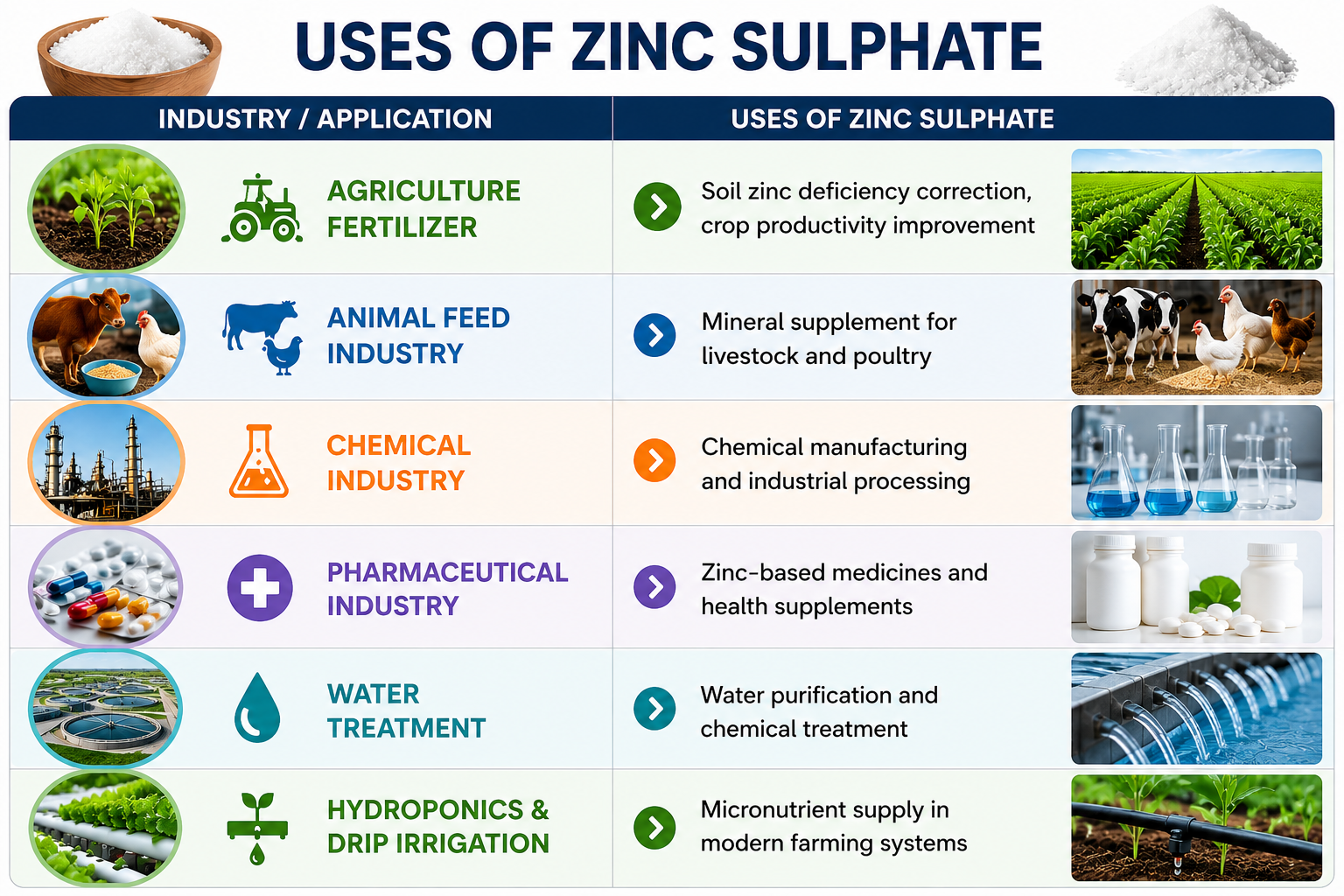
Zinc Sulphate is widely used in agriculture, chemical industries, pharmaceuticals, animal feed, water treatment, and modern farming systems due to its important micronutrient and chemical properties.
Agriculture Fertilizer
The largest use of Zinc Sulphate is in agriculture as a micronutrient fertilizer. It helps improve soil fertility, crop growth, grain quality, root development, and overall crop productivity. It is widely used in crops such as wheat, rice, maize, cotton, soybean, sugarcane, vegetables, and fruits.
Animal Feed Industry
Zinc Sulphate is used as a mineral supplement in poultry feed, cattle feed, and animal nutrition products. Zinc helps improve animal growth, immunity, metabolism, and reproductive performance.
Chemical Industry
In the chemical industry, Zinc Sulphate is used in various chemical manufacturing processes, textile processing, electroplating, rayon production, and industrial chemical formulations.
Pharmaceutical Industry
Pharmaceutical-grade Zinc Sulphate is used in health supplements, zinc tablets, syrups, oral rehydration products, and other medicinal applications related to zinc deficiency treatment.
Water Treatment
Zinc Sulphate is also used in water treatment chemicals and industrial water purification systems for specific treatment applications.
Hydroponics and Drip Irrigation
EDTA Chelated Zinc and water-soluble Zinc Sulphate products are increasingly used in hydroponics, drip irrigation, greenhouse farming, and precision agriculture systems where controlled micronutrient supply is important for high-value crop production.
5. Raw Materials Required
Zinc Ash/Dross
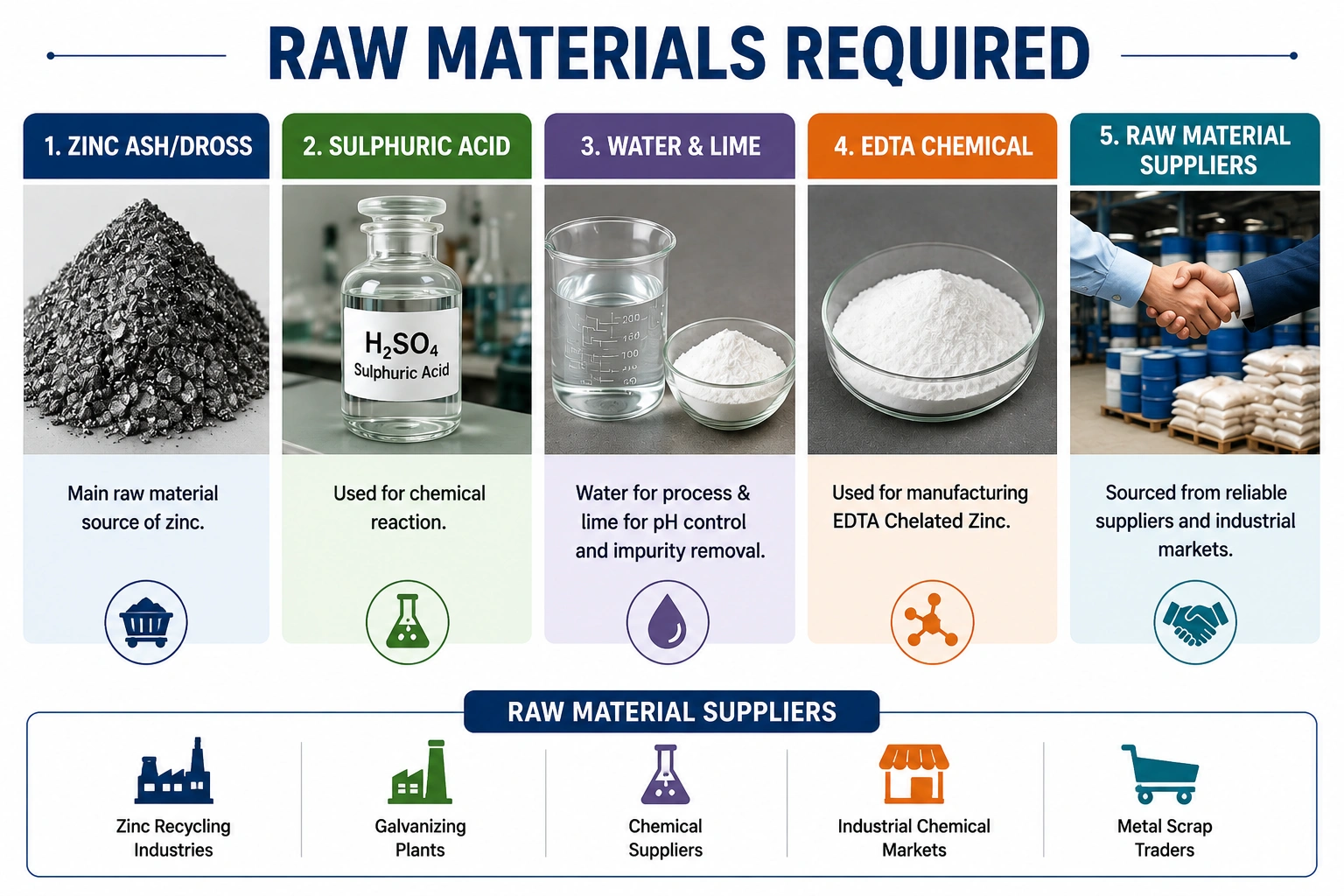
Zinc Ash and Zinc Dross are the primary raw materials used in Zinc Sulphate manufacturing. These materials are obtained from galvanizing industries, zinc processing units, and metal recycling industries. The zinc content in ash and dross directly affects product quality and production efficiency.
Sulphuric Acid
Sulphuric Acid is an important chemical used for the reaction process in Zinc Sulphate manufacturing. It reacts with zinc raw materials to produce Zinc Sulphate solution. Proper handling and storage systems are necessary because sulphuric acid is highly corrosive.
Water & Lime
Water is required during the chemical reaction, filtration, and crystallization process. Lime is commonly used for impurity control and pH adjustment during manufacturing. Good quality water helps improve final product quality.
EDTA Chemical
EDTA chemical is mainly used for manufacturing EDTA Chelated Zinc products. It helps improve zinc absorption in plants and is widely used in premium agriculture products, hydroponics, and drip irrigation systems.
Raw Material Suppliers
Raw materials can be sourced from zinc recycling industries, galvanizing plants, chemical suppliers, industrial chemical markets, and metal scrap traders. Major industrial areas and chemical hubs in India provide regular supply of Zinc Ash, Zinc Dross, Sulphuric Acid, and other chemicals required for production.
Entrepreneurs interested in metal recovery and processing industries may also explore the Gold Refining Business in India, where various chemical compounds are widely used during refining operations.
6. Manufacturing Process of Zinc Sulphate
The manufacturing process of Zinc Sulphate mainly involves chemical reaction, filtration, evaporation, crystallization, drying, and packing. The process may vary slightly depending on whether Zinc Sulphate Monohydrate, Heptahydrate, or EDTA Chelated Zinc is being manufactured.
Step-by-Step Manufacturing Process
| Process Step | Purpose |
|---|---|
| Raw Material Preparation | Preparation of zinc-containing materials |
| Chemical Reaction | Formation of Zinc Sulphate solution |
| Filtration | Removal of impurities |
| Evaporation | Increasing solution concentration |
| Crystallization | Formation of Zinc Sulphate crystals |
| Drying | Moisture removal |
| Pulverizing | Powder preparation |
| Packing | Final product packaging |
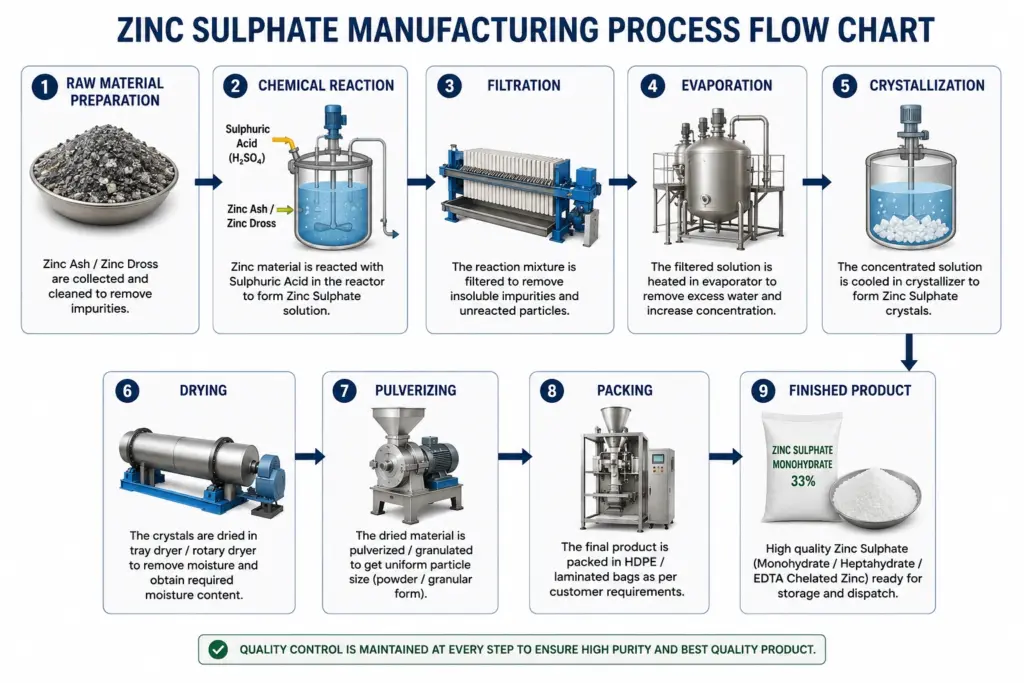
Raw Material Preparation: Zinc Ash, Zinc Dross, or other zinc-containing raw materials are collected, cleaned, and prepared for the manufacturing process.
Chemical Reaction: The prepared zinc material is reacted with Sulphuric Acid in a reaction vessel to produce Zinc Sulphate solution.
Chemical Reaction:
Zn + H_2SO_4 \rightarrow ZnSO_4 + H_2
Filtration: The reaction mixture contains impurities and insoluble materials which are removed through filtration using filter press systems.
Evaporation: The filtered Zinc Sulphate solution is heated to remove excess water and increase solution concentration.
Crystallization: After evaporation, the concentrated solution is cooled to form Zinc Sulphate crystals.
Drying: The crystals are dried using tray dryers, rotary dryers, or other industrial drying systems to reduce moisture content.
Pulverizing: The dried material is pulverized or converted into powder/granular form depending on market requirements.
Packing: The final Zinc Sulphate product is packed in HDPE bags, laminated bags, or bulk packaging for storage and transportation.
Manufacturing Process Flow Chart
7. Plant & Machinery Required
The Zinc Sulphate manufacturing business requires chemical processing machinery, drying equipment, filtration systems, storage tanks, and pollution control equipment. The machinery selection mainly depends on production capacity and product type.
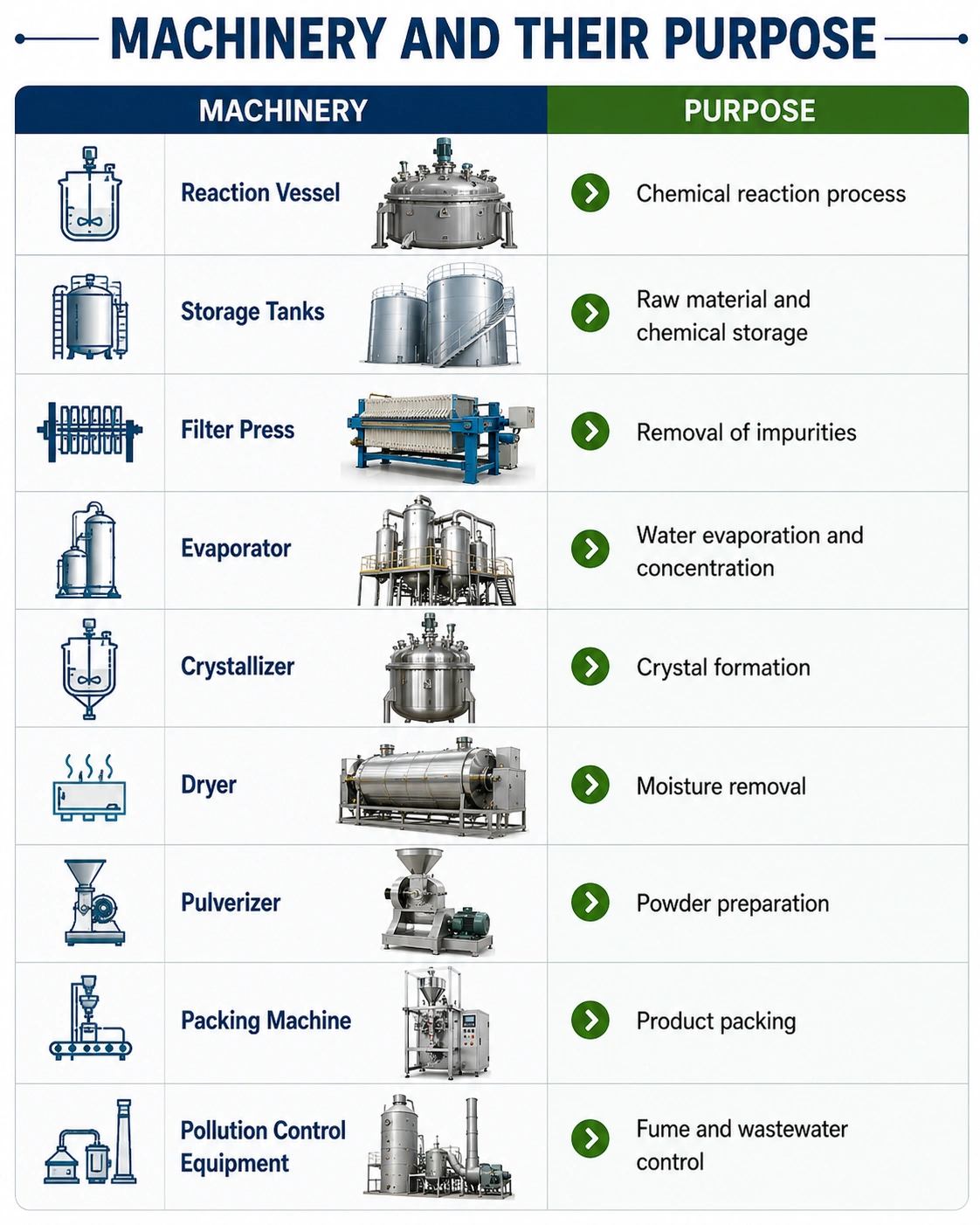
Reaction Vessel
Reaction vessels are used for reacting Zinc Ash or Zinc Dross with Sulphuric Acid to produce Zinc Sulphate solution. These vessels are generally made of acid-resistant material.
Storage Tanks
Storage tanks are used for storing Sulphuric Acid, water, intermediate chemicals, and final Zinc Sulphate solution.
Filter Press
Filter press systems help remove insoluble impurities and unwanted particles from the reaction mixture.
Evaporator
Evaporators are used to remove excess water from the Zinc Sulphate solution and increase concentration before crystallization.
Crystallizer
Crystallizers help convert concentrated Zinc Sulphate solution into crystal form during the cooling process.
Dryer
Tray dryers or rotary dryers are used to remove moisture from Zinc Sulphate crystals and achieve the required product quality.
Pulverizer
Pulverizers convert dried Zinc Sulphate material into powder or granular form as per market demand.
Packing Machine
Packing machines are used for filling and sealing Zinc Sulphate in HDPE bags or laminated bags.
Pollution Control Equipment
Pollution control systems such as scrubbers, chimneys, and Effluent Treatment Plants (ETP) are required for controlling acid fumes and wastewater.
Machinery Cost Estimation
| Approx Cost | |
| Small Scale Plant | ₹30 lakh – ₹80 lakh |
| Medium Scale Plant | ₹1 crore – ₹4 crore |
| Large Scale Plant | ₹5 crore – ₹15 crore |
8. Land, Power & Infrastructure Requirement
Land Requirement
A small or medium-scale Zinc Sulphate plant generally requires around 10,000 to 25,000 sq. ft. of land for production, storage, and utilities.
Factory Shed
The factory shed should have proper space for machinery installation, raw material handling, and finished goods storage with good ventilation.
Electricity & Water
Continuous electricity and water supply are required for operating machinery, chemical processing, cleaning, and cooling activities.
Storage Area
Separate storage areas should be maintained for raw materials, chemicals, and finished products to ensure smooth operations and safety.
Safety Arrangements
The plant should have fire safety systems, proper ventilation, emergency exits, and protective equipment for workers because chemicals like sulphuric acid are used during manufacturing.
9. Pollution Control & Licenses
Pollution Control Requirements
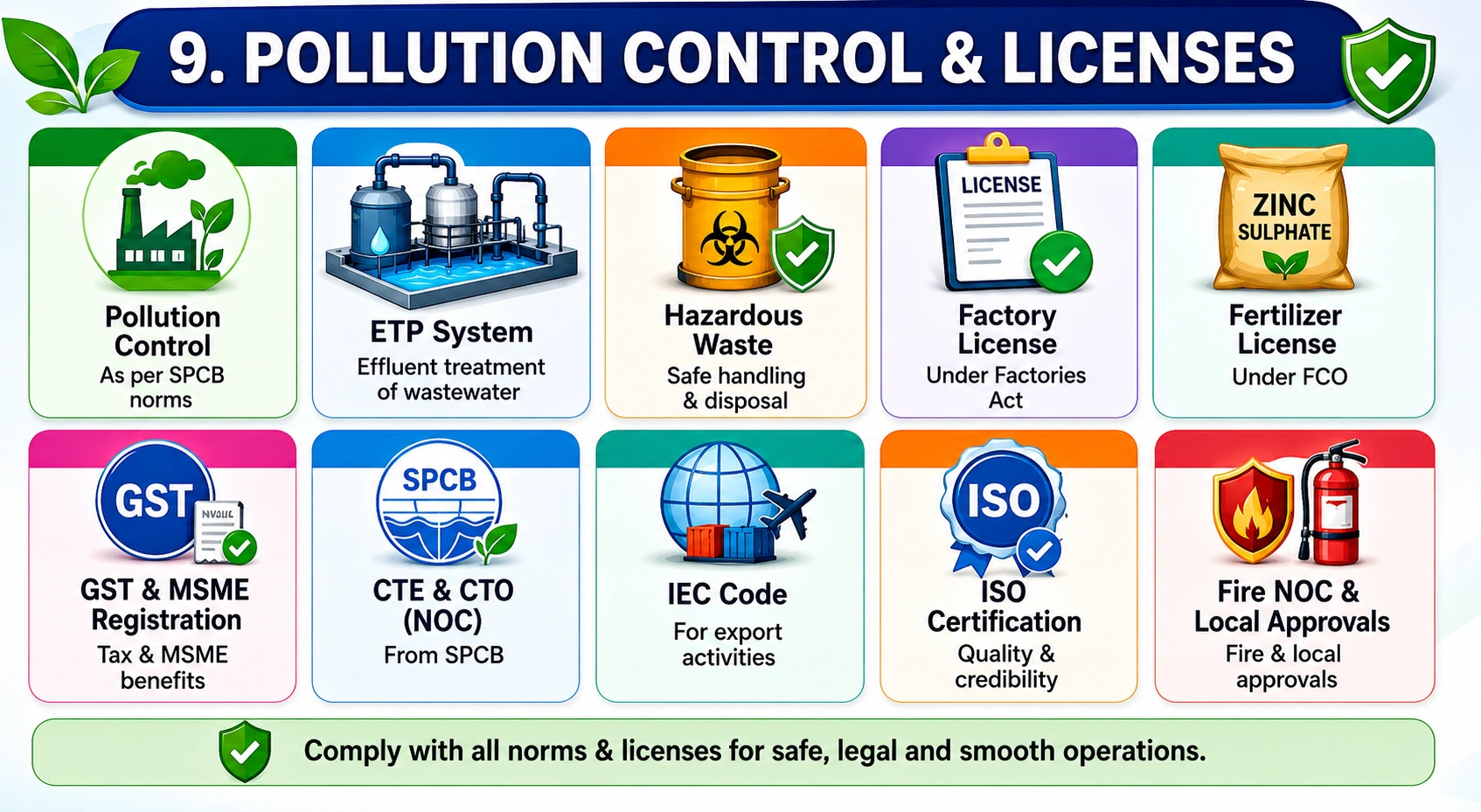
Zinc Sulphate manufacturing involves chemical processing and the use of sulphuric acid, therefore proper pollution control systems are necessary. The plant should comply with State Pollution Control Board norms related to air pollution, wastewater discharge, and hazardous waste management.
ETP System
An Effluent Treatment Plant (ETP) is generally required for treating wastewater generated during the manufacturing process. Proper treatment helps reduce environmental pollution and ensures compliance with pollution control regulations.
Hazardous Waste Handling
Chemical sludge, acid waste, and other hazardous materials should be handled and disposed of safely as per environmental guidelines. Proper storage tanks, safety equipment, and disposal systems are important for safe plant operations.
Factory License
A Factory License is required under the Factories Act for operating the manufacturing unit. This license is generally issued by the local factory department.
Fertilizer License
Since Zinc Sulphate is mainly sold as a micronutrient fertilizer, a Fertilizer License is required under the Fertilizer Control Order (FCO) for manufacturing and sale activities.
GST & MSME Registration
GST Registration is required for business operations and tax compliance. MSME Registration helps businesses avail government benefits, subsidies, and easier loan facilities.
Pollution NOC
Consent to Establish (CTE) and Consent to Operate (CTO) from the State Pollution Control Board are generally required before starting commercial production.
IEC Code
If the company plans to export Zinc Sulphate products, obtaining an Import Export Code (IEC) from DGFT is necessary for export activities.
ISO Certification
ISO certification such as ISO 9001 helps improve product quality, business credibility, and customer trust. Many large buyers and export customers prefer ISO-certified manufacturers.
Fire NOC
A Fire No Objection Certificate (Fire NOC) may be required from the local fire department to ensure proper fire safety arrangements inside the factory premises.
Trade License & Local Approvals
Depending on the project location, local municipal approvals, building permissions, and trade licenses may also be required before starting plant operations.
10. Project Cost & Investment
Land & Building Cost
Investment is required for land, factory shed, storage area, office space, and utility setup. The cost depends on plant size and location.
Machinery Cost
Major machinery includes reaction vessel, filter press, dryer, crystallizer, pulverizer, packing machine, and pollution control equipment.
Working Capital
Working capital is required for raw materials, labour, electricity, transportation, packaging, and daily operational expenses.
Total Investment Estimate
A small-scale Zinc Sulphate plant may require investment of around ₹25 lakh to ₹75 lakh, while medium-scale projects may require ₹1 crore to ₹5 crore.
Small vs Medium Scale Setup
Small-scale plants are suitable for local markets with lower investment, while medium-scale plants offer higher production capacity and better profitability opportunities.
11. Profit Margin & Financial Analysis
Production Cost
Production cost mainly includes raw materials, chemicals, electricity, labour, packaging, and transportation expenses.
Selling Price
The selling price depends on zinc content, product quality, and market demand. Premium products usually have higher prices.
Profit Margin
The Zinc Sulphate manufacturing business can provide good profit margins due to strong demand in the agriculture sector.
ROI
Return on Investment (ROI) is generally attractive because of growing micronutrient fertilizer demand in India.
Break-Even Period
A properly managed plant may achieve break-even within around 2 to 4 years depending on production capacity and market conditions.
12. Marketing & Sales Strategy
Fertilizer Dealers
Building a strong network of fertilizer dealers helps increase product availability and market reach in agriculture areas.
Agriculture Distributors
Agriculture distributors and wholesalers play an important role in supplying Zinc Sulphate products to retailers and farmers across different regions.
Direct Farmer Marketing
Manufacturers can directly promote products to farmers through field demonstrations, agriculture meetings, and local marketing campaigns.
B2B Platforms
Online B2B platforms such as IndiaMART, TradeIndia, and Alibaba help manufacturers generate business inquiries and expand customer reach.
Export Marketing
Export marketing provides opportunities to supply Zinc Sulphate products to international markets where demand for micronutrient fertilizers is increasing.
13. Risks & Challenges
Zinc Price Fluctuation
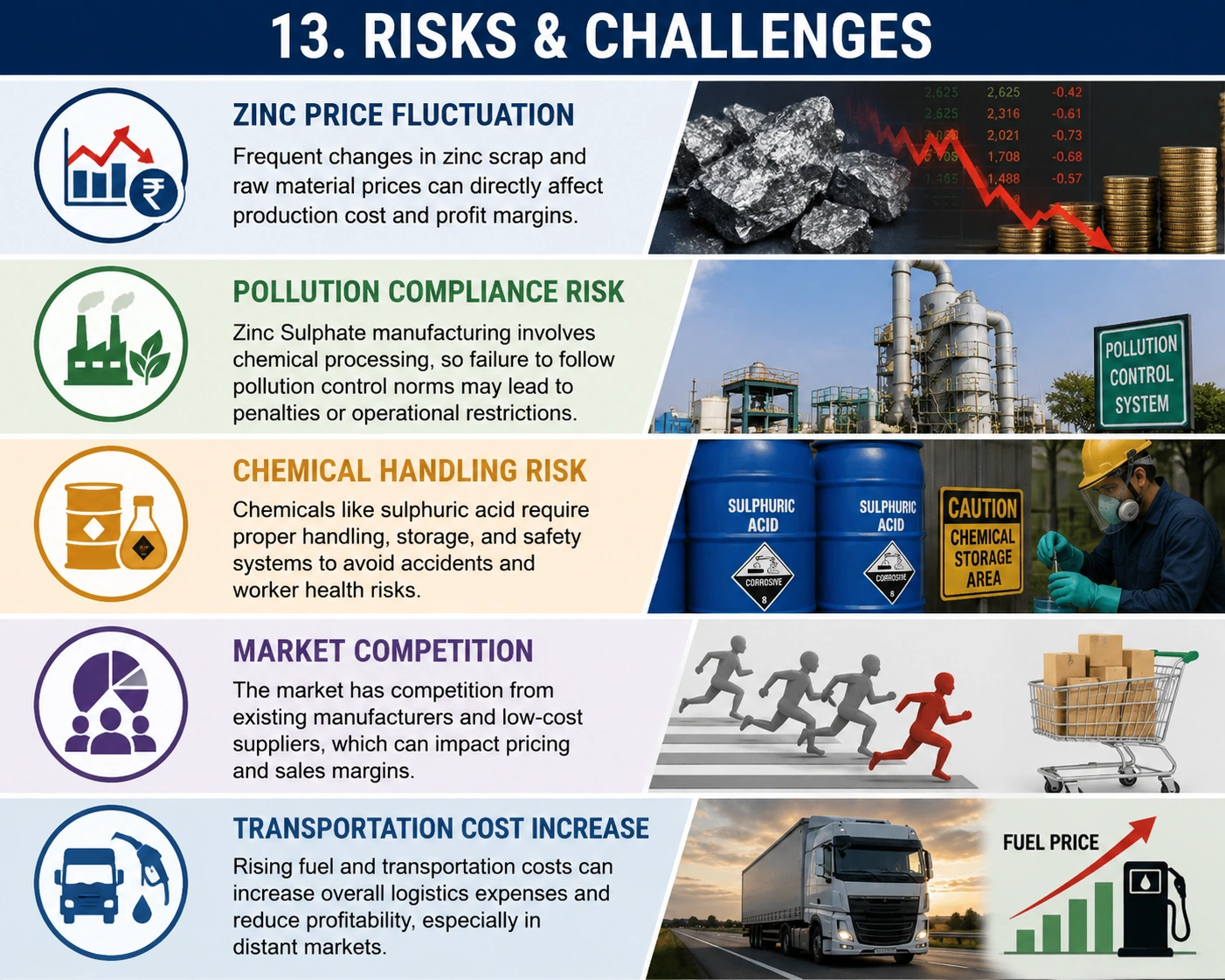
Frequent changes in zinc scrap and raw material prices can directly affect production cost and profit margins.
Pollution Compliance Risk
Zinc Sulphate manufacturing involves chemical processing, so failure to follow pollution control norms may lead to penalties or operational restrictions.
Chemical Handling Risk
Chemicals like sulphuric acid require proper handling, storage, and safety systems to avoid accidents and worker health risks.
Market Competition
The market has competition from existing manufacturers and low-cost suppliers, which can impact pricing and sales margins.
Transportation Cost Increase
Rising fuel and transportation costs can increase overall logistics expenses and reduce profitability, especially in distant markets.
14. Government Schemes & Industrial Incentives
CGTMSE Scheme
Eligible MSME manufacturing units can obtain collateral-free bank finance under the CGTMSE guarantee framework, reducing the need for additional security.
Mutual Credit Guarantee Scheme (MCGS-MSME)
The Government has strengthened this scheme to support MSME manufacturers in acquiring plant, machinery, and equipment, making it relevant for expansion and modernization projects.
State Industrial Promotion Policies
Most states provide capital subsidy, SGST reimbursement, electricity duty exemption, stamp duty exemption, and interest subsidy for manufacturing projects established in approved industrial areas.
Capital Subsidy for Manufacturing Units
Several state governments offer capital subsidies on eligible plant and machinery investment, particularly for MSME manufacturing projects and technology upgradation.
Export Promotion Schemes
Export-oriented Zinc Sulphate manufacturers can benefit from RoDTEP and other export promotion incentives that improve international competitiveness.
Chemical Parks Scheme
The Union Budget 2026 announced support for new Chemical Parks, creating opportunities for chemical manufacturers through shared infrastructure, utilities, and cluster-based benefits.
Technology Upgradation Support
Manufacturing MSMEs may avail technology upgradation and cleaner production incentives for modernization, pollution control systems, and energy-efficient equipment.
Industrial Cluster & PCPIR Benefits
Units established in chemical and petrochemical clusters can benefit from common infrastructure, logistics support, effluent treatment facilities, and lower operating costs.
15. Conclusion
The Zinc Sulphate manufacturing business has strong potential due to increasing demand from the agriculture and micronutrient fertilizer sectors. Growing awareness about soil health and balanced fertilizer usage is supporting market growth.
With proper raw material sourcing, quality production, and efficient marketing, the business can generate attractive profit margins and stable long-term income opportunities.
The future scope of Zinc Sulphate manufacturing appears highly promising due to rising fertilizer consumption, modern farming practices, export demand, and government support for agriculture productivity improvement.
You may also be interested in exploring opportunities in Hydrogen Gas Plant, EV Battery Recycling Business, and Rare Earth Magnet Recycling Business, which are emerging sectors supported by India’s industrial growth and sustainability initiatives.
16. Why Buy Our eBook (Project Report)?
Our Zinc Sulphate Manufacturing Project Report is specially designed for entrepreneurs, investors, startups, consultants, and MSME businesses planning to enter the micronutrient fertilizer industry. The report provides practical, business-oriented, and industry-focused information to help readers make better investment decisions.