

Introduction
Applying for a Mudra Loan is an important step for entrepreneurs who want to start, expand, or strengthen their business. During the loan process, one of the most common questions applicants face is whether they need a guarantor or any form of security. Many borrowers become confused when bank officials ask for a guarantor, mention hypothecation, or discuss loan security. This confusion often leads to unnecessary delays, misunderstandings, or even the belief that a Mudra Loan cannot be approved without a guarantor.
Why Do Banks Ask About Guarantors?
Banks assess every loan application to understand the borrower’s repayment capacity and the level of risk involved. In some cases, a bank may ask for a guarantor to provide additional assurance that the loan will be repaid if the borrower defaults. However, the requirement for a guarantor depends on several factors, including the applicant’s financial profile, business nature, loan amount, banking relationship, and the lending institution’s internal credit assessment. This is why two applicants with similar loan amounts may receive different requirements from different banks.
Guarantor vs. Security – Understanding the Difference
Another major area of confusion is the difference between a guarantor and loan security. A guarantor is a person who agrees to take responsibility for repayment if the borrower fails to repay the loan. Security, on the other hand, refers to an asset or legal charge associated with the loan. In Mudra Loans, banks may also use hypothecation, where the financed business assets remain with the borrower but serve as security for the loan. Since these terms are often used together during the loan process, many applicants mistakenly assume they mean the same thing.
Why Applicants Often Get Confused
Most first-time entrepreneurs have limited experience with banking terminology and loan documentation. They may hear words like guarantor, co-applicant, collateral, security, hypothecation, and borrower liability without understanding how each one differs. In addition, different banks may follow slightly different internal procedures, making the process appear inconsistent. As a result, applicants frequently rely on hearsay, social media advice, or outdated information instead of understanding the actual lending process.
Common Misconceptions About Mudra Loan Guarantors
Several myths continue to circulate among borrowers. Many people believe that every Mudra Loan requires a guarantor, that family members can always act as guarantors, or that a guarantor and co-applicant have identical responsibilities. Some also think that a guarantor can withdraw at any time without any formal process or that banks cannot reject an application if a guarantor is unavailable. These assumptions can create unnecessary confusion and may affect the loan application process if applicants are not aware of the actual banking practices.
Who Should Read This Guide?
This comprehensive guide is designed for first-time entrepreneurs, MSME owners, shopkeepers, service providers, manufacturers, professionals, startups, and anyone planning to apply for a Mudra Loan. It is equally useful for existing borrowers, prospective guarantors, family members, accountants, and business consultants who want a clear understanding of guarantor requirements and security-related concepts.
In this guide, you’ll find answers to every important question regarding Mudra Loan guarantors, guarantor liability, documents, security, hypothecation, co-applicants, family guarantors, and much more.
Quick Information
- ✓ Suitable for new entrepreneurs
- ✓ Covers all Mudra Loan categories
- ✓ Updated practical guidance
- ✓ Written in easy-to-understand language
- ✓ Written by CA Manish Gugliya
What You'll Learn
- ✔ Who can become a Mudra Loan guarantor
- ✔ When a guarantor is required
- ✔ Can banks reject a Mudra Loan without a guarantor?
- ✔ Rights and responsibilities of a guarantor
- ✔ Guarantor liability in case of loan default
- ✔ Can family members become guarantors?
- ✔ Difference between a guarantor and a co-applicant
- ✔ What happens if a guarantor withdraws?
- ✔ Can you change a guarantor after loan sanction?
- ✔ Understanding hypothecation in Mudra Loans
- ✔ Documents required for a Mudra Loan guarantor
- ✔ Common myths about guarantors and loan security
Quick Navigation
Select the situation that matches your concern and open the relevant detailed guide.
Understanding Mudra Loan Guarantor
Many first-time entrepreneurs believe that every Mudra Loan requires a guarantor. Others assume that if they cannot arrange a guarantor, their application will automatically be rejected. In reality, the requirement for a guarantor depends on the bank’s credit assessment, the applicant’s financial profile, the nature of the business, and the perceived repayment risk. Understanding why banks ask for a guarantor and how the lending process works can help applicants prepare better and avoid unnecessary confusion.
A guarantor is not the borrower but a person who agrees to take responsibility for the loan if the borrower fails to repay it according to the agreed terms. The guarantor provides additional confidence to the lending institution, particularly when the bank considers the loan to involve a higher level of risk. However, this does not mean that every Mudra Loan application follows the same process. Different banks may adopt different credit assessment methods while remaining within applicable banking guidelines.
Why Do Banks Ask for a Guarantor?
The primary objective of every bank is to ensure that the loan is repaid on time. Before approving a Mudra Loan, banks evaluate several factors such as the applicant’s business experience, income potential, repayment capacity, financial history, and overall risk profile. If the bank believes that additional assurance is required, it may request a guarantor.
A guarantor provides an extra layer of confidence for the bank because they agree to fulfil the repayment obligation if the borrower defaults. This helps reduce the lender’s financial risk, particularly in cases where the applicant has limited business experience or insufficient financial strength.
RBI and PMMY Perspective
Mudra Loans are offered under the Pradhan Mantri Mudra Yojana (PMMY) to encourage small businesses and self-employed individuals. The objective of the scheme is to improve access to institutional finance for micro and small enterprises.
While PMMY provides the framework for Mudra Loans, lending banks are responsible for evaluating each application based on their internal credit policies, applicable banking regulations, and risk assessment procedures. Therefore, documentation requirements, guarantor requests, and security arrangements may differ depending on the bank and the applicant’s individual circumstances.
Applicants should understand that a guarantor requirement is generally linked to credit evaluation rather than being an automatic condition for every Mudra Loan.
Practical Banking Practices
In actual banking operations, loan officers assess much more than the loan amount. They review factors such as business viability, projected cash flow, repayment capacity, applicant experience, existing banking relationship, previous loan history, and supporting documents.
For applicants with a strong financial profile and a well-prepared business proposal, banks may process the application without seeking additional comfort. On the other hand, where the bank identifies higher repayment risk or insufficient supporting information, it may ask for a guarantor or additional documentation before making its lending decision.
This explains why two applicants applying for similar loan amounts may receive different requirements from different branches or banks.
Understanding Business Risk and Creditworthiness
Every loan carries a certain level of business risk. Banks try to estimate whether the proposed business can generate sufficient income to repay the loan within the agreed period.
Creditworthiness refers to the applicant’s ability and willingness to repay borrowed money. Banks consider several aspects while assessing creditworthiness, including repayment history, existing liabilities, banking behaviour, business experience, projected profitability, and financial stability.
Where the overall risk appears manageable, the loan approval process may be straightforward. If the perceived risk is higher, the bank may seek additional safeguards such as a guarantor or enhanced documentation before sanctioning the loan.
Mudra Loan Categories and Guarantor Requirements
Mudra Loans are broadly classified into three categories:
Shishu – Loans for businesses in the initial stage with smaller funding requirements.
Kishore – Loans for growing businesses that require additional working capital or expansion finance.
Tarun – Loans for relatively established businesses seeking higher financial assistance.
The requirement for a guarantor is not determined solely by the loan category. Instead, banks evaluate each application individually by considering the borrower’s financial profile, business viability, repayment capacity, and overall credit risk. As the loan amount and business complexity increase, banks may conduct a more detailed credit assessment before arriving at a lending decision.
Common Myths About Mudra Loan Guarantors
Many applicants rely on incomplete or incorrect information when applying for a Mudra Loan. Here are some of the most common myths:
- Myth 1: Every Mudra Loan requires a guarantor.
- Myth 2: Any family member can automatically become a guarantor.
- Myth 3: A guarantor and a co-applicant have the same role and responsibilities.
- Myth 4: A guarantor can withdraw from the loan at any time without completing any formal process.
- Myth 5: Providing a guarantor guarantees loan approval.
- Myth 6: Banks ask for a guarantor only because the applicant has a poor CIBIL score.
- Myth 7: A guarantor has no financial liability if the borrower defaults.
- Myth 8: Hypothecation and a guarantor are the same form of loan security.
- Myth 9: Every bank follows exactly the same guarantor requirements for Mudra Loans.
- Myth 10: Once a guarantor signs the documents, their responsibility ends immediately after loan disbursement.
Understanding the actual purpose of a guarantor, the bank’s credit assessment process, and the responsibilities associated with loan guarantees helps applicants make informed decisions. Instead of relying on rumours or unofficial advice, borrowers should carefully understand the loan terms, seek clarification whenever needed, and submit accurate information to improve their chances of a smooth and successful loan approval process.
Difference Between Security, Collateral, Guarantor and Co-applicant
These terms are often used during the Mudra Loan process, but they do not mean the same thing. A guarantor provides a personal repayment commitment, collateral is an asset offered as security, hypothecation creates a charge over business assets, and a co-applicant applies for the loan jointly with the main borrower.
| Basis | Guarantor | Collateral | Hypothecation | Co-applicant |
|---|---|---|---|---|
| Meaning | A person who promises to repay the loan if the borrower fails to do so. | A movable or immovable asset offered to secure the loan. | A legal charge created over movable business assets while the borrower continues to use them. | A person who applies for the loan jointly with the main applicant. |
| Nature of Support | Personal repayment assurance | Asset-based security | Charge over financed or business assets | Joint borrowing responsibility |
| Owner of the Asset or Obligation | The guarantor gives a personal commitment but does not become the main borrower. | The asset generally belongs to the borrower or an acceptable third party. | The borrower owns and uses the asset, but the bank holds a charge over it. | The co-applicant shares the loan obligation with the main borrower. |
| Repayment Liability | May become liable if the borrower defaults, subject to the guarantee terms. | The lender may enforce its rights against the secured asset in case of default. | The bank may take action against the hypothecated assets if repayment fails. | Usually shares direct repayment responsibility from the beginning of the loan. |
| Use of Asset | Not applicable | Depends on the type of collateral and loan agreement. | The borrower normally continues using the machinery, stock, vehicle, or equipment. | Not applicable |
| Credit Assessment | The bank may examine the guarantor's income, credit history, liabilities, and repayment capacity. | The bank examines ownership, valuation, legal title, and enforceability of the asset. | The bank verifies the asset, invoices, ownership records, stock statements, or insurance documents. | The income, credit history, liabilities, and financial profile of both applicants may be assessed. |
| Role in Loan Application | Provides additional comfort to the bank. | Reduces the lender's risk through asset backing. | Secures the loan against movable assets financed or used in the business. | Strengthens the application through joint income, ownership, or repayment responsibility. |
| Can It Be Changed? | Only with the lender's approval and completion of required formalities. | Replacement generally requires lender approval, valuation, and fresh documentation. | Changes in charged assets generally require bank permission and updated records. | Removal or replacement usually requires the bank's approval and reassessment of the loan. |
| Simple Example | A parent guarantees the repayment of a business loan taken by their child. | Property, fixed deposit, or another acceptable asset is offered to secure a loan. | Machinery purchased with the loan remains with the borrower but is charged to the bank. | A spouse or business partner applies jointly and shares repayment responsibility. |
| Detailed Guide | Guarantor rights and responsibilities | Understand the loan agreement and the bank's security requirements before offering any asset. | Understanding hypothecation in Mudra Loans | Guarantor vs co-applicant comparison |
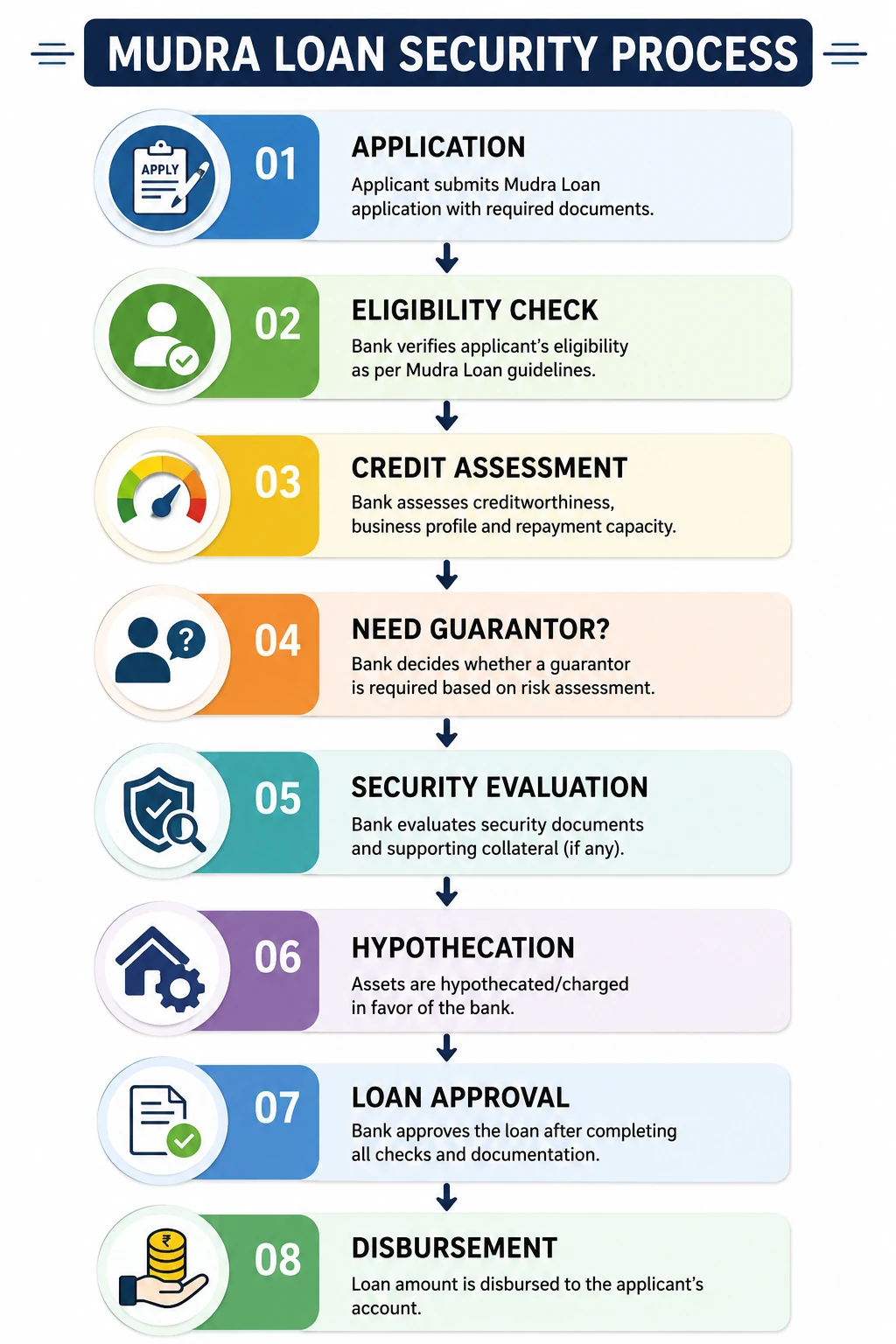
Mudra Loan Security Process (Infographic)
Complete Library: Mudra Loan Guarantor & Security Issues
Who Can Become a Mudra Loan Guarantor?
Not everyone is eligible to become a Mudra Loan guarantor. Banks generally evaluate the guarantor’s financial stability, repayment capacity, income, banking history, and relationship with the borrower before accepting the guarantee. This guide explains the eligibility criteria, factors banks consider, and who is most likely to qualify.
Read Complete Guide:
https://projectreportbank.com/who-can-become-guarantor-mudra-loan/
Can a Bank Reject a Mudra Loan Without a Guarantor?
Many applicants worry that their Mudra Loan application will be rejected if they cannot arrange a guarantor. This guide explains whether banks can refuse an application on this basis, when a guarantor may be requested, and the factors that influence the bank’s lending decision.
Read Complete Guide:
https://projectreportbank.com/bank-reject-mudra-loan-without-guarantor/
Rights and Responsibilities of a Mudra Loan Guarantor
Before agreeing to become a guarantor, it is important to understand the legal responsibilities and financial obligations involved. This guide explains the rights of guarantors, their duties, and the situations in which they may become liable for loan repayment.
Read Complete Guide:
https://projectreportbank.com/rights-responsibilities-mudra-loan-guarantor/
Mudra Loan Guarantor Liability in Case of Default
What happens if the borrower fails to repay the Mudra Loan? This guide explains the extent of a guarantor’s liability, how banks may recover outstanding dues, and the legal implications that guarantors should understand before signing any guarantee documents.
Read Complete Guide:
https://projectreportbank.com/mudra-loan-guarantor-liability-default/
What Happens If a Mudra Loan Guarantor Withdraws?
Sometimes a guarantor wishes to withdraw after the loan application has been submitted or even after loan sanction. This guide explains whether withdrawal is possible, the bank’s approval process, and the consequences for both the borrower and the guarantor.
Read Complete Guide:
https://projectreportbank.com/what-happens-if-mudra-loan-guarantor-withdraws/
Can You Change the Guarantor After Mudra Loan Sanction?
There may be situations where replacing an existing guarantor becomes necessary. This guide discusses whether banks permit a guarantor change after loan sanction, the required documents, approval process, and practical considerations involved.
Read Complete Guide:
https://projectreportbank.com/change-guarantor-after-mudra-loan-sanction/
Mudra Loan Guarantor Documents Checklist
Banks usually require identity, address, income, and financial documents from the guarantor before approving the loan. This guide provides a complete checklist of commonly required documents and practical tips to avoid delays during loan processing.
Read Complete Guide:
https://projectreportbank.com/mudra-loan-guarantor-documents/
Guarantor vs Co-applicant in a Mudra Loan
Many borrowers mistakenly believe that a guarantor and a co-applicant perform the same role. This guide explains the differences between these two positions, including repayment responsibility, ownership, legal liability, and their impact on the loan application.
Read Complete Guide:
https://projectreportbank.com/guarantor-vs-co-applicant-mudra-loan/
Can Family Members Become Guarantors for a Mudra Loan?
Parents, spouses, siblings, and other relatives are often considered as potential guarantors. This guide explains when family members may act as guarantors, what eligibility conditions banks may consider, and the factors that influence their acceptance.
Read Complete Guide:
https://projectreportbank.com/family-members-guarantors-mudra-loan/
Understanding Hypothecation in Mudra Loans
Hypothecation is one of the most misunderstood concepts in business lending. This guide explains how hypothecation works, how it differs from collateral and guarantees, and why banks create a charge over business assets while allowing borrowers to continue using them.
Read Complete Guide:
https://projectreportbank.com/understanding-hypothecation-mudra-loans/
Which Guide Should You Read?
Use this decision table to quickly find the most relevant guide according to your Mudra Loan guarantor or security-related concern.
| If Your Issue Is | Read This Guide |
|---|---|
| Bank is asking you to arrange a guarantor | Who Can Become a Mudra Loan Guarantor? |
| Guarantor wants to withdraw from the loan | What Happens If a Mudra Loan Guarantor Withdraws? |
| You want a family member to become guarantor | Can Family Members Become Mudra Loan Guarantors? |
| Bank rejected or may reject the loan without guarantor | Can a Bank Reject a Mudra Loan Without a Guarantor? |
| You have doubts about guarantor liability | Mudra Loan Guarantor Liability in Case of Default |
| You want to understand guarantor rights and duties | Rights and Responsibilities of a Mudra Loan Guarantor |
| You need to change the guarantor after sanction | Can You Change the Guarantor After Mudra Loan Sanction? |
| You want to know which guarantor documents are required | Mudra Loan Guarantor Documents Checklist |
| You are confused between guarantor and co-applicant | Guarantor vs Co-applicant in a Mudra Loan |
| You have doubts about security or hypothecation | Understanding Hypothecation in Mudra Loans |
Common Mistakes Borrowers Make Regarding Mudra Loan Guarantors
Borrowers often make avoidable mistakes because they do not fully understand the difference between a guarantor, co-applicant, collateral, and hypothecation. These mistakes can delay loan processing, create disputes with family members, or increase the financial risk of the people involved. The following points explain the most common errors applicants should avoid.
❌ Assuming a Guarantor Is Compulsory for Every Mudra Loan
One of the most common mistakes is believing that every Mudra Loan application must include a guarantor. Banks assess each application based on the borrower’s business viability, credit profile, repayment capacity, documents, and overall risk.
A guarantor may be requested in certain cases, but it should not automatically be assumed to be compulsory in every application. Borrowers should ask the bank to clearly explain the requirement instead of arranging a guarantor based only on informal advice.
❌ Confusing a Guarantor with a Co-applicant
A guarantor and a co-applicant do not perform the same role. A co-applicant applies for the loan jointly with the main borrower and may share direct repayment responsibility. A guarantor provides an assurance to the bank and may become liable when the borrower fails to repay.
Confusing these roles can result in a person signing documents without understanding their actual liability. Applicants should confirm whether the bank requires a guarantor, co-applicant, joint borrower, or another form of support.
❌ Not Reading the Guarantee Documents
Many guarantors sign documents because they trust the borrower or believe the papers are only a formality. This can be a serious mistake. A guarantee document may create significant financial and legal obligations.
The guarantor should read the complete document, understand the amount covered, duration of responsibility, circumstances of default, and the bank’s recovery rights. Any unclear clause should be explained by the bank before signing. Verbal assurances should never replace written terms.
❌ Providing Incorrect or Incomplete Guarantor Details
Incorrect information relating to the guarantor’s income, address, employment, liabilities, bank accounts, or credit history can delay the application. In serious cases, it may reduce the bank’s confidence in both the applicant and the guarantor.
Applicants should ensure that all details match the supporting documents. They should not exaggerate the guarantor’s income or hide existing loan obligations. Accurate and complete information makes the verification and assessment process smoother.
❌ Believing Every Family Member Will Qualify
A close family relationship does not automatically make a person an acceptable guarantor. Banks may examine the proposed guarantor’s age, income, financial stability, repayment capacity, existing liabilities, credit history, and relationship with the applicant.
A parent, spouse, sibling, or other relative may be considered, but acceptance depends on the lender’s assessment. Borrowers should avoid pressuring a family member to provide a guarantee before confirming whether that person meets the bank’s requirements.
❌ Ignoring the Guarantor’s Financial Responsibilities
Some borrowers treat the guarantor’s signature as a procedural requirement and fail to explain the possible consequences. However, the guarantor may face recovery action if the borrower defaults, depending on the terms of the guarantee.
The borrower should openly discuss the loan amount, repayment period, monthly instalments, business risks, and expected cash flow with the guarantor. A person should never be asked to sign without understanding the potential liability.
❌ Selecting a Guarantor Only for Quick Approval
Choosing someone merely because they are willing to sign can create future difficulties. The proposed guarantor should have a stable financial profile, proper documentation, and a clear understanding of the responsibility.
A weak or unsuitable guarantor may not strengthen the application. It may instead result in additional queries, document requests, or reassessment by the bank. Suitability is more important than speed.
❌ Assuming a Guarantor Can Withdraw at Any Time
Borrowers sometimes believe that the guarantor can withdraw by simply giving a letter to the bank. Once the guarantee has been accepted and the loan sanctioned or disbursed, withdrawal may require the lender’s approval, replacement arrangements, fresh documentation, or reassessment.
The borrower and guarantor should understand the withdrawal conditions before signing. They should not assume that the guarantee can be cancelled unilaterally.
❌ Failing to Inform the Guarantor About Repayment Problems
When a business faces financial difficulty, some borrowers stop communicating with the guarantor. This can damage personal relationships and leave the guarantor unprepared for possible notices from the bank.
The guarantor should be informed early about missed instalments, temporary cash-flow problems, restructuring discussions, or recovery communication. Transparent communication may help both parties respond responsibly.
❌ Depending on Verbal Statements Instead of Written Clarification
Applicants often rely on statements such as “the guarantor has no real liability” or “the signature is only for the file.” Such verbal claims can be misleading.
Borrowers and guarantors should rely on the sanction letter, guarantee agreement, loan documents, and written communication from the bank. Understanding the written terms before signing is one of the best ways to prevent future disputes and financial complications.
Applicant Rights Regarding Guarantor
Many Mudra Loan applicants believe they must simply accept every condition imposed during the loan process. However, borrowers have certain rights when a bank asks for a guarantor or additional security. Understanding these rights helps applicants communicate confidently with the bank, submit accurate documents, and make informed decisions before signing any guarantee-related documents.
While banks have the authority to assess loan applications and evaluate repayment risk, applicants also deserve fair treatment, clear communication, and transparency throughout the lending process.
Right to Fair Treatment
Every Mudra Loan applicant has the right to be treated fairly and professionally. Banks should evaluate each application based on objective factors such as business viability, repayment capacity, financial profile, and supporting documents.
If a guarantor is requested, the requirement should arise from the bank’s credit assessment rather than arbitrary decision-making. Applicants should not assume that different treatment automatically means unfair treatment, as lending decisions depend on individual circumstances.
Right to Transparency
Applicants have the right to understand why a guarantor or additional security is being requested. The bank should clearly explain the purpose of the requirement and the documents needed to complete the loan process.
Transparency allows borrowers to make informed decisions instead of relying on assumptions or unofficial advice.
Right to Receive Proper Communication
During the application process, borrowers should receive clear communication regarding additional requirements, missing documents, verification procedures, or guarantor-related formalities.
Keeping copies of acknowledgement receipts, application forms, and important communications can also help applicants track the progress of their Mudra Loan application.
Right to Ask Questions and Seek Clarification
Loan applicants should never hesitate to ask questions if they do not understand terms such as guarantor, co-applicant, hypothecation, or security.
For example, borrowers may ask:
Why is a guarantor required?
Is the guarantor mandatory in my case?
What documents are required?
What responsibilities will the guarantor have?
Can another eligible person become the guarantor?
Understanding these points before signing any documents helps avoid future misunderstandings.
Right to Know the Reason for Important Decisions
If additional guarantor requirements are imposed or the loan application is not approved, applicants may politely request clarification regarding the reasons behind the decision.
Understanding the bank’s concerns helps borrowers improve their documentation, strengthen their application, or take corrective action before reapplying.
Right to Proper Documentation
Applicants should carefully review every document before signing. They should ensure that all information is accurate, complete, and consistent with the supporting records.
Similarly, every guarantor should understand the guarantee agreement, repayment responsibilities, and related terms before giving consent. Proper documentation protects both the borrower and the guarantor throughout the loan process.
Learn More About Your Rights
Understanding your rights is only one part of the Mudra Loan process. You should also know the guarantor’s legal responsibilities, required documents, liability in case of default, and whether a guarantor can be changed or withdrawn after loan sanction.
To explore these topics in detail, read the following guides:
Rights & Responsibilities of a Mudra Loan Guarantor: https://projectreportbank.com/rights-responsibilities-mudra-loan-guarantor/
Mudra Loan Guarantor Documents: https://projectreportbank.com/mudra-loan-guarantor-documents/
Mudra Loan Guarantor Liability in Case of Default: https://projectreportbank.com/mudra-loan-guarantor-liability-default/
Can You Change the Guarantor After Mudra Loan Sanction? https://projectreportbank.com/change-guarantor-after-mudra-loan-sanction/
Expert Guidance from CA Manish Gugliya
As a Chartered Accountant with over 20 years of practical experience in Project Reports, CMA Data, MSME Finance, Business Loans, and Mudra Loan consultancy, I have worked with thousands of entrepreneurs seeking business finance. One common observation is that many Mudra Loan applications are delayed or become complicated not because the business idea is weak, but because applicants misunderstand guarantor requirements, security concepts, and banking procedures.
The following practical guidance is based on my professional experience and is intended to help entrepreneurs prepare better, avoid common mistakes, and improve their chances of a smooth loan approval process.
Arrange a Guarantor Only When It Is Actually Required
Many applicants start looking for a guarantor immediately after deciding to apply for a Mudra Loan. In reality, every application is evaluated individually, and whether a guarantor is required depends on the bank’s credit assessment, business profile, repayment capacity, and internal lending policies.
Before requesting someone to become your guarantor, first understand your bank’s actual requirement. If a guarantor is needed, choose the person carefully rather than making a hurried decision.
Read More:
https://projectreportbank.com/who-can-become-guarantor-mudra-loan/
Choose the Right Guarantor Carefully
Selecting a guarantor should never be based only on personal relationships. Banks generally assess the proposed guarantor’s financial stability, repayment capacity, banking history, and overall credibility before accepting the guarantee.
A suitable guarantor should:
Understand the responsibility before signing.
Have a stable source of income.
Maintain a satisfactory banking relationship.
Possess a reasonable financial profile.
Be willing to cooperate throughout the loan process.
If you plan to choose a family member as your guarantor, ensure they meet the bank’s eligibility criteria.
Read More:
https://projectreportbank.com/family-members-guarantors-mudra-loan/
Avoid Common Banking Mistakes
Many loan delays occur because applicants unknowingly make avoidable mistakes.
Some of the most common ones include:
Assuming every Mudra Loan requires a guarantor.
Confusing a guarantor with a co-applicant.
Submitting incomplete guarantor documents.
Providing incorrect or inconsistent information.
Depending only on verbal assurances.
Asking someone to sign without explaining their responsibilities.
Ignoring the importance of business projections and repayment planning.
Avoiding these mistakes improves both your application quality and the bank’s confidence in your proposal.
Keep Documentation Complete and Organised
Proper documentation significantly improves the speed of loan processing. Missing or inconsistent documents are among the most common reasons for unnecessary delays.
Before submitting your application:
Verify identity and address proofs.
Ensure names match across all documents.
Keep guarantor documents updated.
Organise financial records properly.
Maintain copies of every document submitted.
Preserve acknowledgement receipts and important communications.
A well-organised application demonstrates professionalism and makes verification easier for the lending bank.
Complete Checklist:
https://projectreportbank.com/mudra-loan-guarantor-documents/
Read Every Guarantee Document Before Signing
A guarantee is a legal commitment—not merely a formality. Both borrowers and guarantors should understand the implications before signing any document.
Always:
Read the complete guarantee agreement.
Understand repayment obligations.
Ask the bank to explain unfamiliar clauses.
Never sign blank or incomplete forms.
Keep copies of important documents for future reference.
Taking a few extra minutes to review the paperwork can prevent significant disputes in the future.
Maintain Clear Communication With Your Guarantor
The guarantor should understand the purpose of the loan, repayment schedule, business plan, and potential financial responsibilities before signing.
If your business faces repayment difficulties in the future, communicate openly with your guarantor instead of waiting until recovery notices are issued. Honest communication helps preserve trust and allows both parties to respond responsibly.
Read More:
https://projectreportbank.com/rights-responsibilities-mudra-loan-guarantor/
Build a Strong Business Proposal
Banks approve businesses—not just borrowers. A realistic project report supported by proper financial projections demonstrates that you have carefully planned your business.
A strong proposal should include:
A practical business model.
Realistic sales estimates.
Proper working capital calculations.
Genuine repayment capacity.
Accurate Project Report and CMA Data.
Professional preparation significantly improves the credibility of your application.
Understand That Every Bank May Follow Different Internal Procedures
Applicants often compare their experience with someone who obtained a Mudra Loan from another branch or bank. However, every lending institution may have different internal credit assessment procedures and documentation requirements.
Rather than relying on rumours or social media advice, always follow the instructions provided by your lending branch.
If your bank requests a guarantor or additional documents, politely seek clarification and understand the reason behind the requirement.
Related Guide:
https://projectreportbank.com/bank-reject-mudra-loan-without-guarantor/
Focus on Building a Long-Term Banking Relationship
A Mudra Loan is often the first step in a long-term relationship with your bank. Timely repayments, transparent communication, proper documentation, and responsible financial behaviour help establish credibility for future business loans and working capital requirements.
Banks are more comfortable supporting entrepreneurs who maintain a positive banking relationship over time.
Final Advice from CA Manish Gugliya
A guarantor should never be viewed as merely another signature required for loan approval. It represents a significant financial commitment for the person providing the guarantee. As a borrower, your responsibility is to prepare a strong loan application supported by a realistic business plan, complete documentation, honest financial information, and a clear understanding of your obligations.
In my professional experience, the entrepreneurs who achieve the smoothest Mudra Loan approvals are those who prepare thoroughly, communicate openly with their bank, and understand every requirement before signing any documents. Choosing the right guarantor, maintaining complete records, understanding the guarantee terms, and following proper banking procedures not only improve your chances of approval but also protect the interests of everyone involved.
If you are still unsure about guarantor liability, withdrawal, changing a guarantor, hypothecation, or required documents, I recommend reading the detailed guides included in this cluster before submitting your Mudra Loan application.
Expert Tip from CA Manish Gugliya
In my professional experience, borrowers who submit a well-prepared project report, complete documentation, realistic financial projections, and understand the guarantor's role usually experience a smoother loan approval process. Never arrange a guarantor simply because someone advises you to do so—first understand whether your bank actually requires one and ensure the proposed guarantor fully understands the responsibility before signing.
Frequently Asked Questions (FAQs)
1. Is a guarantor compulsory for every Mudra Loan?
No. A guarantor is not automatically required for every Mudra Loan. Banks decide based on the applicant’s credit profile, business viability, repayment capacity, and internal lending policies.
2. Who can become a Mudra Loan guarantor?
A financially stable person with satisfactory repayment capacity and acceptable banking history may be considered as a guarantor, subject to the bank’s assessment.
3. Can parents become guarantors for a Mudra Loan?
Yes. Parents may become guarantors if they satisfy the bank’s eligibility criteria and agree to undertake the guarantee obligations.
4. Can a wife or husband become a guarantor?
Yes. A spouse may become a guarantor if the bank considers them financially eligible and accepts the guarantee.
5. Can a friend become a Mudra Loan guarantor?
Yes. In some cases, a friend may become a guarantor, provided they meet the bank’s financial and documentation requirements.
6. Can a guarantor withdraw after signing the guarantee?
Withdrawal is not automatic. It generally depends on the bank’s approval, loan status, and completion of the required formalities.
7. Can a guarantor be changed after loan sanction?
In certain situations, banks may permit a change of guarantor after completing the necessary verification, documentation, and approval process.
8. What documents are usually required from a guarantor?
Banks commonly ask for identity proof, address proof, PAN, income proof, photographs, and other financial documents, depending on their internal requirements.
9. Is a guarantor legally liable if the borrower defaults?
A guarantor may become liable according to the terms of the guarantee agreement if the borrower fails to repay the loan.
10. Does every Mudra Loan require security?
No. Security requirements depend on the loan structure, applicable banking guidelines, and the bank’s credit assessment.
11. Can a bank reject a Mudra Loan without a guarantor?
A bank evaluates the overall application before making a lending decision. Whether a guarantor is required depends on the bank’s assessment of the individual case.
12. What is the difference between a guarantor and a co-applicant?
A guarantor provides repayment assurance, whereas a co-applicant jointly applies for the loan and usually shares repayment responsibility from the beginning.
13. Is hypothecation the same as a guarantee?
No. Hypothecation is a charge created over movable business assets, whereas a guarantee is a personal commitment made by an individual.
14. Can family members always become guarantors?
Not necessarily. Family members must also satisfy the bank’s eligibility criteria before their guarantee is accepted.
15. Can a retired person become a guarantor?
Possibly. Banks may consider retired persons based on their financial position, regular income, and repayment capacity.
16. Does the guarantor become the owner of the business?
No. A guarantor only provides financial assurance and does not become the owner or partner of the borrower’s business.
17. Will the guarantor’s CIBIL score be checked?
Banks may review the guarantor’s credit profile and financial standing during the loan assessment process.
18. Should the guarantor read the guarantee agreement before signing?
Yes. Every guarantor should carefully understand the guarantee terms, responsibilities, and potential liabilities before signing any document.
19. Can one person become guarantor for multiple loans?
It depends on the individual’s financial capacity, existing obligations, and the lending bank’s assessment.
20. How can borrowers improve their chances of loan approval?
A well-prepared project report, complete documentation, realistic financial projections, proper repayment planning, and transparent communication with the bank can significantly improve the chances of approval.
21. Can the bank ask for additional guarantor documents later?
Yes. During verification or credit assessment, the bank may request additional information or supporting documents if required.
22. What should I do if I don’t understand the bank’s guarantor requirement?
Ask the loan officer for a clear explanation before submitting documents or signing any agreement. Understanding the requirement helps avoid future misunderstandings.
23. Is choosing the right guarantor important?
Yes. Selecting a financially stable and eligible guarantor who understands the responsibility can help avoid delays during loan processing.
24. Can a Mudra Loan be approved without hypothecation?
The security structure depends on the nature of the loan and the bank’s lending policies. Applicants should understand the terms applicable to their specific case.
25. Where can I learn more about Mudra Loan guarantors and security issues?
This cluster guide links to detailed articles covering guarantor eligibility, liability, withdrawal, change of guarantor, hypothecation, required documents, family guarantors, and other important topics to help you understand every aspect of the Mudra Loan process.
Conclusion
Understanding the role of a guarantor is an important part of the Mudra Loan application process. However, borrowers should remember that a guarantor is only one aspect of the bank’s overall credit assessment. Factors such as your business plan, repayment capacity, documentation, financial profile, and compliance with the bank’s requirements also play a significant role in the loan approval process.
Many applicants face delays or confusion because they misunderstand the difference between a guarantor, co-applicant, collateral, and hypothecation. By learning these concepts in advance, maintaining complete documentation, and communicating openly with the bank, you can avoid common mistakes and improve your chances of a smooth loan experience.
This cluster page has provided an overview of every major topic related to Mudra Loan Guarantor & Security Issues, including guarantor eligibility, liability, required documents, family guarantors, guarantor withdrawal, changing a guarantor, co-applicants, hypothecation, and borrower rights. Since each topic involves its own practical considerations, we encourage you to explore the detailed guides linked throughout this page for comprehensive explanations and step-by-step guidance.
Whether you are applying for your first Mudra Loan, acting as a guarantor, or simply trying to understand the bank’s requirements, these in-depth articles will help you make informed decisions and confidently complete your loan application. If you still have questions after reading the guides, consider consulting your lending bank or a qualified financial professional before signing any loan or guarantee documents.
Explore the complete Mudra Loan Guarantor & Security Issues library above and choose the guide that best matches your situation to get detailed, practical, and easy-to-understand answers.