Key Takeaways
Many Mudra loan borrowers panic the moment their guarantor says they want to withdraw. But the outcome depends entirely on timing and how you respond. Here is a quick summary of what this article covers:
- A guarantor cannot usually walk out unilaterally after loan sanction or disbursement. The bank must consent, and proper paperwork is needed before any release happens.
- If the guarantor withdraws before sanction, the bank normally pauses the loan application until a new guarantor or alternate comfort is provided. This may delay approval but does not automatically kill the loan.
- After disbursement, the original guarantor remains liable for the outstanding loan amount until the bank formally substitutes them with another guarantor or other acceptable security.
- Borrowers should immediately meet the nearest branch manager, understand the bank’s internal policy, and explore practical solutions such as a replacement guarantor, additional income proof, or other security rather than panicking.
- The legal position, your rights as a borrower, the guarantor’s rights, and step-by-step solutions are all covered in detail below.
Introduction: Why Guarantor Withdrawal Creates Panic
Imagine this. You run a small shop in your town. You applied for a ₹3 lakh Mudra loan under the Kishore category. Your uncle agreed to be your guarantor. The bank processed everything. Then, just days before disbursement, your uncle calls and says he no longer wants to be your guarantor. What do you do?
This is a situation I have seen dozens of times in my career. And it almost always sends borrowers into a spiral of worry.
Let me explain the basics first. A Mudra loan falls under the Pradhan Mantri Mudra Yojana (PMMY), a government scheme launched on 8th April 2015 to provide financial assistance to non-farm small businesses. Applicants must be aged between 18 to 65 years. Eligible businesses include vendors, shop owners, and service providers. MUDRA loans are available up to ₹20 lakh, and no collateral is required to obtain a MUDRA loan. These loans can be applied for online or offline.
However, in practice, some Mudra loans may require a guarantor based on specific bank policies, especially for higher loan amounts or weaker credit profiles. This is where the problem begins.
Here is the reassuring part: a guarantor deciding to withdraw does not always mean your loan will be cancelled or your EMI will stop. The outcome depends on timing-before sanction, after sanction, or after disbursement-and on the lending institution’s internal policy.
I am CA Manish Gugliya (FCA), and I have spent over 20 years working on project reports, CMA data, MSME finance, and Mudra loan consultancy. Everything I share in this article comes from real branch-level banking practice, not textbook theory.
In this article, you will learn the legal position, actual bank behaviour at each stage, your rights as a borrower, the guarantor’s rights, and practical solutions-including when to visit your nearest branch and what documents may be asked again.

Table of Contents
What Does It Mean When a Mudra Loan Guarantor Withdraws?
“Guarantor withdrawal” can mean very different things depending on the stage of your loan. Let me break it down simply.
First, some quick terminology. The loan application stage is when you submit your form and documents. The sanction stage is when the bank issues a sanction letter with your approved loan amount, interest rate, and conditions. The disbursement stage is when money is actually credited to your account.
MUDRA loans are classified into Shishu, Kishore, and Tarun categories. Shishu loans provide up to ₹50,000 for startups. Kishore loans range from ₹50,000 to ₹5 lakh for growth. Tarun loans offer ₹5 lakh to ₹10 lakh for established businesses.
Now, here are the four scenarios of guarantor withdrawal:
Scenario 1 – Before signing: The prospective guarantor simply says “no” during processing. There is no legally binding contract yet. The bank just asks you to bring another guarantor or additional proof.
Scenario 2 – After signing but before sanction: The guarantor has signed the guarantee document, but the bank has not yet approved the Mudra loan. The bank can normally accept a written withdrawal request and reprocess the file with new guarantor details.
Scenario 3 – After sanction but before disbursement: The bank has sanctioned a loan with a specific guarantor mentioned in the sanction note. If the guarantor withdraws now, the bank may revise the sanction with a new guarantor, adjust the loan amount, or reconsider the eligibility criteria.
Scenario 4 – After disbursement: The guarantor has already become legally liable. Withdrawal becomes a “guarantor exit process”-not a simple cancellation, but a renegotiation between bank, borrower, and guarantor.
Each bank’s internal credit policy differs, especially between public sector banks, private banks, and NBFCs. The final decision lies with the financial institution handling your loan.
Can a Mudra Loan Guarantor Legally Withdraw?
This is the most important question. Once a guarantee deed is properly signed and the Mudra loan has been sanctioned or disbursed, a guarantor usually cannot walk away on their own just by giving a letter. A guarantor can withdraw their guarantee with lender consent-but that consent is rarely given without conditions.
Under Section 128 of the Indian Contract Act, a guarantor’s liability is co-extensive with that of the primary borrower. This means the guarantor is equally responsible for the debt, including principal, interest, and charges.
A notice to revoke a guarantee only applies to future advances; it does not erase liability for already disbursed amounts. Courts have consistently held that unilateral revocation by the guarantor, without the creditor accepting it, does not release the guarantor from obligations.
In practice, banks allow change of guarantor only if:
- The outstanding balance is small and the borrower’s track record is good
- A new guarantor of equal or better financial strength is available
- Additional security or margin money is brought in
The typical banking process for guarantor withdrawal involves a written request from the guarantor, a meeting at the nearest branch, re-assessment of the borrower and business performance, fresh documentation and KYC for the replacement guarantor, and a formal release letter issued by the bank only after full completion.
| Factor | Before Disbursement | After Disbursement |
|---|---|---|
| Unilateral withdrawal possible? | Sometimes, with bank’s agreement | Almost never without bank’s consent |
| Documents required | Written request, new guarantor KYC | Written request, replacement guarantor docs, possibly partial prepayment proof |
| Who must consent? | Bank + Borrower | Bank + Borrower + Guarantor (all three) |
This article is not a legal opinion. For disputes, consult a local lawyer. My focus is on real banking practice under the Mudra Yojana and business loans.

What Happens If the Guarantor Withdraws Before Loan Sanction?
If your guarantor withdraws before sanction, the situation is usually manageable and less risky for everyone involved. The guarantee has not yet been activated by disbursement.
Here is how banks generally respond:
- The file goes back to “under process” status
- The loan application is kept on hold
- The credit officer updates internal records that the guarantor has backed out
The bank will ask you to immediately arrange a new guarantor. They will check the new person’s CIBIL score, income proof, and KYC documents. The appraisal note and loan amount may need to be reworked.
From my practical experience, this can delay sanction by 3 to 15 working days depending on how quickly you arrange a replacement and how busy the branch is.
In some strong cases-good CIBIL, stable business, existing relationship with the bank-the lenders may proceed without a guarantor or with a reduced loan amount. But this is at the sole discretion of the sanctioning authority.
Example: A borrower applies for ₹1.5 lakh under the Kishore category. The guarantor backs out. The bank reviews the case and agrees to sanction only ₹1 lakh without a guarantor, or asks for the spouse as a co-applicant instead.
My strong advice: visit the nearest branch in person instead of relying only on phone calls. Carry updated financial documents-bank statements, sales records, GST returns-to support reassessment. Proactive borrowers get faster decisions.
What Happens If the Guarantor Withdraws After Loan Sanction?
“After sanction” means the sanction letter has already been issued with the specific guarantor’s name, but funds may or may not yet be disbursed. This is a sensitive stage.
Banks consider the guarantor as part of the risk assessment that determined your loan amount, interest rate, and repayment period. If the guarantor withdraws now, the basis of sanction changes.
From practical experience, common bank reactions include:
- Cancelling the existing sanction and reprocessing from scratch
- Keeping the sanction alive but making disbursement conditional on a new guarantor
- Offering a lower sanctioned limit without a guarantor
Your EMI schedule, interest rate, and tenure described in the sanction letter may remain the same, but conditions precedent to disbursement (like “personal guarantee of Mr. X”) must be satisfied or modified before the bank releases money.
The bank can insist on additional comfort: mortgage of small property (where permitted under PMMY guidelines), hypothecation of stock and machinery, or adding a financially stronger co-applicant instead of a guarantor.
You should request a written clarification from the bank on whether the sanction is still valid and whether a revised sanction letter will be issued. If you are in this exact stage, I recommend reading the detailed guide on Can You Change the Guarantor After Mudra Loan Sanction? for step-by-step help.
What Happens If the Guarantor Withdraws After Loan Disbursement?
Once the Mudra loan is disbursed, the guarantor is fully on record as a surety. Withdrawal is no longer a simple choice but a negotiated exit which banks almost always resist.
The loan agreement and guarantee deed together create a joint liability. This means the bank can recover the full outstanding loan amount either from the borrower or from the guarantor, or from both. A guarantor remains bound until a suitable replacement is found.
The guarantor’s withdrawal request will generally not affect existing EMI schedules. EMIs continue as per the original repayment plan. Any change in guarantor is handled separately.
Lenders are generally reluctant to release a guarantor while the major portion of debt is outstanding. Banks may consider release only if:
- The borrower has built a strong repayment track record over 12 to 18 months
- Another guarantor or collateral is provided
- The borrower makes a substantial partial prepayment to reduce risk
Withdrawal involves formal legal documentation and outstanding dues clearance. Even if the guarantor writes a letter asking for cancellation, the bank can still proceed against them for payments already due and for future dues until a formal release letter is issued.
If the loan agreement permits, the bank may freeze operations or demand repayment if the guarantor withdraws without a replacement in place.
Example: A woman entrepreneur has a ₹7 lakh Tarun category loan. Her brother, the guarantor, wants to exit after one year. She has a good track record and offers her spouse as a replacement. The bank accepts the conditional replacement, but issues a release letter for the brother only after the new guarantee is fully executed.
Even though Mudra loans are smaller in loan amount compared to secured business loans or home loans, guarantor liability is taken equally seriously by banks.
Can the Bank Ask for Another Guarantor or Extra Security?
In most real-life cases, whenever a guarantor withdraws at any stage, the bank’s first response is to ask for a replacement guarantor rather than immediately cancelling the Mudra loan.
Banks usually insist on a new guarantor for:
- Higher ticket Mudra loans (₹5 to ₹10 lakh Tarun category)
- Borrowers with thin income or weak credit history
- New businesses without strong cash flow or financials
- Short repayment track records
Withdrawal requires a replacement guarantor with equal creditworthiness. Banks may also ask for additional documentation: updated bank statements, ITRs, GST returns, business registration details, and stock records to reassess risk.
Contrasting examples:
- A borrower with 750+ CIBIL and 18 months of perfect EMIs asked for guarantor removal. Bank agreed based on strong credit profile alone.
- Another borrower with average CIBIL and only 6 months of repayment was told to provide not just a new guarantor but also hypothecation of business assets as additional security.
| Borrower Profile | Likely Bank Reaction |
|---|---|
| Strong CIBIL + good repayment | May waive guarantor requirement |
| Average profile + new guarantor offered | Accept with minor conditions |
| Weak profile + no replacement available | May reduce loan or add collateral demand |
| Very weak profile + no alternatives | Possible loan rejection or recall |
While the Mudra scheme emphasises collateral-free lending for eligible borrowers, individual banks frame their own internal risk rules. Some link guarantor withdrawal with conditions like hypothecation, especially for composite funding. If you are confused about the difference, the guide on Guarantor vs Co-applicant in a Mudra Loan explains it clearly.
Will the Mudra Loan Be Cancelled If the Guarantor Withdraws?
Automatic cancellation is rare. Banks usually try to save the Mudra loan by adjusting terms. But some borderline cases do result in cancellation, especially before disbursement.
| Situation | Possible Outcome |
|---|---|
| Guarantor withdraws before sanction | File on hold; reprocess with new guarantor |
| After sanction but before disbursement | Sanction may be revised, reduced, or cancelled |
| After disbursement, borrower paying regularly | Loan continues; bank may refuse guarantor exit |
| After disbursement, borrower defaulting | Bank tightens follow-up; may invoke guarantee against existing guarantor |
Cancellation is more likely when the borrower’s own financial strength is weak and the guarantor was the main comfort for approval. In such cases, withdrawal can make the credit unviable for the bank.
For very small Shishu loans (up to ₹50,000), many banks do not even ask for a guarantor under the Mudra scheme, so the question of cancellation due to guarantor withdrawal generally does not arise.
If the Mudra loan is already disbursed and the borrower is regular in EMIs, banks do not normally cancel or recall the loan simply because the guarantor wants to exit. However, they may refuse to release the guarantor.
If your loan is being cancelled due to guarantor issues, request the bank’s decision in writing. This documentation can help while applying with another bank or NBFC for future credit needs.
Rights of the Borrower When a Guarantor Withdraws
Both borrower and guarantor have rights. The bank must balance its risk with fair treatment, especially in government-backed schemes like Pradhan Mantri Mudra Yojana.
Your key rights as a borrower:
- Right to clear information: The bank should explain what impact guarantor withdrawal will have on your Mudra loan, EMI, and interest rate, and whether any conditions are changing.
- Right to explore alternatives: You can ask the bank to consider options other than cancellation-such as a lower loan amount, higher margin from your side, or alternate security.
- Right to participate in the replacement process: You should be allowed to propose another guarantor, a co-applicant, or provide updated business documents to prove financial improvement.
- Right to written communication: Insist on email or letter confirmation regarding any refusal of replacement guarantor or change in terms. Verbal assurances often cause confusion later.
If you are facing denial purely because you do not have a guarantor, the article on Can Banks Reject a Mudra Loan Without a Guarantor? is a helpful reference point.
Rights of the Mudra Loan Guarantor
A guarantor is not just a “name on paper.” They are a legally recognised party in the loan contract with clear rights and responsibility.
Before signing: The guarantor has the right to see the draft loan agreement and guarantee deed. They can ask about the loan amount, interest rate, tenure, borrower’s existing loans, and nature of the business under the Mudra scheme.
After signing but before disbursement: The guarantor has the right to withdraw consent by giving a written letter to the bank. This is easier if the bank has not yet relied on the guarantee to disburse funds.
During loan tenure: The guarantor has the right to request information about loan status, overdues, and whether EMIs are regular. This matters because the guarantor’s own CIBIL and credit profile get affected if the primary borrower defaults.
After repayment: The guarantor can request a formal “release of guarantee” letter from the bank. This letter protects them from any future disputes related to that loan.
For a deeper understanding, I recommend reading the detailed guide on Rights and Responsibilities of a Mudra Loan Guarantor.

Practical Solutions If Your Guarantor Withdraws
In most day-to-day Mudra cases, a practical solution is possible if you act quickly and cooperate with the branch instead of avoiding calls. Here are the steps I recommend:
Solution 1: Immediately meet the nearest branch manager with your guarantor (if possible) to discuss reasons. Sometimes misunderstandings about liability can be resolved through proper explanation rather than full withdrawal.
Solution 2: Arrange a replacement guarantor with stable income, good credit, and a close relationship with you. Typical Mudra loan guarantor documents include PAN, Aadhaar, latest salary slip or ITR, bank statements, and a photograph.
Solution 3: If no guarantor is available, strengthen your case with financial data. Provide updated bank statements, GST returns, Udyam registration, and a simple business plan or CMA data to demonstrate business viability. Strong cash flow evidence matters.
Solution 4: Request the bank to reduce the loan amount. For example, from ₹8 lakh to ₹5 lakh. A smaller outstanding loan may allow the credit officer to proceed without a guarantor.
Solution 5: Consider partial prepayment to bring down the outstanding balance, especially for loans already disbursed. This makes it easier for the bank to agree to guarantor exit over time.
Solution 6: Maintain transparent communication with both bank and guarantor. Avoid hiding repayment delays-they directly impact the guarantor’s creditworthiness and trust. Remember, MUDRA loans can be applied for online or offline, and if your current bank is uncooperative, you can explore other lenders with a fresh application.
Common Mistakes Borrowers Make About Mudra Loan Guarantors
Many guarantor withdrawal problems arise because of mistakes made at the time of the loan application, especially among first-time entrepreneurs in small towns.
Mistake 1: Selecting an unwilling or half-informed guarantor. For example, just getting a signature without fully explaining that they are liable for the full outstanding loan amount if the primary borrower defaults.
Mistake 2: Hiding existing loans or a poor CIBIL score from the guarantor. This later shocks them when they realise their own eligibility for a personal loan or home loan is affected.
Mistake 3: Not giving the guarantor a copy of the sanction letter, repayment schedule, and key terms like interest rate and EMI amount. This lack of transparency leads to fear and withdrawal requests.
Mistake 4: Ignoring early warning signs like bank SMS about overdue EMIs, which both borrower and guarantor often receive. By the time they react, the relationship with the bank has already strained.
Mistake 5: Not informing the bank promptly when the guarantor expresses discomfort. Delays make the bank suspicious and less flexible about replacements or restructuring.
These mistakes are extremely common in PMMY Mudra loans because many borrowers apply in a hurry, sometimes guided by agents, without proper counselling from a professional like a CA or loan consultant. Taking five minutes to explain the default scenario and legal action possibilities to your guarantor upfront can save months of stress later.
Expert Tips from CA Manish Gugliya for Handling Guarantor Issues
These recommendations come from over two decades of working on Mudra loans, CMA data, project reports, and various MSME business loans across multiple banks.
- Educate your guarantor before applying. Explain the mudra scheme, your business plan, repayment capacity, and total loan amount. Clarity upfront reduces withdrawal chances dramatically.
- Choose guarantors whose monthly surplus income is comfortably higher than your EMI. They will feel more secure about backing you and less anxious during the loan tenure.
- Avoid making elderly parents guarantors where possible. Health and emotional factors often lead them to seek withdrawal later when they realise the stress involved.
- Share copies of your sanction letter and EMI schedule with the guarantor. Treat them as a financial partner, not just a formality for the bank’s form.
- Maintain a clean repayment track record for at least 12 to 18 months. If you ever need guarantor release, a strong history gives you negotiation power with the bank.
- If you plan to change your guarantor, do it when your CIBIL is strong and business cash flow is stable. Timing matters. Banks are far more cooperative when your credit profile is solid.
- Never depend purely on verbal assurances from branch staff. Request written communication for important decisions like release of guarantor or modification of terms.
- For complex cases-multiple loans, stressed cash flow, trading slowdowns-consider professional help. A CA or finance consultant can prepare a proper proposal for the bank with realistic projections that demonstrate your ability to repay without the guarantor’s financial support.
- Periodically review your guarantor’s comfort level. If they are anxious, discuss openly and plan for a gradual exit through prepayment milestones, rather than dealing with a sudden dispute that could invite legal action from the bank.
These tips apply whether you are dealing with micro enterprises, small enterprises, a company, or any other legal entity under the Mudra Yojana. Success stories in guarantor replacement come from borrowers who plan ahead rather than react in panic.
Frequently Asked Questions on Mudra Loan Guarantor Withdrawal
These FAQs cover practical doubts that may not have been directly addressed in the main sections. All answers are focused on real bank practice for Mudra loans.
Can a Mudra loan guarantor withdraw after signing but before the loan amount is disbursed?
In many banks, if the guarantor gives a written request before actual disbursement, the branch can accept the withdrawal and send the file for reassessment. The bank still has flexibility to change conditions, including guarantor details, without affecting any existing liability. However, this may delay disbursement, and in some borderline cases it can lead to a reduction in the sanctioned limit or even rejection if no alternate comfort-such as other documents proving income or assets-is available.
Will my EMI stop if my guarantor withdraws from my Mudra loan?
No. Your EMI obligation is between you and the bank. Payments continue on scheduled dates regardless of guarantor withdrawal or replacement discussions. The bank will treat any missed EMI as default and report it to credit bureaus, affecting both your and the guarantor’s CIBIL scores while the guarantee is still in force. Do not wait for guarantor-related decisions to be finalised before paying EMIs. Regular repayment actually strengthens your case for a favourable outcome. Think of your EMI as completely independent of the guarantor situation.
Does guarantor withdrawal affect my CIBIL score as a borrower?
Your CIBIL score is primarily driven by your repayment track record, total credit exposure, and past delays or defaults-not by whether a guarantor stays or withdraws. If the bank cancels the Mudra loan before disbursement due to guarantor issues, it usually does not directly harm your score. However, repeated enquiries and rejections across multiple lenders for a new loan application can gradually lower it. Maintaining clean EMI payments on any existing working capital facility, personal loan, or other business loans is the best way to protect your credit during this period.
Can a family member replace the original guarantor in a Mudra loan?
Yes. Banks commonly accept close family members such as a spouse, parents, or siblings as replacement guarantors, provided they meet the bank’s income and credit requirements. The new guarantor will need to submit full KYC, income proof (like ITR or salary slip, rent agreement if self-employed), consent forms, and sign fresh guarantee documents-similar to what the original guarantor submitted. The bank will formally release the old guarantor only after the replacement guarantee is fully executed and approved internally. For details on what paperwork is needed, check the guide on Who Can Become a Guarantor for a Mudra Loan?
How long does it usually take to replace a Mudra loan guarantor?
From practical experience, the process takes roughly 7 to 21 working days depending on how quickly you provide complete documents and how many approval levels are involved at the bank. Public sector banks with larger hierarchies may take slightly longer than small NBFCs, especially for higher loan amounts in Kishore and Tarun categories. My advice: follow up politely but regularly with the nearest branch, and document all submissions. This prevents repeated requests for the same information and keeps the next phase of your loan on track. Having a secure set of pre-verified documents ready can cut the timeline significantly. Some customers find it helpful to prepare a checklist in advance-think of it as a reference point for your entire replacement process.
Banks and lending institutions across the country handle Mudra loan guarantor issues every day. The Mudra card facility, credit guarantee coverage via NCGTC/CGFMU, and the refinance agency structure of MUDRA (as a beneficiary micro unit development agency) all work together to support micro units. But at the individual branch level, it always comes down to your preparation, your communication, and your willingness to find a workable solution. Whether your business involves food processing, trading, services, or any other eligible activity, the path forward after a guarantor withdrawal is almost always available-if you take the right steps at the right time.
Do not panic. Visit your bank. Carry your documents. Talk to your branch manager. And if needed, take professional guidance to secure funding for your business’s future.
- Mudra Loan Guarantor & Security Issues: Complete Guide for Borrowers (2026)

- What Is the Liability of a Mudra Loan Guarantor in Case of Default?
- What Happens If Your Mudra Loan Guarantor Withdraws?

- Can You Change the Guarantor After Mudra Loan Sanction?
- Understanding Hypothecation in Mudra Loans

- Rights and Responsibilities of a Mudra Loan Guarantor – Complete Legal Guide for Borrowers & Guarantors
- What Documents Are Required from a Mudra Loan Guarantor? Complete Checklist

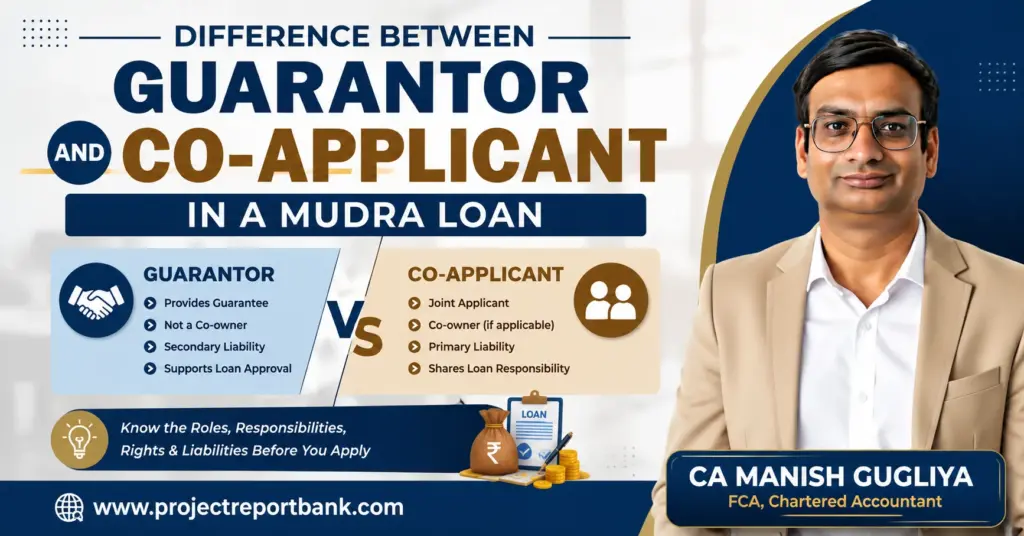
- Guarantor vs Co-applicant in Mudra Loan: Which Option is Right for Your Business?
- Can Family Members Be Guarantors for a Mudra Loan?