Key Takeaways
- A mudra loan pending because of CIBIL verification is a standard processing stage in most banks and does not automatically mean your loan is rejected.
- CIBIL verification usually completes within a few working days, but it can stretch to 10–15 days or more if there are mismatches in personal details, multiple active loans, or the need for manual review.
- Banks check your full credit report, including past EMI history, enquiries, overdue amounts, and existing liabilities, alongside business viability and cash flow. They do not decide based on one CIBIL score number alone.
- While waiting, track your mudra loan application status, keep your phone and documents ready, avoid applying for new loans or credit cards, and politely follow up if the delay crosses 10–15 working days without any communication.
Introduction: Why Your Mudra Loan Shows “Pending Due to CIBIL Verification”
If you have applied for a mudra loan and your application status shows “pending because of CIBIL verification” or “under CIBIL check,” you are not alone. This is one of the most common status messages that applicants see, whether they check online or ask at the branch.
CIBIL is a credit bureau that maintains records of your borrower history. When you submit a mudra loan application form, the bank pulls your credit report to see your existing loans, EMI performance, and overall credit behaviour. This applies to all Mudra categories, including shishu loan, Kishore, and tarun category applications. A Mudra loan application may be pending due to CIBIL verification issues, but this status is a routine checkpoint, not a fraud investigation or a sign of rejection.
Mudra loans can be applied online or offline, and no collateral is required for these loans. This article, written from my practical experience of 20+ years in MSME finance and business loans, will focus specifically on the delay caused by CIBIL verification and explain what you should expect, do, and avoid during this period.
Table of Contents
Quick Answer: Is Mudra Loan CIBIL Verification Normal?
Yes. CIBIL verification for a mudra loan is completely normal. It does not always indicate a problem, and a large number of applications are approved after this stage.
A CIBIL score is not mandatory for mudra loan applications. Having no CIBIL score does not disqualify mudra loan applicants either. However, most banks still run a credit report check as part of their internal process. A good credit score can expedite the loan approval process, while the absence of one simply means the bank may take a little longer to assess risk through other documents.
In most banks, the CIBIL check itself is completed within minutes, but the “pending” status remains because the credit officer still has to manually review and record their observations. Unless the bank has specifically informed you about a serious issue in the report, this status alone should not cause panic.
What You Will Learn in This Guide
Here is what this article covers:
- Why banks verify CIBIL even for a flagship scheme like Mudra
- What information appears in a credit report and how it fits into overall credit appraisal
- How long CIBIL verification normally takes across Shishu, Kishore, and Tarun loans
- Common reasons this stage gets delayed
- What happens after CIBIL verification is completed
- When to be patient versus when to contact the bank
- What identity proof, address proof, PAN, Aadhaar card, bank statement, and other documents to keep ready
- Activities that can harm your case during this period
- Practical expert tips, myth-versus-fact clarifications, and real-life case examples
- FAQ section addressing additional common concerns
What Is CIBIL Verification in a Mudra Loan?
CIBIL verification is the bank’s process of obtaining and reviewing your credit report from TransUnion CIBIL, a licensed credit bureau in India. Even though the mudra scheme is a government flagship scheme designed for small businesses and micro units, banks still use credit information to assess risk.
Your credit report includes total outstanding loans (business loans, housing, vehicle, credit cards), repayment history, days past due (DPD), written-off or settled accounts, and recent credit enquiries. A CIBIL score ranges from 300 to 900 in India, indicating your creditworthiness as a borrower. For Kishore and tarun category loans, banks examine this report closely alongside business cash flow projections, bank statement analysis, and your project report.
The maximum loan amount under the Mudra scheme is Rs 10 lakh (now up to Rs 20 lakh under Tarun Plus for eligible repeat borrowers). Applicants must be between 18 and 65 years old, must be Indian citizens, and should ideally not have any past loan defaults. The mudra loan eligibility criteria also look at the type of income generating businesses you run, whether it is trading, services, manufacturing, or activities allied to agriculture (non farm).
CIBIL verification is only one part of the broader credit appraisal. The bank also considers your business registration, enterprise turnover, income proof, and its own internal risk policy. Even for a shishu loan up to ₹50,000, some lenders may still pull a CIBIL report, though they tend to give more weight to your existing account behaviour with them.

Why Banks Put Mudra Loan Applications Under CIBIL Verification
Banks must follow RBI guidelines and their own internal risk policies. Before arriving at a final decision, they mark applications as “under CIBIL verification” to ensure the applicant’s financial background is reviewed systematically.
Here is why this step is necessary:
| Reason | Why the Bank Checks |
|---|---|
| Multiple existing loans | To measure total existing liability and repayment load |
| High EMI burden compared to income | A high debt-to-income ratio can affect loan approval decisions |
| Recent heavy credit enquiries | Too many recent loan inquiries can suggest financial distress to lenders |
| New-to-credit borrower | No prior repayment data available for assessment |
| PAN or name mismatch | Discrepancy between application and bureau records |
| Address or KYC inconsistency | Needs manual verification before proceeding |
| Internal bank risk policy | Different banks may have varying thresholds for acceptable CIBIL scores |
For mudra loan online applications, this verification may be triggered automatically by the system. For branch applications, it is usually requested by the branch manager or credit officer.
If your application moves from CIBIL verification to deeper checks, the process is similar to what happens during credit appraisal. You can also read about how long a bank can keep your Mudra loan application pending if you want to understand the full processing timeline.
What Exactly Happens During CIBIL Verification? (Step-by-Step Flow)
Here is the typical sequence from the moment you submit your application to the point where a decision is recorded:
- Application submitted – You fill and submit the mudra loan application form at the branch or apply online through the bank’s portal.
- Basic document and eligibility screening – The bank checks your identity proof, address proof, business proof, and verifies whether you meet the eligibility criteria (minimum age, maximum age limit, business type, etc.).
- Bank requests CIBIL report – Using your PAN and personal details, the bank sends a request to the credit bureau.
- Credit report retrieved – The report typically arrives within minutes. CIBIL guidelines require lenders to persistently verify the accuracy of credit reports they receive.
- Officer reviews credit history – The bank officer examines your score, repayment track, enquiries, and any overdue or settled accounts.
- Issues flagged for manual review – Manual reviews by banks occur due to strict risk-assessment standards for Mudra loans. If anything looks inconsistent, the file goes for deeper examination.
- Overall credit appraisal – The bank considers your business viability, cash flow, required documents, and internal risk rating.
- Decision recorded – Status updates to approved, sanctioned with conditions, or declined.
In practice, even though the CIBIL retrieval takes minutes, the status “mudra loan CIBIL verification pending” may stay on the system until the officer completes internal notings and gets branch manager approval. From here, the file might also move to stages like regional office review or disbursement.
Applicants rarely see these internal steps and only see status labels, which sometimes creates confusion and anxiety. This is entirely normal across public and private sector banks.
How Long Does Mudra Loan CIBIL Verification Usually Take?
While the actual CIBIL retrieval is almost instant, the total time from “CIBIL check started” to “decision updated” varies from the same day to around 7–10 working days, depending on branch workload and complexity of the applicant’s financial history.
| Stage | Approximate Time |
|---|---|
| CIBIL report retrieval | Minutes to a few hours |
| Credit report review by officer | 1–3 working days |
| Internal approval / notings | 1–3 working days |
| Additional clarification from customer | 2–5 working days (if needed) |
| Overall timeline (clean file) | 3–7 working days |
| Overall timeline (complex file) | 7–15 working days |
Mudra loan applications are processed quickly if documents are complete. For straightforward shishu loan applications with clean records, verification may finish within 1–3 working days. For Kishore or Tarun applications with multiple existing facilities, manual review can extend beyond one week.
Bank holidays, year-end closing (especially March), and high application volumes during government campaigns can temporarily slow processing. A court decision (Umakant Ashok Giri vs SBI, July 2023) established that completed Mudra loan applications must receive a decision within 14 working days from acceptance with all required KYC documents.
If your status remains unchanged for more than 10–15 working days without any communication, politely visit or call the branch to check if clarification or additional documents are needed.
Why Can CIBIL Verification Take Longer in Some Mudra Loan Cases?
Extended CIBIL verification usually means the bank is trying to resolve a mismatch or is performing deeper manual checks. It does not mean the loan is silently rejected.
Common reasons for delays include:
- Technical issues with the bureau link or the bank’s core banking system
- Incorrect or outdated PAN details in the application
- A discrepancy in personal details such as name or date of birth between application and credit bureau records can lead to CIBIL verification delays
- Identity verification issues, including Aadhaar or address mismatch, can cause applications to be held for extra KYC checks
- Multiple active loans scattered across different banks, requiring cross-verification
- Common reasons for loan application delays include low credit scores, which trigger additional scrutiny
- Recent defaults or overdue loans can prompt lenders to conduct additional checks
In more complex cases, old overdue accounts may still appear on the credit report even if the borrower claims they are settled. Banks typically report data to CIBIL every 30–45 days, so recent payments or closures may not yet be reflected. A complete absence of credit history can also delay loan processing, as the bank must then rely more heavily on bank statements, GST returns, or business turnover for risk assessment.
Errors or mismatches in the CIBIL report can lead to further verification delays. If you suspect such errors, know your rights to timely communication and clear reasons for delay.
Does Pending CIBIL Verification Mean Mudra Loan Rejection?
No, “mudra loan pending because of CIBIL verification” does not by itself mean that your loan is rejected.
“Pending” simply means the bank has not yet completed its review of the credit report and internal appraisal. Many applications move from this stage to “approved” or “sanctioned” once checks are finished.
The final decision depends on a combination of factors: business viability, cash flow projections, KYC and address proof, existing relationship with the bank, and overall risk rating. Past loan defaults directly increase the probability of loan application rejection, but the bank looks at the full picture, not just one data point. Applicants must not have any past loan defaults for the smoothest processing, but even those with minor past issues may receive approval with conditions.
Sometimes extended CIBIL verification leads to a request for more documents, like updated bank statements or clarification on old loans, rather than outright rejection. This is standard banking practice. If a bank does reject, it must do so with a written reason.
I never promise guaranteed approval to any applicant. As a Chartered Accountant, my guidance is always to present an accurate financial picture and cooperate fully with the bank’s queries.

What Should You Do While Your Mudra Loan Is Under CIBIL Verification?
There are constructive steps you can take while waiting so that once CIBIL verification is complete, the file can move smoothly to sanction and disbursement.
Here is a practical checklist:
- Regularly track your mudra loan status through the bank’s online portal, SMS updates, or a branch visit
- Keep your phone switched on and answer unknown numbers – banks often call to seek clarification
- Keep all key documents organised: PAN, Aadhaar card, address proof, bank statement (6–12 months), passport size photos, rent agreement (if applicable), existing loan closure letters, and any other documents the bank specified
- Avoid applying for multiple new loans or credit cards during this time, as fresh enquiries appear in the credit report and may cause the bank to question your repayment capacity
- Respond quickly if the bank asks about any old overdue, settled account, or name mismatch – carry documentary proof such as closure letters, NOC, or updated address documents
- If more than 10 working days have passed with no update, politely visit the branch and speak to the loan officer or branch manager in a calm, solution-focused manner
What NOT to Do When Mudra Loan Status Shows “CIBIL Verification Pending”
Many applicants make avoidable mistakes when they see a delay. Here are the most common errors and their impact:
| Mistake | Impact |
|---|---|
| Submitting multiple mudra loan applications to different banks simultaneously | Creates multiple enquiries in the credit report, raising suspicion |
| Ignoring calls or emails from the bank | Bank cannot obtain clarification, causing further delay or decline |
| Giving inconsistent information about existing loans | Flags the file for deeper investigation |
| Hiding existing EMIs or liabilities | If discovered through CIBIL, damages your credibility |
| Excessive credit card usage during this period | Increases utilisation ratio and signals financial stress |
| Frequently checking CIBIL through multiple lenders | Adds hard enquiries and lowers score |
| Approaching unregistered “agents” promising instant CIBIL clean-up | Can lead to legal and financial trouble |
Avoid excessive credit card usage to maintain a good score. Do not attempt to manipulate your credit report or pay anyone who promises guaranteed mudra loan approval overnight. Long-term business health depends on honest financial records, not on shortcuts or misrepresentation during the application process.
When and How Should You Contact the Bank About CIBIL Verification Delay?
Following up at the right time, in the right way, can speed up resolution without irritating bank staff.
Contact the bank when:
- The “CIBIL verification pending” status has not changed beyond 7–10 working days
- There has been no SMS or call despite promised timelines
- You submitted requested clarification but nothing has moved since
- You suspect a technical issue with the system
When visiting the branch, carry a copy of your mudra loan application, acknowledgement slip, and basic KYC documents. Politely ask which exact stage the file is in. Use focused questions such as: “Is any document pending from my side?” or “Has the CIBIL report been received and reviewed?”
If the delay continues for several weeks without any written reason, you can request a written update. Disputes regarding inaccuracies in the CIBIL report can take around 30 days to resolve, so if the bank flags a report error, factor this into your timeline. For prolonged delays, you may want to understand your rights when a Mudra loan is delayed for months.
Can You Improve Your Position While Mudra Loan Is Under CIBIL Verification?
You cannot change your past credit history instantly, but you can strengthen your case during the verification and appraisal period.
Practical steps include:
- Pay all existing dues on time – even minimum dues on credit cards and EMIs should be paid on or before the due date
- Avoid cheque bounces in your bank account, as these are visible to the bank in your statement
- If possible, reduce very high credit card utilisation
- For Kishore or Tarun applicants, keep updated financial documents handy: bank statements, simple projected cash flow, basic project report, GST returns, or income proof
CIBIL encourages users to routinely check and dispute errors in their reports. If you have past disputes, collect closure letters, settlement confirmations, or updated NOCs to quickly clarify any negative items the bank may question. Unresolved errors in credit reports can prevent loan approvals, so getting ahead of this is critical.
From my experience, presenting a clear, realistic picture of business income and expenses often helps the bank take a balanced view even where the credit report is not perfect.
Common Myths and Facts About Mudra Loan CIBIL Verification
Many first-time mudra loan applicants misunderstand what CIBIL verification really means. Here are the most common misconceptions:
| Myth | Fact |
|---|---|
| Mudra loans never involve CIBIL checks | Most banks do run CIBIL checks, especially for Kishore and Tarun amounts |
| Pending CIBIL status means definite rejection | Pending is a processing stage, not a verdict; many files are approved after this stage |
| A low CIBIL score below 650 always leads to automatic decline | A low CIBIL score below 650 is generally seen as higher risk, and a CIBIL score below 650 increases loan rejection chances, but banks consider the full picture including business strength |
| No CIBIL score means disqualification | No credit score is required to apply for a Mudra loan; the scheme is designed for first-time borrowers too |
| CIBIL alone decides the interest rate on Mudra loans | Interest rates depend on bank policy, loan amount, risk category, and scheme guidelines, not just CIBIL |
| Banks cannot question old loans once CIBIL is pulled | Banks can and do ask about old settled, written-off, or disputed accounts |
| Every bank has the same CIBIL cut-off | Different banks and non banking financial companies may have different internal thresholds |
Keep in mind that no external consultant can overrule the bank’s credit policy. The right approach is to understand what the bank is looking at and present your case honestly.
Case Examples: How CIBIL Verification Affected Real Mudra Loan Applications
The following examples are illustrative, based on typical patterns seen in practice, with names changed for confidentiality.
Example 1 – Quick Resolution (Shishu Loan) A vegetable vendor applied for a shishu loan of ₹40,000. The application status showed “CIBIL verification pending” for 3 days because of a technical issue in the bank’s bureau link. Once the system was restored and the report confirmed no negative history, the loan was sanctioned within 24 hours.
Example 2 – PAN Mismatch (Kishore Loan) A small garment manufacturer applied for ₹3.5 lakh under Kishore. The PAN on his application did not match the PAN in the bank’s records, causing a mismatch in the credit report. The delay stretched to about 10 working days. Once the applicant supplied the corrected PAN and supporting identity proof, the bank completed verification and approved the loan.
Example 3 – Multiple Loans Triggering Manual Review (Tarun Loan) A trader with multiple existing loans and an unsettled credit card applied for a Tarun category loan. The bank flagged the high EMI burden and asked for 12 months of bank statements, proof of cleared dues, and a project report. After detailed appraisal, the bank approved a reduced loan amount with monitoring conditions.
These examples show that delay due to CIBIL verification can end in full approval, partial approval, or conditions. Timely clarification and proper documentation greatly influence the outcome.

Expert Tips from CA Manish Gugliya for Handling CIBIL Verification Delays
Based on my experience handling many Mudra loan and MSME finance cases, here are practical tips:
- Always use the correct PAN and exact spelling of your name as it appears on your government-issued ID
- Ensure KYC, address proof, and Aadhaar card details are current and consistent across all documents
- Do not suppress information about existing loans – the bank will see them in the credit report anyway
- Maintain a clean transaction track record in your main business bank account
- Check your CIBIL score for errors before applying for loans – this one step can save weeks of delay
- Maintain a CIBIL score of 650 or above for better loan terms and faster processing
- Ask the bank which exact stage the loan is in: CIBIL verification, credit appraisal, branch manager approval, regional office, or disbursement
- Keep a written record of dates, persons contacted, and responses for later reference if delay becomes excessive
- Applicants must be between 18 and 65 years old – verify this eligibility before applying
- Prepare a simple projected cash flow or business plan even for small loans, so the officer sees a clear repayment path
- If you are applying for Mudra loan without a CIBIL score, carry strong business proof and bank statements as alternative evidence
- Do not rely on verbal promises – always get the required documents list from the branch
- If you are confused about financial projections, consider professional help for a project report or CMA data to support your file during bank scrutiny
Frequently Asked Questions on Mudra Loan Pending Due to CIBIL Verification
This section covers additional questions that often come up but may not have been fully addressed above. Answers are kept brief and practical.
Can I see the same CIBIL report that the bank sees?
Yes. You can obtain your own CIBIL report from myscore.cibil.com. The report you see is essentially the same data the bank accesses. Checking it yourself before applying helps you spot and dispute errors early.
What should I do if I disagree with information in the CIBIL report?
You can raise a dispute directly with CIBIL through their online portal. The resolution process typically takes around 30 days. If the error is from a specific lender, you can also contact that lender with proof and request correction.
Does CIBIL verification happen again if my Mudra loan processing takes too long?
In some cases, yes. If the application process stretches beyond the validity window of the original credit pull (usually 30–90 days depending on bank policy), the bank may re-pull the report. Any changes in your credit profile during that time, positive or negative, will be visible.
Can the bank ask for additional documents after CIBIL verification?
Absolutely. If the credit report reveals existing loans, high utilisation, or any settled accounts, the bank may request updated bank statements, closure letters, rent agreement, business registration documents, or a simple project report to complete its assessment. This is normal and covered under standard bank processing guidelines.
Is the mudra loan interest rate affected by my CIBIL findings?
The Mudra scheme provides financial assistance through a refinance agency (MUDRA – Micro Units Development and Refinance Agency), and interest rates are influenced by bank policy, risk assessment, and the loan amount category. While a stronger credit profile may help you obtain more favourable terms, the rate is not directly set by your CIBIL score alone.
Conclusion: Stay Calm, Stay Transparent, and Support the Verification Process
A mudra loan pending because of CIBIL verification is typically a routine checkpoint in the loan journey, not a final decision. Most applicants who see this status eventually move forward to sanction once the bank completes its review.
Banks use CIBIL verification to understand your existing liabilities and repayment habits, but they also look closely at your business strength, cash flow, eligibility criteria, and documentation before making a final call. The scheme exists to provide funding and financial assistance to income generating small businesses and micro units, and lenders are expected to process applications fairly and transparently.
As a borrower, your role is to maintain honest communication, correct any mismatches quickly, avoid risky financial behaviour during processing, and follow up politely if the delay exceeds normal timelines.
My advice to every small enterprise owner: focus on building a clean financial history, keep proper business records, and fill all required details accurately in your application. Do not fear every internal status message. Instead, understand the process, be prepared, and seek professional guidance where needed.
If you want to understand each stage of the Mudra loan journey better, explore related guides on Mudra loan eligibility and the appeal process after rejection to know your complete rights as an applicant.
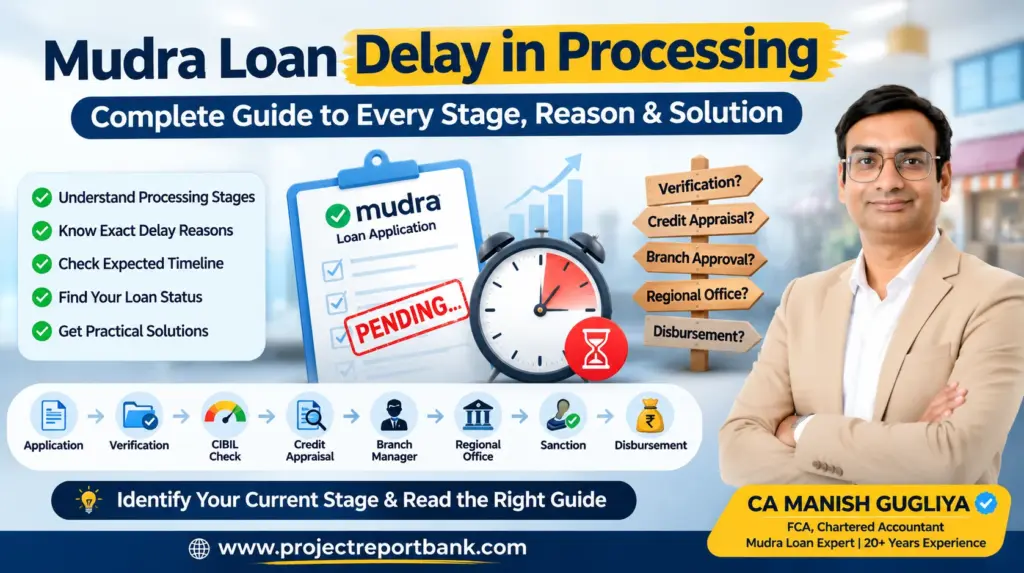
- Mudra Loan Delay in Processing: Complete Guide to Every Stage, Reason & Solution

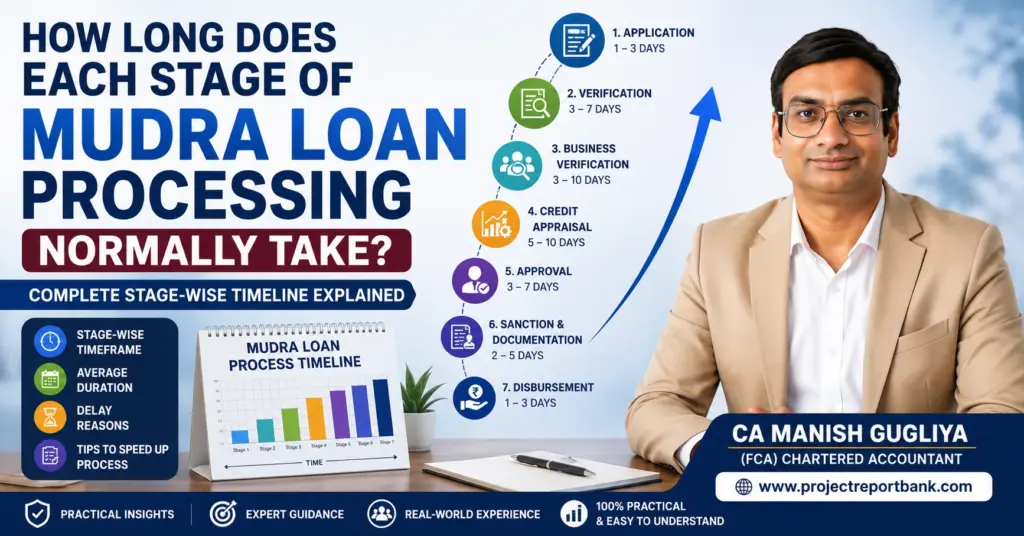
- Mudra Loan Processing Time: Stage-Wise Timeline from Application to Disbursement

- Why Does Mudra Loan Verification Take Longer for New Businesses?

- Can Festivals, Holidays or Financial Year-End Delay Mudra Loan Processing?

- Mudra Loan Pending Due to Internal Bank Approval: What Should You Do?

- Mudra Loan Pending Because of CIBIL Verification: What to Expect

- Mudra Loan Sanctioned but Disbursement Delayed: Reasons & Solutions (By CA Manish Gugliya)

- Why Is My Mudra Loan Still Under Credit Appraisal?

- Mudra Loan Pending After Site Inspection: What It Really Means (From a Banker’s Desk)