A bank sanctions your Mudra Loan and presents two insurance products at the counter. One is called credit life insurance. The other is asset insurance. The loan officer tells you both are “recommended.” You are not sure what either one does, whether you actually need them, or whether you can refuse. Most borrowers sign without asking questions.
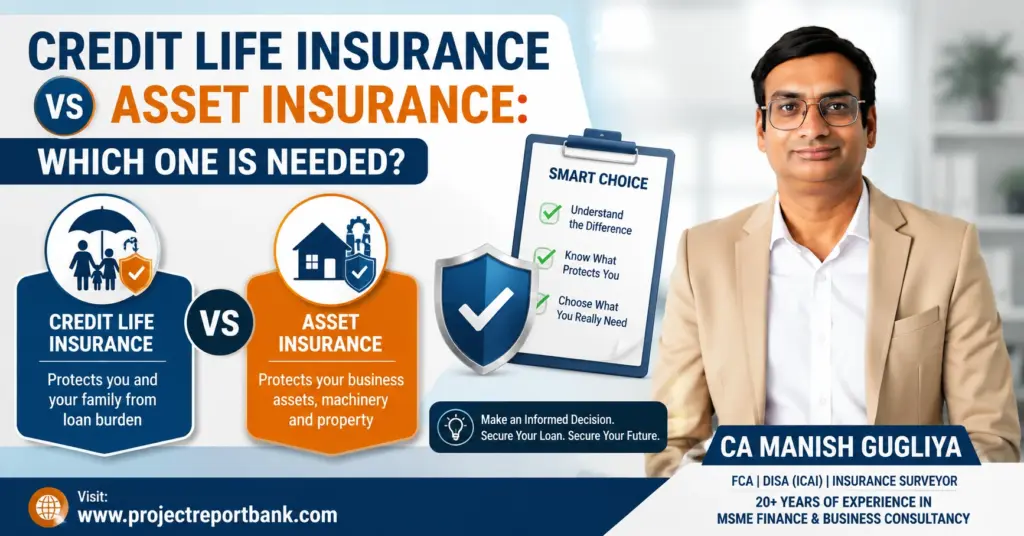
That is a mistake, because these two insurance products solve entirely different problems. Credit life insurance pays off your outstanding loan balance to the lender if the borrower dies. Asset insurance replaces or repairs your business equipment, machinery, or inventory if they are damaged by fire, theft, flood, or similar events. One protects your family from debt. The other protects your business from shutting down.
This article breaks down exactly how credit life insurance works, how asset insurance works, where they overlap (they don’t), what each one costs, and which one a Mudra loan borrower should actually buy. By the end, you will know precisely which insurance product fits your situation.
The short answer: If you have family dependents and no existing life cover, credit life insurance protects your loved ones from inheriting your outstanding debt. If you have financed machinery or equipment that your business cannot survive without, asset insurance keeps your operations alive after a fire or flood. For most Kishore and Tarun category Mudra borrowers with both family dependents and financed equipment, carrying both makes practical sense. For Shishu borrowers with loans under ₹50,000, a single policy (usually credit life) is often sufficient.
What Is Credit Life Insurance?
Credit life insurance is a life insurance policy tied to a specific loan. If the borrower dies during the loan tenure, the policy pays the remaining loan balance directly to the lender, not to the borrower’s family. The family’s obligation to repay the loan ends.
The coverage amount decreases as the loan balance reduces. On Day 1 of a ₹5 lakh loan, the coverage is ₹5 lakh. Two years later, if the outstanding loan amount has dropped to ₹3 lakh, the coverage is ₹3 lakh. This declining structure is a defining feature of credit life insurance.
Credit life insurance protects the borrower’s family and co-signers from assuming the outstanding debt after the borrower’s untimely death. It provides peace of mind by preventing the financial burden of unpaid loans from falling on heirs. The death benefit goes to the lender directly; it does not pass through the family. If there is any surplus over the outstanding balance, some policies pass it to the nominee, but many group credit life policies do not.
Simple example: A borrower takes a ₹2 lakh Mudra loan and buys a credit life insurance policy. Eighteen months later, the outstanding balance is ₹1.4 lakh. The borrower passes away. The insurer pays ₹1.4 lakh to the bank. The family owes nothing. However, if the borrower’s tailoring machine breaks down during the same period, credit life insurance does nothing; it only responds to death.
Credit life insurance is often easier to obtain than term life insurance because the underwriting is simpler. Many group credit life policies require no medical exam. The premium is small relative to the loan; a microfinance sector survey by NCAER found the average credit life insurance premium was ₹1,547, roughly 3% of the average loan amount.
The limitations are clear: credit life only covers death. It does not cover disability, business failure, theft, or asset damage. And once the loan is fully repaid, the policy expires; there is no residual coverage.
Table of Contents
What Is Asset Insurance?
Asset insurance (also called business property insurance, fire insurance, or equipment insurance) protects the physical assets of your business against damage, destruction, or loss from specified events: fire, theft, natural disasters, storm, flood, and similar perils.
The types of assets covered include:
- Fixed assets: Machinery, tools, equipment, shop interiors, furniture, fixtures
- Inventory: Raw materials, stock, finished goods
- Premises: Commercial building (if owned)
- Electronics and vehicles: Computers, office equipment, commercial vehicles (if financed)
When a covered event occurs, the insurer assesses the loss, adjusts for depreciation and any applicable deductibles, and pays the business owner (or the lender, if the asset is pledged as collateral) for repair or replacement. Asset insurance typically reflects the value of the physical property insured. Some policies also cover business interruption losses; the income lost while the business is shut down for repairs.
Example: A food processing unit financed under a Kishore Mudra loan has a commercial fryer, grinder, and cooking equipment worth ₹2.5 lakh. A short circuit causes a fire that destroys the fryer and damages the grinder. The asset insurance policy covers repair and replacement costs (minus depreciation and deductible). The business owner gets funds to rebuild and restart. Without asset insurance, the borrower would need to fund repairs from savings or take another loan, all while continuing EMI payments on the original Mudra loan.
Asset insurance premiums are annual and depend on the sum insured, location, asset type, risk exposure, and claim history. According to fire insurance guidelines from Ethika, premiums for small business fire policies typically range between 0.5% and 2.5% of the insured value annually.
The limitations: asset insurance does not cover wear and tear, gradual deterioration, misuse, or loss of market demand. Claims can be slow. Depreciation reduces the payout. And asset insurance does nothing if the borrower dies; the family still owes the outstanding loan.
Credit Life Insurance vs Asset Insurance: How They Compare at a Glance
| Factor | Credit Life Insurance | Asset Insurance |
|---|---|---|
| Best for | Borrowers with family dependents, co borrowers, or no existing life cover | Borrowers with high-value financed machinery, equipment, or inventory |
| Purpose | Clears outstanding loan balance upon borrower’s death | Repairs or replaces business assets after covered damage/loss |
| Risk covered | Death of borrower | Fire, theft, flood, storm, accidents affecting assets |
| Claim beneficiary | Lender (bank/NBFC) receives payout directly | Business owner (or lender if asset is collateral) |
| Coverage amount | Declines as loan balance decreases | Based on declared value of insured assets |
| Premium | Typically one-time or included in EMI; ~3% of loan amount | Annual; ~0.5%–2.5% of insured asset value |
| Mandatory under PMMY | Not mandatory | Not explicitly mandatory; banks may require it for financed assets |
| Coverage period | Until loan is fully repaid | Annual, renewable |
| Business continuity | No direct impact | Directly enables business restart |
The core takeaway: these two products respond to entirely different events and protect entirely different interests. There is zero overlap in what they cover.
Who Is Protected
Credit life insurance protects the borrower’s family and co-signers. When the borrower dies, family members do not inherit the outstanding debt. If a co signer guaranteed the loan, they are released from their financial obligations. The family keeps whatever personal assets they have, free from the lender’s claim on the loan. Credit life insurance is voluntary and cannot be required by lenders as a condition for sanctioning the loan, as confirmed by the Ministry of MSME’s FAQ on PMMY.
Asset insurance protects the business itself and its physical property. Asset insurance protects against the physical loss of the property, whether from fire, flood, or theft. The beneficiary of asset insurance is typically the property owner (the business operator), though if equipment is financed and pledged as collateral, the lender may be named as loss payee.
Consider two scenarios. A Kishore Mudra borrower running a small bakery with ₹3 lakh in equipment dies unexpectedly. Credit life insurance settles the ₹2.5 lakh outstanding balance with the bank. The family owes nothing. But the bakery equipment still exists, and the family can sell it or continue the business.
Now, same borrower, alive, but a flood destroys the oven and mixer. Asset insurance pays for replacement. Credit life insurance does nothing here because the borrower is alive. Without asset insurance, the borrower still owes loan payments on equipment that no longer works.
Winner: Depends on what you are protecting. Credit life wins for family financial security. Asset insurance wins for business survival. They are not substitutes for each other.
Type of Risk Covered
Credit life insurance covers one specific risk: death of the borrower during the loan tenure. Credit life insurance pays off debts if the borrower dies. In its basic Indian form, it typically does not cover disability, hospitalization, or income loss. Some extended credit insurance products abroad include disability coverage, but in India, that extension is rare and costs more.
Asset insurance covers a broader spectrum of physical perils. Standard business fire policies cover fire, lightning, explosion, riot, strike, malicious damage, storm, tempest, flood, inundation, and impact damage. Theft coverage may be included or added as an endorsement. Business fire insurance policies can be customized to include STFI (storm, tempest, flood, inundation) and RSMD (rain, storm, hail, snow, sleet damage) covers, which is increasingly relevant given rising climate risks.
What neither insurance covers: business failure due to low demand, inability to sell products, regulatory shutdown, or market conditions. Neither policy is a safety net against commercial risk.
Credit life insurance is tied to specific loans, unlike term life insurance, which can cover broader financial needs. If you already hold a term insurance policy with adequate coverage, the family is protected regardless. But term life insurance pays beneficiaries directly, not lenders; the family would need to use those funds to settle outstanding loans voluntarily.
Winner: Asset insurance. It covers a wider range of unforeseen events that can actually shut down a business. Credit life covers only one event (death), and only protects against the loan liability arising from it.
Claim Beneficiary and Payout
Credit life insurance pays the lender directly upon death. The insurance payout goes to the bank or NBFC that issued the loan. The family does not receive cash. The loan account is closed, and the family is freed from repayment. It protects co-signers from assuming debt after death.
Asset insurance pays the business owner (or lender, if assets are pledged as collateral) for repair or replacement. The payout is based on the assessed loss, adjusted for depreciation and deductibles. If the insured assets serve as collateral for the loan, the insurer may pay the lender first, with any balance going to the borrower. For equipment finance products, banks like ICICI Bank include asset insurance as part of the financing facility, and the bank is typically named as loss payee.
The difference in payout destination matters for business continuity. After a credit life claim, the loan is settled, but no money flows to the business. After an asset insurance claim, funds flow toward rebuilding the business. One settles a debt; the other restores an operation.
Winner: Neither universally. If the goal is debt elimination for the family, credit life delivers directly. If the goal is keeping the business running after physical damage, asset insurance delivers. The “better” beneficiary structure depends on what the borrower needs to protect.
Premium Costs and Value
Credit life insurance premiums are typically paid as a lump sum at loan disbursement (added to the loan principal) or spread across EMIs. The NCAER microfinance survey found an average premium of roughly 3% of the loan amount. For a ₹5 lakh Mudra loan, that translates to approximately ₹15,000. If this premium is added to the principal, the borrower pays interest on that amount for the full loan tenure, increasing the total cost.
The coverage amount decreases as the loan balance decreases. A borrower who pays ₹15,000 in premium on Day 1 for ₹5 lakh coverage may have only ₹2 lakh coverage remaining by the midpoint of the loan. The premium paid does not decrease proportionally.
Asset insurance premiums are annual and based on the declared sum insured. For a manufacturing setup with ₹5 lakh in machinery and ₹1 lakh in inventory, the annual premium at 1.5% of insured value would be roughly ₹9,000. Unlike credit life, the coverage does not decline; it stays at the declared value as long as the policy is renewed and premiums are paid. However, the payout is adjusted for depreciation at the time of claim.
Cost comparison for two Mudra loan scenarios:
| Scenario | Credit Life Premium (one-time, ~3%) | Asset Insurance Premium (annual, ~1.5%) |
|---|---|---|
| ₹5 lakh manufacturing loan | ~₹15,000 | ~₹9,000/year |
| ₹10 lakh retail setup | ~₹30,000 | ~₹15,000/year (₹10 lakh assets) |
Over a 5-year loan tenure, asset insurance for the ₹5 lakh scenario costs ₹45,000 total, while credit life costs ₹15,000 (plus interest if financed). Asset insurance is more expensive over the full tenure but maintains constant coverage and protects against a broader range of events.
Winner: Credit life insurance on pure cost. It is cheaper overall. But cost alone is a poor metric. Term life insurance is usually more affordable than credit life insurance and maintains its value over time, making it worth considering as an alternative for the life cover component.
Business Continuity Impact
Credit life insurance has no direct effect on business continuity. If the borrower dies, the loan is cleared, but the business has lost its operator. The remaining family members may or may not be able to continue operations. If the business depended entirely on the borrower’s skills, credit life only ensures the family is not burdened with debt; it does not keep the business alive.
Asset insurance directly enables business restart after physical damage. A manufacturing unit that loses its primary machine to fire can file a claim, receive repair or replacement funds, and resume production. Without asset insurance, the borrower must either fund repairs from personal savings (which many Mudra borrowers lack) or take a second loan while still servicing the first.
Consider a Tarun borrower with an ₹8 lakh manufacturing setup. A flood damages three machines worth ₹4 lakh collectively. With asset insurance, the borrower receives claim funds (adjusted for depreciation) within weeks and can restart. Without it, the business may shut down permanently, while the borrower continues paying EMIs on destroyed equipment.
In contrast, if the same borrower dies, credit life settles the ₹8 lakh loan. The family is debt-free. But if those three machines were also damaged in the same event (say, a natural disaster that injured the borrower fatally), credit life clears the debt while asset insurance replaces the machines. One without the other leaves a gap.
Winner: Asset insurance. For the specific question of keeping a business running after unexpected events, asset insurance is the only product that responds. Credit life does not address business operations at all.
Credit Life Insurance vs Asset Insurance: Which Should You Choose?
Choose credit life insurance if:
- Your family depends entirely on your income and has no savings or alternate earners
- You have co borrowers or a co signer on the loan who would be liable if you die
- You do not have existing term insurance or whole life insurance with sufficient coverage
- Your financed assets are low-value or easily replaceable (e.g., basic tools, small equipment)
- You want to ensure that unpaid debts do not become your family’s financial burden
Choose asset insurance if:
- You have financed high-value machinery or equipment that your business cannot operate without
- Your business is located in a flood-prone, fire-risk, or theft-prone area
- You lack the savings to repair or replace critical equipment on your own
- Your lender requires insurance on financed assets (check your loan agreement)
- Downtime from equipment failure would eliminate your only income source
Choose both if:
- You have a Kishore or Tarun loan with financed equipment worth ₹2 lakh or more AND family dependents with no alternate income
- Your business is your family’s sole livelihood, and both the operator (you) and the equipment are irreplaceable in the short term
For most Mudra borrowers with meaningful loan amounts and financed business assets, carrying both provides full protection. Credit life clears the debt if the worst happens to you. Asset insurance keeps the business alive if the worst happens to your equipment.
If you already hold a term insurance policy with a sum assured that covers your outstanding loans and family needs, you may not need credit life separately. Conventional life insurance can cover broader financial needs than credit life insurance. However, remember that term life insurance benefits go to the policyholder’s heirs, not the lender; your family would need to use those funds to settle the bank loan voluntarily. To understand whether your bank can insist on their insurance product over your existing cover, read this guide on whether insurance is compulsory with Mudra loans.
Real-Life Examples by Mudra Loan Category
Shishu borrower: ₹50,000 tailoring machine
Rekha takes a Shishu Mudra loan of ₹50,000 to buy a sewing machine. She operates from home. Her husband works separately.
- If Rekha dies: Credit life insurance settles ₹50,000 with the bank. Her family is not burdened with unpaid loans.
- If the machine catches fire: Asset insurance pays for repair or replacement. Without it, Rekha must fund a new machine on her own.
Recommendation: At this loan size, credit life costs roughly ₹1,500 (3% of ₹50,000). Asset insurance on a ₹50,000 machine might cost ₹500–₹1,250 annually. Credit life alone is usually sufficient unless the machine is Rekha’s sole income source and she has no savings to replace it. The family’s financial exposure on a ₹50,000 loan is manageable compared to losing the income-generating machine.
Kishore borrower: ₹3 lakh food processing unit
Suresh takes a Kishore loan of ₹3 lakh. He purchases a commercial fryer (₹80,000), grinder (₹60,000), cooking equipment (₹40,000), furniture and interiors (₹50,000), and initial inventory (₹70,000).
- If Suresh dies: Credit life settles the outstanding loan amount with the bank. His wife and two children do not inherit the debt.
- If a gas leak causes a fire: Asset insurance covers equipment damage. Credit life is irrelevant because Suresh is alive.
- If both happen (fire injures Suresh fatally): Credit life clears the loan. Asset insurance replaces the equipment. If either policy is missing, the family faces both debt and a destroyed business.
Recommendation: Both insurances make sense here. Credit life premium: ~₹9,000. Asset insurance premium: ~₹3,000–₹6,000 annually (depending on risk profile). Total annual insurance cost: ₹12,000–₹15,000. For a business generating monthly revenue of ₹40,000–₹60,000, this is a reasonable protection cost.
Tarun borrower: ₹8 lakh manufacturing setup
Pradeep takes a Tarun loan for ₹8 lakh to set up a small plastics manufacturing unit. He buys an injection molding machine (₹4 lakh), supporting equipment (₹2 lakh), raw material stock (₹1 lakh), and shop interiors (₹1 lakh).
- If Pradeep dies: Credit life settles ₹8 lakh (or whatever the remaining balance is). His family is free from financial commitments on the loan.
- If the injection molding machine breaks down due to an electrical surge: Depending on policy terms, asset insurance covers repair. Without it, Pradeep faces a ₹2–₹3 lakh repair bill while still paying EMIs on the original loan.
- If a flood damages the entire unit: Asset insurance covers all insured assets. Credit life does nothing.
Recommendation: Both insurances are strongly advisable. The asset values are high, the loan is large, and the business cannot operate without the injection molding machine. Credit life premium: ~₹24,000. Asset insurance: ~₹8,000–₹20,000 annually depending on location and risk.
Service business vs. manufacturing business
A service business (tutoring center, beauty salon, consultancy) typically has lower-value equipment and higher dependence on the operator’s skills. Credit life insurance is more important here because the business value is tied to the person.
A manufacturing business depends heavily on machinery. If the lathe stops, the business stops. Asset insurance is more important here because the business value is tied to the equipment. For a deeper understanding of types of insurance offered with Mudra loans, including how these apply across business categories, see the linked guide.
Advantages and Disadvantages
Credit Life Insurance
Advantages:
- Settles the outstanding loan balance upon death; family members and co borrowers carry no liability
- Credit life insurance is often easier to obtain than term life insurance; minimal or no medical exam required
- Premium is small relative to loan size (~3% of loan amount in the microfinance sector)
- Underwriting under group credit life policies is fast and paperwork-light
- Provides a safety net specifically designed for loan-linked risk
Disadvantages:
- Only covers death; does not protect against disability, business failure, asset damage, or income loss
- Coverage amount decreases as the loan balance decreases; the death benefit declines over time
- If premium is paid upfront and added to loan principal, the borrower pays interest on the insurance premium for the full tenure
- Exclusions apply: pre-existing conditions, suicide clauses, age limits
- The insurance payout benefits the lender, not the family; no surplus in many group policies
- Once the loan is fully repaid, the policy ends; there is no residual life cover
- May be redundant if the borrower already holds adequate term insurance
Asset Insurance
Advantages:
- Protects physical assets (machinery, equipment, inventory, interiors) against fire, theft, flood, and natural disasters
- Enables business restart after asset damage; directly supports business continuity
- Coverage stays at the declared sum insured (not declining); provides consistent protection
- Some policies include business interruption coverage, compensating for lost income during repair periods
- Increases lender confidence; may improve lending decisions and loan terms
- Protects the borrower’s investment in equipment beyond just the loan liability
Disadvantages:
- Annual premium renewal; total cost over loan tenure can exceed credit life premium
- Depreciation reduces claim payout; a 3-year-old machine’s claim value is lower than its purchase price
- Exclusions for wear and tear, gradual deterioration, misuse, and pre-existing damage
- Claims process can be slow; survey and assessment required before payout
- No protection against death of borrower; family still liable for outstanding loans without separate life cover
- Administrative compliance: policy must be kept current; some banks impose penalties for delayed insurance renewal. For instance, Equitas Bank’s MSME loan terms include penalties for delayed submission of applicable insurance policy renewals.
Common Misconceptions
“I already have life insurance, so I don’t need credit life.”
This is partially correct. If your existing term insurance sum assured is large enough to cover both your outstanding loans and your family’s living expenses, separate credit life may be redundant. But term life insurance pays beneficiaries directly, not lenders. Your family receives the payout and must choose to repay the loan; there is no automatic settlement with the bank. If your family is financially unsophisticated or emotionally distressed after your death, the loan may go unpaid despite available funds.
“My machinery is under warranty, so I don’t need asset insurance.”
Manufacturer warranty covers defects in materials and workmanship. It does not cover fire, flood, theft, electrical surge, or accidental damage. A machine destroyed in a fire gets zero coverage under warranty.
“Bank insurance is compulsory.”
Under PMMY, life insurance is not mandatory. Lenders cannot require borrowers to have credit life insurance as a precondition for loan sanction. Asset insurance may be required by specific lenders for financed assets, but this varies by bank and loan agreement. Always read your sanction letter. If you feel pressured, learn whether you can refuse insurance on a Mudra loan.
“One insurance covers everything.”
No single policy covers both death-related loan liability and physical asset damage. Credit life and asset insurance respond to different triggers with different payouts to different beneficiaries. They are complementary, not interchangeable.
“Asset insurance pays my EMI if I can’t earn.”
Asset insurance pays for repair or replacement of damaged assets. It does not cover loan payments, EMI shortfalls, or income loss (unless the policy specifically includes a business interruption rider). It is not income protection insurance.
When Should You Choose Credit Life Insurance?
Credit life insurance makes sense when:
- Your family has no alternate income earner and depends on your business for survival
- Your loan has a co signer (parent, spouse, friend) who would be legally liable for the remaining balance if you die
- You do not have term insurance, whole life insurance, or any other life cover
- The loan amount is large relative to your family’s savings and assets
- Your financed business assets are low-value, fungible, or easily replaceable
A home-based tutor taking a ₹1 lakh Shishu loan to buy a computer and furniture has modest asset risk but real family risk. Credit life is the priority here.
When Should You Choose Asset Insurance?
Asset insurance makes sense when:
- You have financed expensive machinery that is critical to operations (CNC machines, industrial ovens, injection molding equipment)
- Your business is in a flood-prone, fire-risk, or high-theft area
- You lack savings to fund repairs or replacements out of pocket
- Your loan agreement requires you to maintain insurance on financed assets (common in equipment finance; ICICI Bank’s construction equipment loans include asset insurance as a component)
- Equipment downtime would eliminate your revenue entirely
A Tarun borrower running a printing press with ₹6 lakh in financed machines cannot operate without those machines. Asset insurance is non-negotiable here, regardless of whether credit life is also purchased.
Can Existing Insurance Policies Be Used?
If you hold an existing term insurance policy with sufficient coverage, discuss with your lender whether they will accept it in lieu of credit life insurance. Many banks will, provided the sum assured exceeds the loan amount and the policy is in force. However, term insurance does not automatically assign the bank as beneficiary; you may need to add the bank as an assignee or provide a letter of comfort.
For asset insurance, if you already have a commercial property or fire insurance policy that covers the financed assets, submit it to the lender. Ensure the bank is named as loss payee if required by your loan terms. Avoid duplicate coverage on the same assets; paying premiums on two overlapping policies wastes money.
When banks push their own insurance products aggressively, this falls under cross-selling practices. Understand your rights by reading about cross-selling in Mudra loans and its legality.
Mistakes Borrowers Make
- Buying without understanding: Signing insurance forms at the loan counter without knowing what the policy covers, its exclusions, or its premium structure
- Ignoring asset insurance: Many borrowers buy credit life (because the bank pushes it) but skip asset insurance, leaving their expensive machinery unprotected
- Assuming everything is compulsory: Treating all bank-offered insurance as mandatory without checking the sanction letter or PMMY guidelines
- Taking duplicate insurance: Buying credit life when an existing term insurance policy already provides adequate coverage; paying twice for the same risk
- Ignoring policy exclusions: Not reading what is excluded; flood damage may not be covered unless STFI is specifically added; theft may require separate endorsement
- Not checking claim conditions: Some asset policies require specific safety measures (fire extinguisher, security guard) as preconditions for valid claims
- Letting asset insurance lapse: Forgetting to renew annual asset insurance policies; one missed renewal during a flood year can be catastrophic
- Not comparing premiums: Accepting the bank’s offered policy without comparing market rates from other insurers; credit life premiums vary between providers
Expert Tips from CA Manish Gugliya
Based on 20+ years of working with MSME borrowers on project reports and Mudra loan consultancy, here are my practical recommendations:
- Read the sanction letter first. Check which insurance is marked as mandatory by the bank and which is optional. Do not rely on verbal instructions from the loan officer.
- Separate your risks. Ask yourself two questions: “What happens to my family if I die?” and “What happens to my business if my equipment is destroyed?” If both answers are “serious trouble,” you need both policies.
- Check your existing life cover. If you have a term insurance policy with a sum assured above your total outstanding loans plus 3 years of family expenses, you may not need credit life. Term life insurance maintains its value over time unlike credit life insurance, where the coverage declines.
- Never let asset insurance lapse. Set a calendar reminder 30 days before renewal. One year without coverage can wipe out everything.
- Insist on transparent premium disclosure. Under IRDAI and RBI norms, the Key Facts Statement (KFS) must disclose insurance premium costs if bundled with the loan. Ask for it in writing.
- Avoid financing the credit life premium. If possible, pay it upfront from your own funds rather than adding it to the loan principal. Adding ₹15,000 to a ₹5 lakh loan at 12% over 5 years costs you an additional ₹3,500+ in interest.
- Match asset insurance to actual asset value. Over-insuring wastes premium. Under-insuring means partial claim payouts. Get a proper valuation.
- Add STFI and flood riders if your area needs them. Standard fire policies may not cover flood or storm damage unless specifically added.
- Name the lender as loss payee on asset insurance. If the bank requires it, do it at policy inception; don’t wait for them to demand it later and charge penalties.
- Keep copies of all insurance documents. Store them separately from your business premises. A fire that destroys your machines may also destroy your insurance papers.
- Compare quotes from at least two insurers. Banks often partner with specific insurance companies, but you are generally free to buy from any IRDAI-registered insurer. Why banks recommend specific insurance products is worth understanding.
- Review insurance coverage annually. If you have added new machinery or expanded inventory, update your asset insurance sum insured.
- For women entrepreneurs under PMMY: The same logic applies. Evaluate your family’s financial exposure and your equipment value separately. There is no gender-specific insurance rule under PMMY; the decision depends on your business structure and family situation.
- For new startups: Prioritize asset insurance if your entire capital is in equipment. Prioritize credit life if your family has zero savings and you are the sole earner. If both are true, budget for both.
- Understand that IRDAI does not maintain centralized data on how many MSMEs carry asset insurance. This was confirmed in a Parliamentary reply. The low penetration suggests most small businesses are underinsured. Don’t assume others are covered just because you are not.
Frequently Asked Questions
Can I refuse both insurance options offered by the bank?
Credit life insurance is voluntary and cannot be required by lenders under PMMY. Asset insurance may be required by specific banks for financed assets. Check your loan agreement. If neither is marked mandatory, you can refuse both. If only asset insurance is a loan condition, you must comply or negotiate.
Is either insurance mandatory for Mudra loans?
The Ministry of MSME states that life insurance is not required for loans under PMMY. Asset insurance is not explicitly mandated under PMMY either, but individual banks may require it for financed equipment as part of their internal lending policies.
Which insurance helps if my business shuts down permanently?
Neither. Credit life insurance only responds if the borrower dies. Asset insurance only responds to physical damage or loss of assets. A business shutting down due to low demand, market failure, or the borrower’s decision is not an insured event under either policy.
Does credit life insurance cover partial disability or job loss?
In standard Indian credit life products, no. Basic credit life insurance covers death only. Some extended credit insurance products may offer disability riders, but these are rare and more expensive. Always check your specific policy terms.
Can I use my existing life insurance instead of credit life?
Yes, in principle. If your existing term insurance sum assured is adequate, discuss with your lender. The bank may accept it, especially if you assign the policy or add the bank as a nominee/beneficiary for the loan amount. However, conventional life insurance can cover broader financial needs than credit life insurance; using it exclusively for loan coverage may leave your family underprotected for other expenses.
What happens if I take both insurances and file claims for the same incident?
If a single event triggers both (e.g., a fire that destroys equipment and injures the borrower fatally), both policies can be claimed. Credit life settles the outstanding loan with the lender. Asset insurance pays for equipment repair/replacement. There is no duplication because they cover different losses; one covers debt liability, the other covers physical property damage.
Which insurance is better for women entrepreneurs under PMMY?
The choice depends on the same factors as for any borrower: family dependence on income, value of financed assets, existing insurance coverage, and risk exposure. There is no PMMY-specific insurance rule or benefit for women entrepreneurs that changes the credit life vs. asset insurance calculus.
Do I need asset insurance if my equipment has manufacturer warranty?
Yes, if your concern is fire, flood, theft, or accidental damage. Manufacturer warranty covers manufacturing defects. It does not cover external damage events. These are separate risk categories.
Can banks force me to buy insurance from specific companies?
Banks may recommend their partner insurer, but under IRDAI and RBI guidelines, borrowers generally have the right to choose their own insurer. If you feel forced, document the interaction and raise a grievance through the bank’s internal process or with the banking ombudsman.
Which insurance protects against business failure due to market conditions?
Neither credit life insurance nor asset insurance covers commercial or market risk. If your business fails because customers stop buying, competition increases, or input costs rise, no standard insurance policy compensates for that. These are business risks, not insurable perils.
Does Credit Life Insurance protect financed equipment?
No. Credit life insurance pays off loans if the borrower dies. It does not cover equipment, machinery, or any physical asset. If your machine breaks down or is destroyed, credit life is irrelevant.
Who receives claim money in each case?
For credit life insurance, the payout goes directly to the lender, not heirs. The bank receives the remaining balance, and the loan account is closed. For asset insurance, the business owner receives the payout (or the lender, if assets are pledged and the bank is named as loss payee).
Should startups buy both insurance products?
For startups with financed equipment above ₹2 lakh and a family dependent on the borrower, both make financial sense. For very small startups (Shishu category with ₹30,000–₹50,000 loans), one policy may suffice; choose based on whether family debt protection or equipment protection is the greater risk.
Does insurance reduce my loan burden?
Credit life insurance eliminates the loan burden entirely, but only upon death of the borrower. It does not reduce EMIs or loan payments during the borrower’s lifetime. Asset insurance has no effect on loan burden; it covers asset damage only.
Can I buy insurance after the loan is sanctioned?
Yes. Credit life can be bought at any point during the loan tenure, though premiums may differ. Asset insurance can be purchased independently from any general insurer. Some banks require proof of insurance within a specified period after loan disbursement.
Conclusion
Credit life insurance and asset insurance protect against fundamentally different risks. Credit life insurance protects the borrower’s family from outstanding debt by settling the remaining loan balance with the lender if the borrower dies. Asset insurance protects financed business assets from covered physical damage or loss, enabling the business to restart after fire, flood, or theft.
Neither is universally “better.” The right choice depends on four factors: your family’s financial vulnerability, the value and criticality of your financed assets, your existing insurance coverage, and your loan terms.
For Shishu borrowers with small loans and low-value assets, credit life insurance alone often provides adequate protection. For Kishore and Tarun borrowers with expensive machinery and family dependents, both policies together close the two largest risk gaps. For borrowers with existing term insurance, credit life may be redundant; redirect that premium toward asset insurance.
The uptake of credit life insurance among small borrowers stands at roughly 84.4% according to NCAER’s microfinance survey, but non-life insurance coverage for MSMEs remains far lower. This gap leaves millions of small businesses exposed to asset destruction without any financial backup.
Before signing any insurance form at the loan counter, read the policy terms. Understand what is covered, what is excluded, who receives the payout, and whether the insurance is mandatory or optional for your specific loan. Buy because you understand the protection, not because it was presented as compulsory.
If you are exploring related topics, our detailed guides cover the types of insurance offered with Mudra loans and why banks recommend insurance during the loan process.
This article is authored by CA Manish Gugliya (FCA), a Chartered Accountant with 20+ years of experience in MSME finance, project reports, and Mudra loan consultancy at ProjectReportBank.com.
- Mudra Loan Insurance & Cross-selling Issues: Complete Guide to Your Rights and Safe Borrowing


- Hidden Insurance Charges in Mudra Loans: How to Spot Them

- Can Insurance Premium Be Included in Your Mudra Loan Amount?
- What to Do If Insurance Was Added Without Your Consent in a Mudra Loan
- Warning Signs of Forced Cross-selling by Banks
- How to Identify Insurance Mis‑selling During Mudra Loan Processing
- Credit Life Insurance vs Asset Insurance: Which Is Better for Mudra Loan Borrowers?
- Types of Insurance Offered with Mudra Loans Explained

- Why Do Banks Recommend Insurance with Mudra Loans?