
Key Takeaways
- Instant poha plant bank finance depends not only on projected profit but equally on DSCR, cash flow adequacy, realistic project cost and structured sensitivity analysis across the loan tenure.
- Banks in India examine the debt service coverage ratio for instant poha projects, promoter contribution, market demand for packaged poha, and overall project feasibility before sanctioning term loan and working capital limits.
- A detailed project report with financial projections, ROI, IRR, projected pay back period, break-even and risk analysis is essential for making an instant poha manufacturing plant bankable.
- Project Report Bank, led by CA Manish Gugliya, prepares instant poha plant bank loan project reports, CMA data and feasibility reports tailored to the exact production capacity and product mix of each proposed unit.
- All financial examples used in this article are illustrative only. Actual performance will depend on installed capacity, capacity utilisation, selling price, raw material cost, financing terms and market conditions.
Introduction: Why Instant Poha Plant Bank Finance Needs More Than Profit Numbers
Instant poha is a value-added extension of traditional rice flakes poha, targeting the rapidly growing demand for ready-to-cook convenience foods in India. As food habits shift toward quicker meal preparation among working professionals and urban households, this segment presents genuine business opportunities for MSME promoters and food processing entrepreneurs.
However, securing bank financing for an instant poha manufacturing plant requires a structured project report and proper documentation that goes far beyond showing an attractive net profit percentage. Lenders focus on loan repayment capacity, not just accounting profit. A plant may show healthy margins on paper yet fail the bank’s appraisal if cash flow cannot comfortably cover annual debt service obligations.
Before committing capital, promoters must understand key appraisal concepts: the debt service coverage ratio, return on investment, internal rate of return, projected pay back period, break-even volume, project feasibility and sensitivity analysis. Each instant poha manufacturing business is unique depending on installed capacity (say 1,000 kg/day versus 3,000 kg/day), product mix (plain, masala, organic poha, fortified poha), selling price and raw material sourcing strategy. A structured instant poha plant financial analysis provides the common language between promoters, bankers and investors.
Business Overview of Instant Poha Manufacturing and Market Demand
The food processing industry in India has seen remarkable growth in convenience and ready-to-cook breakfast segments. India’s poha market is valued at approximately ₹8,500 crore annually, and the instant and packaged variants are gaining share as urbanisation, e-commerce expansion and modern retail penetrate semi urban areas and smaller towns.
Instant poha differs from conventional beaten rice in several ways. It is pre-seasoned, partially cooked or processed, requiring minimal preparation time. This additional processing-parboiling, flavouring, specialized packaging-adds cost but also yields substantially higher price realisation per kilogram compared to raw flattened rice.
Market demand drivers include dual-income households, growth of institutional buyers such as canteens, hostels, QSR chains, educational institutions and mid day meal schemes, as well as export potential to diaspora markets where Indian consumers seek familiar convenience foods. Positioning opportunities like organic poha, fortified rice flakes, single-serve pouches and multi-grain instant poha SKUs can influence pricing and margins favourably. Poha manufacturing is classified as an agro-processing MSME activity, which opens access to several government support schemes.
These industry trends and growth opportunities make a strong case for the segment, but they also underscore why a focused feasibility study and market study are required before committing large capital.
Understanding Bank Finance Structure for an Instant Poha Plant
A typical instant poha plant in India, depending on daily production capacity, automation level and location, involves total project cost in the range of ₹75 lakh to ₹3 crore (indicative). The financing structure usually comprises:
- Term loan for fixed assets including plant and machinery, factory building and civil work
- Working capital limits (cash credit or overdraft) for raw materials, packaging, labour and operational expenses during initial operations
- Promoter’s equity contribution (typically 25–30% or more of project cost)
- Subsidy or grant components under applicable government schemes
Banks differentiate clearly between term loan (repayable over 5 to 7 years, sometimes up to 10 years including moratorium) and working capital finance (a revolving limit linked to stock and receivable levels). The debt equity ratio for an instant poha plant is typically expected at 3:1 or lower by most lenders, though this varies by institution.
Government schemes like PMEGP and PMFME offer credit-linked assistance for food processing units. The PMFME scheme provides a credit-linked subsidy for food processing units up to 35% of the project cost. PMEGP offers government subsidies for manufacturing projects with costs up to ₹50 lakh, with capital subsidy ranging from 15% to 35% depending on category and location. Mudra loans can provide up to ₹20 lakh without collateral for smaller setups, and CGTMSE facilitates collateral-free loans for eligible micro and small enterprises. Even gold-backed loans can offer short-term liquidity for poha businesses during cash flow gaps.
Collateral requirements for term loans can range from 30% to 50% depending on the scheme, though CGTMSE coverage reduces this burden for qualifying units. Beyond financial metrics, banks also examine the promoter’s profile, experience in food processing, CIBIL score, existing banking relationship, security and compliance track record before sanctioning finance.
Sanction percentages and terms vary by institution policy. No fixed loan-to-project-cost ratio can be promised for any specific bank.
Project Cost and Means of Finance for an Instant Poha Plant
Realistic project costing is the backbone of any instant poha plant project finance proposal. Total investment for a poha mill ranges from ₹25 lakh to ₹140 lakh depending on scale, automation and infrastructure choices. At the micro end, a poha manufacturing unit can be set up for ₹5 to ₹10 lakh with manual equipment, while micro-scale instant poha manufacturing units typically require an initial setup cost of ₹15 lakh to ₹30 lakh. A semi-automatic poha making machine setup costs between ₹5 to ₹10 lakh for the machinery alone.
Major cost heads in a detailed project report include:
- Land purchase or lease deposit and site development
- Factory building with hygienic flooring
- Instant poha plant machinery and equipment (cookers, roasters, flakers, blenders, packaging machine)
- Electrical installation and utility systems (boiler, compressor)
- Quality and total lab equipment
- Packaging line and labelling systems
- Furniture, fixtures pre operative expenses, office equipment
- Preliminary and pre-operative expenses
- Contingency provision
- Margin for working capital
Under-estimating total cost leads to funding gaps and working capital stress during commercial production. Over-estimation inflates the debt requirement, increasing interest burden, depressing ROI and distorting DSCR calculations.
As an illustration (not a formula), a project with ₹1.2 crore total project cost might be funded with 30% promoter contribution (₹36 lakh including share capital) and 70% term loan (₹84 lakh). Before freezing numbers, promoters should review the detailed Instant Poha plant project cost and means of finance analysis to ensure completeness and accuracy.
Financial Projections Required for Instant Poha Plant Bank Finance
A bankable detailed project report for an instant poha plant must present 5 to 7 year projections aligned with the proposed loan tenure. The main projected statements include:
- Monthly and annual sales estimates based on realistic capacity utilisation ramp-up
- Cost of production including raw material cost, packing material cost, fuel expenses, power and direct labour
- Projected profit and loss account with gross profit, administration expenses, financial charges and net profit
- Cash flow statement capturing operating, investing and financing activities
- Projected balance sheet showing total assets, fixed assets, current assets and liabilities
- Term loan repayment schedule with interest and principal phasing
- Working capital assessment using stock and receivable norms relevant to food-processing MSMEs
Working capital needs are necessary for raw materials, packaging, and labour during initial operations. The holding period for raw rice, seasoning ingredients, packaging materials and finished goods must be captured accurately.
Projections must integrate depreciation as per applicable rules, interest calculation based on realistic rates, and correct phasing of capacity utilisation. Internal consistency is critical: production volumes must tally with installed capacity, raw material quantities, energy usage and staffing costs. Mismatches between technical, market and financial sections are a common cause of DPR rejection.
A structured template for Instant Poha profitability, financial projections and working capital planning can help promoters maintain this consistency.
Debt Service Coverage Ratio (DSCR) for an Instant Poha Plant
The DSCR for an instant poha plant is the central metric in every bank appraisal because it directly reflects debt servicing capacity. Banks require a debt service coverage ratio of 1.25 or above as a general floor for food processing projects, though many prefer higher cushions.
The formula, simplified:
DSCR = Cash Available for Debt Service ÷ Total Annual Debt Service
Where cash available for debt service typically equals net profit after tax plus depreciation plus interest on term loan (and adjustments as per bank format), and total annual debt service equals the sum of annual principal repayment and interest on term loan.
Consider this illustrative example: a hypothetical instant poha plant generates ₹45 lakh in annual cash accruals (net profit + depreciation + term loan interest) against ₹30 lakh in annual debt service (principal + interest). The resulting DSCR is 1.50. This is purely illustrative and does not represent a guaranteed outcome.
Banks examine multiple DSCR variants:
- Annual DSCR for each year of the projection period
- Average DSCR across the entire repayment tenure
- Minimum DSCR in any single year, especially during early peak-repayment years
Factors that alter DSCR include the moratorium period on principal, loan tenure, interest rate, promoter contribution, and the pace of capacity utilisation ramp-up. DSCR calculation for a poha plant can differ slightly between banks depending on their internal formats and treatment of working capital interest.
What Is Considered a Comfortable DSCR for Instant Poha Plant Bank Finance?
There is no RBI-mandated universal DSCR threshold for all instant poha plant project finance proposals. Each lender applies its own comfort ranges based on internal credit policy and risk assessment.
In practice, most banks lending to food processing clusters are comfortable when average DSCR for an instant poha project is in the range of 1.30 to 1.50. This is not a binding rule but a typical banker comfort zone. Projects with volatile margins due to raw paddy price swings or seasonal sales patterns may need higher DSCR headroom.
A common trap: a project may show adequate accounting profit but still have weak DSCR due to heavy term-loan burden, short repayment period, high working-capital interest or long debtor cycles. Promoters should evaluate DSCR for their instant poha plant under both base and stressed scenarios before finalising the borrowing level and repayment structure.
Practical Ways to Improve DSCR of an Instant Poha Manufacturing Project
DSCR is not fixed at the planning stage. Promoters can redesign the project and financing structure to improve poha plant debt servicing capacity before approaching the bank.
Capital structure decisions:
- Increasing promoter contribution to reduce term loan size
- Maintaining prudent debt equity ratio
- Exploring FABUS-type scheme support or PMFME subsidy to reduce effective borrowing
Operational levers:
- Improving gross contribution through better selling price positioning
- Introducing value-added SKUs such as masala instant poha and organic variants
- Reducing wastage and improving production efficiency
- Building direct-to-consumer or e-commerce channels for better margins
Working capital optimisation:
- Negotiating better credit terms from raw material suppliers
- Tighter receivable follow-up with distributors and institutional buyers
- Optimised inventory levels of both raw materials and finished stock
Financial structuring:
- Selecting appropriate loan tenure and moratorium duration
- Avoiding unrealistic bullet repayments
- Synchronising the repayment schedule with expected capacity ramp-up
A well-prepared instant poha plant bank loan project report should clearly show the impact of such improvements on DSCR over the full loan tenure.
Instant Poha Plant Feasibility Study – Technical, Raw Material and Market Aspects
Instant poha plant feasibility is a combination of technical feasibility, raw material feasibility and market feasibility, all of which must be analysed before the final investment decision. A feasibility report should be location-specific, capacity-specific and tied to a concrete business model-whether B2B bulk supply, B2C retail, private label or a combination. The findings of this feasibility study flow directly into the financial feasibility, DSCR and ROI computations.
Technical Feasibility of an Instant Poha Manufacturing Plant
Technical feasibility ensures the proposed manufacturing plant can reliably produce instant poha meeting quality, safety and production capacity targets.
Capacity selection should be driven by market research and realistic sales reach. A 500 kg/day poha unit produces approximately 13 tonnes monthly. Over-sizing without demand proof is a common mistake that inflates project cost and depresses returns.
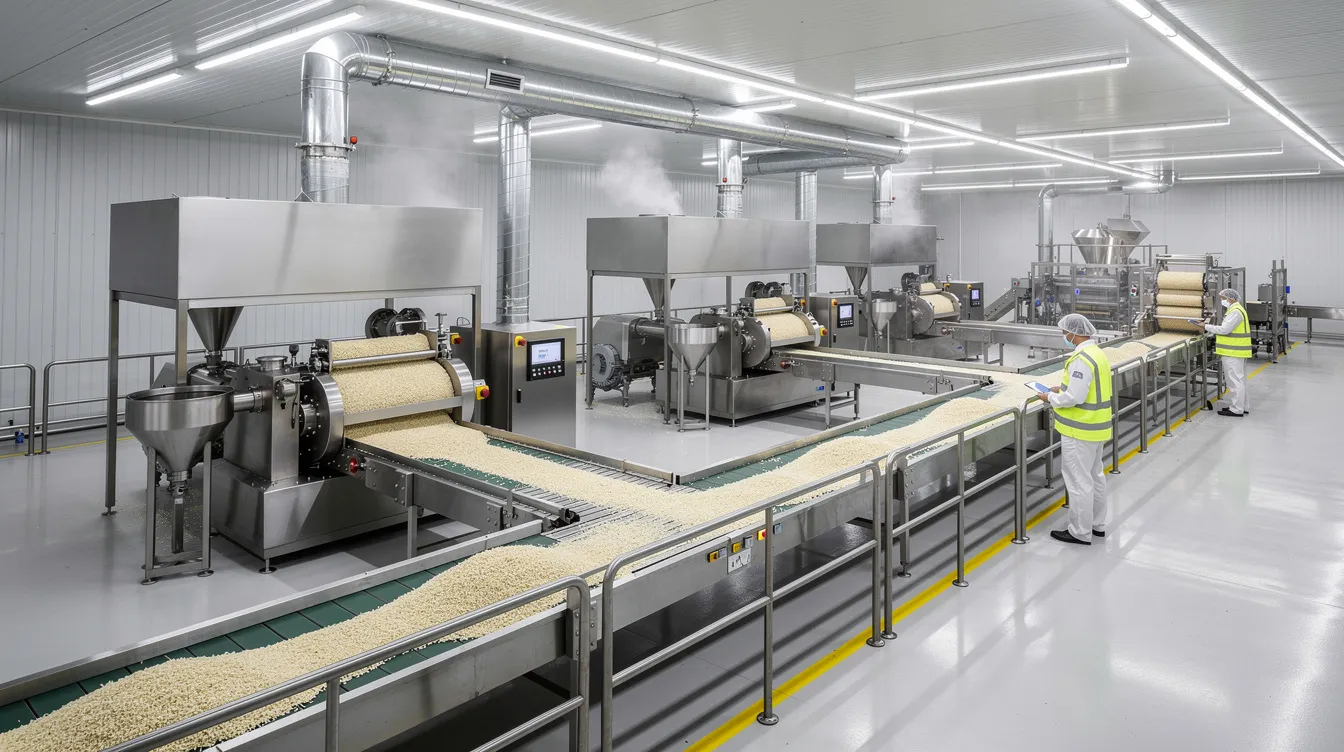
Key process steps in the Instant Poha manufacturing process and production line include cleaning, soaking, cooking or parboiling, seasoning, flaking, drying, cooling and packaging. A poha processing plant requires a de-stoner and aspirator for cleaning. Soaking tanks for poha must be stainless steel or food-grade FRP. Rotary roasting drums operate at temperatures between 180°C and 220°C. Flaking rollers determine the thickness of poha flakes, affecting product quality and market acceptance.
Promoters should evaluate Instant Poha plant machinery and equipment carefully, ensuring quotations include freight, GST, installation, civil foundations and electrical works. The land and utility requirements for an Instant Poha plant must cover power load, boiler capacity, water, compressed air, hygienic plant layout and drainage.
Approval processes for food businesses typically require multiple regulatory registrations and licenses. FSSAI registration is mandatory for food manufacturing units. Udyam registration is required for MSME classification. GST registration is necessary for turnover above ₹40 lakh. A Trade Licence is required from local authorities, and Pollution Control Board approval is needed based on local regulations. Laboratory testing facilities, HACCP or ISO compliance (if targeting retail or international markets) and scalability for future expansion should also be factored in.
Raw Material Feasibility – Rice, Seasoning and Packaging
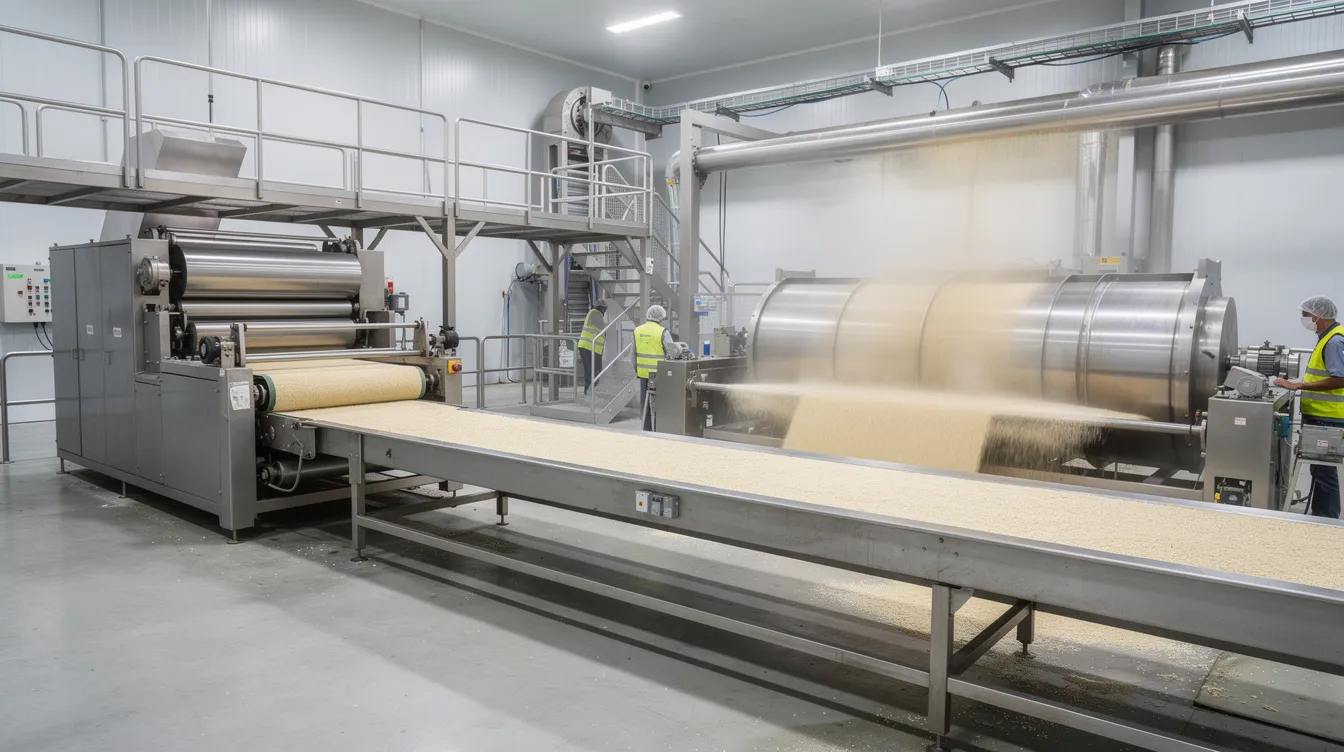
Consistent and economical raw material supply is critical to the financial viability of any poha manufacturing unit. Primary raw materials include suitable rice varieties (raw rice or parboiled rice base), spices, dehydrated vegetables, flavouring agents, edible oil, salt, stabilisers where applicable, and food-grade packaging films or pouches for packaged poha products.
Regional availability of raw paddy, linkage with local mills, and price variations during different crop seasons must be assessed. Seasonal bulk procurement should be integrated into working capital planning. Quality parameters-grain size, breakage levels, moisture, presence of foreign matter-directly affect final instant poha quality, yield and product quality consistency.
A structured approach to Instant Poha raw materials and seasoning selection helps promoters plan sourcing for both standard and organic poha ingredients, as well as food-grade packaging suppliers for retail and export markets.
Market Feasibility and Demand Assessment for Instant Poha
Market feasibility connects instant poha demand with rising consumer preferences for convenient, ready-to-cook breakfast products across India’s urban and semi-urban regions. The market for flattened rice products extends to southern India and beyond, with regional demand patterns varying by food habits and poha consumption traditions.
Target segments include domestic retail (kirana stores, supermarkets), e-commerce platforms, HoReCa channels, institutional buyers (canteens, hostels, mid day meal schemes), and export opportunities to Indian diaspora and diaspora markets internationally. Structured market research should cover competitor analysis of regional brands and national FMCG players, pricing benchmarks for 200 g and 500 g packs, distributor and retailer margins, and charges selling and promotion costs.
Manufacturing capacity does not guarantee sales. Realistic sales ramp-up assumptions should be anchored in channel building, brand awareness and distribution coverage. Product differentiation strategies-healthier recipes, fortified variants, organic positioning, eco-friendly packaging and regional flavour profiles-can help carve a defensible position in the important segment of vegetable food and convenience breakfast categories.
Financial Feasibility and Commercial Viability of Instant Poha Manufacturing
Financial feasibility brings together technical, raw-material and market findings into quantified cash-flow projections. Revenue projections derive from capacity utilisation percentage, average selling price per kg and product mix (plain versus masala versus organic or fortified SKUs).
Principal cost drivers include material cost of rice and other raw materials, seasoning, edible oil, packaging, labour, power and fuel expenses, repairs, marketing and distribution overheads, and administration expenses. The gross profit margin in packaged convenience foods typically ranges from 30% to 45%, though actual margins depend on product positioning and operating costs. Profit margins for branded retail poha range from 16% to 22% at the net level.
Financial feasibility must incorporate depreciation, interest on term loan and working capital, tax, and realistic repayment schedules to verify loan repayment capacity for the instant poha plant. Maintaining a robust cash cycle is essential for converting raw materials to finished goods efficiently.
Outputs include net profit, cash accruals, DSCR, break-even sales and project viability indicators like ROI, IRR and payback period. From my advisory experience, lenders are more comfortable where projections are conservative yet internally coherent, rather than aggressive and inconsistent. The project financials must tell a credible story.
Return on Investment (ROI) of an Instant Poha Plant
Return on investment for instant poha manufacturing measures how effectively the total project investment generates annual returns. Three perspectives matter:
- ROI on total project cost (net profit + depreciation as percentage of total capital invested)
- Return on promoter’s equity (returns after debt service relative to equity contribution)
- Return on capital employed (operating returns relative to debt plus equity net of current liabilities)
Illustrative example (hypothetical): if total project investment is ₹1.5 crore and average annual profit after tax plus depreciation is ₹30 lakh, project ROI is approximately 20%. This does not represent a guaranteed outcome.
Instant poha plant ROI should always be viewed alongside DSCR, cash-flow pattern and risk profile. A project showing higher ROI with very tight DSCR and high earnings volatility may actually be less bankable. ROI can improve through higher value-added SKUs, better capacity utilisation, optimised fixed costs and sound procurement strategies. Comparing two projects solely on ROI without considering debt, cash flow timing and working capital requirement can be misleading.
IRR and Payback Period for Instant Poha Projects
Internal rate of return is the discount rate at which the net present value of all cash flows from the instant poha plant equals zero. In simpler terms, it represents the annualised effective return the project generates over its life.
Project IRR is calculated on total cash flows before financing, while equity IRR measures cash flow available to promoters after servicing debt. Both are relevant to investors and bankers assessing investment opportunities.
Longer gestation periods, slow capacity ramp-up, high working capital requirement or major replacement capex all reduce IRR for a poha plant. The projected pay back period indicates the time needed for cumulative net cash inflows to recover total project cost. Simple payback ignores time value of money, while discounted payback provides a more realistic measure.
For example, an instant poha plant might recover its investment in 5 to 6 years under base-case assumptions (illustrative only). Banks rarely rely on payback alone but consider it alongside DSCR, ROI and profitability ratios.
Break-Even Analysis for an Instant Poha Manufacturing Unit
Break-even analysis is crucial in evaluating the financial viability of a manufacturing project. It indicates the minimum sales volume or capacity utilisation at which the instant poha plant covers all fixed and variable costs without generating profit.
Break-Even Quantity = Fixed Costs ÷ Contribution per Unit
Where contribution per unit equals selling price per kg minus variable cost per kg.
Typical fixed costs for an instant poha unit include salaries of core staff, factory overheads, depreciation, insurance and interest on term loan. Variable costs include rice, spices, packaging, power tied to production and direct labour.
Illustrative example: if annual fixed costs are ₹22 lakh, selling price is ₹80/kg and variable cost is ₹50/kg, contribution per kg is ₹30. Break-even volume equals ₹22,00,000 ÷ ₹30 = approximately 73,333 kg per year. Against a nameplate capacity of 3,00,000 kg per year (1 tonne/day, 300 working days), break-even utilisation is roughly 24%. With realistic fixed costs (which are often higher), break-even may land at 40–50% utilisation.
A plant that breaks even at lower capacity utilisation has better resilience during slow demand periods. Break even analysis for an instant poha plant is closely linked with DSCR, because early years with low utilisation but high fixed outgo strain cash flows and debt servicing.
Instant Poha Plant Sensitivity Analysis and Scenario Testing
Instant poha plant sensitivity analysis is crucial because projections are based on assumptions which may deviate due to market conditions, raw material cost movements or financing changes. Promoters and lenders should review worst-case but plausible scenarios to judge the resilience of the project. A robust instant poha plant financial feasibility and viability study always includes structured sensitivity and risk analysis, not just optimistic base projections.
Sensitivity to Selling Price Movements
Competitive pressure in the packaged instant breakfast market can compress realisation. Even a 5–10% reduction in selling price significantly reduces contribution margins, EBITDA and ultimately DSCR. At lower prices, the plant might remain profitable on paper but DSCR could fall near or below lender comfort levels, jeopardising the project’s bankability.
Sensitivity to Raw Material Cost Changes
Raw material cost sensitivity is particularly relevant for rice, spices, edible oil and packaging materials, all of which face seasonal or commodity-cycle volatility. A 5% increase in raw material cost reduces gross contribution per kg measurably; a 10% increase can compress margins enough to push DSCR below acceptable levels. Risk mitigation measures include long-term contracts where feasible, diversified supplier base, seasonal bulk stocking and adequate working capital planning.
Capacity Utilisation and Sales Volume Sensitivity
Many poha plants take 2 to 3 years to achieve optimal utilisation. A slower ramp-up directly impacts cash flow and DSCR. Compare an optimistic scenario (70–80% utilisation by Year 2) with a conservative one (50–60%). Lower utilisation stretches payback, reduces IRR and increases per-unit fixed cost absorption. Realistic marketing and distribution planning must support these utilisation assumptions.
Interest Rate and Financing Structure Sensitivity
Interest rates and loan terms can change between sanction and disbursement. A 1 to 2 percentage point increase in term-loan interest rate reduces annual cash accruals and weakens DSCR, particularly in early years. Higher promoter equity or subsidy support can partially offset interest-rate sensitivity by reducing overall borrowing.
Working Capital Cycle and Combined Stress Scenarios
Longer inventory and receivable cycles lock up funds and increase working-capital interest, indirectly weakening DSCR. Increased stocks of raw rice and finished instant poha to serve seasonal demand peaks or regional demand variations must be financed, not just assumed available.
The most informative stress test combines multiple adverse assumptions: sales volume is lower than expected, selling price is slightly reduced, raw material cost is higher, and receivables are delayed. A project that can still meet debt obligations under such a combined scenario is considered financially more resilient. Prudent lenders in financial risk analysis routinely evaluate such combinations.
Scenario Analysis: Optimistic, Base and Conservative Cases
Beyond single-factor sensitivity testing, full-project scenario analysis helps compare three coherent pictures. Below is an illustrative table with hypothetical figures (not industry norms or guarantees):
| Parameter | Optimistic | Base Case | Conservative |
|---|---|---|---|
| Capacity Utilisation (Year 2) | 85% | 75% | 55% |
| Selling Price (₹/kg) | 85 | 80 | 74 |
| Raw Material Cost (% of Sales) | 48% | 52% | 58% |
| EBITDA Margin | 28% | 22% | 14% |
| Average DSCR | 1.85 | 1.50 | 1.15 |
| Project ROI | 25% | 20% | 12% |
Banks and investors tend to make decisions closer to the base or conservative scenario, while promoters may internally target optimistic outcomes. A professionally prepared instant poha plant financial analysis will clearly explain assumptions behind each scenario to maintain transparency.

Major Risks in Instant Poha Manufacturing and Mitigation Strategies
Every instant poha manufacturing business faces operational, market, financial and regulatory risks that must be addressed in the DPR and feasibility report.
Operational risks: machinery breakdown, poor product quality or inconsistency, food-safety non-compliance, labour issues, utility disruptions. Mitigation through preventive maintenance, SOPs, quality systems and backup utilities.
Raw material and price risks: paddy price volatility due to monsoon, seasoning and packaging inflation. Mitigation via diversified sourcing, forward contracts, inventory planning.
Market risks: entry of larger FMCG brands, aggressive discounting, changing consumer taste, competition in international markets. Mitigation via niche positioning, regional flavours, strong dealer relationships and brand building in the industrial world of packaged foods.
Financial risks: under-estimation of working capital, interest-rate hikes, weak DSCR. Mitigation by conservative projections, appropriate debt equity ratio and regular monitoring of financial covenants.
Poha plant risk analysis and documentation of mitigation plans significantly enhance project bankability. Credit officers evaluate not just whether the promoter has identified risks, but whether mitigation strategies are practical and funded.
What Makes an Instant Poha Project Bankable?
From my experience advising food-processing entrepreneurs, the instant poha projects that clear bank appraisal smoothly share these traits:
- Realistic and well-researched total cost backed by current machinery quotations
- Adequate promoter contribution with credible source of equity
- Market research supporting the assumed capacity ramp-up and pricing
- Conservative capacity utilisation assumptions in early years
- Clearly defined product mix, pricing strategy and distribution plan
- Sustainable DSCR across all projection years, not just one strong year
- Comfortable break-even utilisation level (ideally below 50%)
- Positive cash accruals even in the conservative scenario
- Reasonable ROI and IRR without excessive leverage
- Availability of land, utilities and raw material tie-ups
- Proper licences (FSSAI, Udyam, GST), adherence to food-safety regulations
- Clear project implementation schedule tied to a realistic business plan
- A professionally prepared, bank-oriented DPR that ties together technical, market and financial aspects without contradictions
Bankable DPR and CMA Data for Instant Poha Plant Loans
Banks require a detailed project report for poha manufacturing loans. A project report is required for bank loan applications, and a DPR follows a standardised format that credit officers expect. Incorrect project report formats can lead to loan application rejection. A well-prepared DPR signals thorough planning to banks. Securing bank financing for an instant poha manufacturing plant requires a structured project report and proper documentation.
Recommended DPR sections include:
- Executive summary with project highlights
- Promoter profile and experience in industrial activity
- Industry and market overview with data on rice flakes poha demand, poha production trends and regional demand
- Detailed production process description
- Capacity, plant layout and infrastructure
- Plant and machinery list with current quotations
- Raw material suppliers and sourcing plan
- Manpower and utility requirements
Financial sections should cover:
- Detailed project cost and means of finance
- Working capital assessment
- Projected financial statements (profit and loss, balance sheet, cash flow) for 5 to 7 years
- DSCR working and term loan repayment schedule
- Break-even analysis
- ROI and IRR calculations with projected pay back period
- Structured sensitivity and risk analysis
Project reports must document technical plans and investment requirements comprehensively. CMA data should logically reconcile with DPR numbers on sales, operating costs, current assets, current liabilities, term-loan servicing and net worth.
Project Report Bank prepares instant poha plant DPRs and CMA data customised to bank formats but does not guarantee loan sanction. The final decision always rests with the lender based on their independent appraisal, credit policy, security requirements and borrower profile.
Role of Project Report Bank and CA Manish Gugliya in Instant Poha Plant Project Finance
CA Manish Gugliya is a practising Chartered Accountant with over 20 years of professional experience in detailed project report preparation, CMA data analysis, MSME advisory, bank finance structuring, financial projections and business advisory.
Professional services for instant poha promoters include:
- Preparation of bankable detailed project reports and instant poha plant feasibility reports
- CMA data preparation and analysis aligned with bank appraisal formats
- Financial projections, DSCR and repayment capacity analysis
- Working capital assessment and structuring of means of finance
- ROI, IRR and instant poha plant sensitivity analysis
- Project cost rationalisation and risk mitigation mapping
- Assistance in preparing investor-oriented pitch decks and projections
Project Report Bank and CA Manish Gugliya assist in analysis and documentation only. Loan sanction depends entirely on the bank’s independent appraisal, internal policies, security requirements, borrower profile and regulatory guidelines.
Serious entrepreneurs seeking to build a sustainable poha manufacturing business should engage for customised instant poha plant bank loan project reports rather than relying on generic templates that may not reflect their specific capacity, location, product mix or market reality.
Conclusion: Evaluating Instant Poha Projects Beyond Profit Projections
The financial viability of an instant poha plant cannot be judged by projected profit margin alone. DSCR, cash flow adequacy, working capital sufficiency, ROI, IRR and risk analysis are equally critical in determining whether the project can sustain itself and service its debt obligations through the full repayment period.
Robust instant poha plant bank finance appraisal must combine realistic project cost, appropriate debt-equity structure, achievable sales assumptions, conservative break-even and sensitivity-tested DSCR. A well-designed DPR and financial model enable transparent, data-driven discussions between promoters, bankers and potential investors.
Those who invest time in a detailed feasibility study, disciplined financial planning and structured market study significantly improve their chances of building a sustainable, bankable instant poha manufacturing business. The difference between a project that gets sanctioned and one that gets returned often lies not in the idea but in the quality of preparation behind it.
Frequently Asked Questions (FAQ)
How do I start the process of getting a bank loan for an Instant Poha plant?
Begin with preliminary market research to validate demand in your target geography. Select your capacity and location, then collect current machinery quotations from at least two to three suppliers. Prepare a realistic project cost covering land, building, machinery, utilities, working capital margin and pre-operative expenses. Engage an experienced CA or consultant to prepare a bank-oriented DPR with financial projections, DSCR computation, break-even and sensitivity analysis. Once documentation is ready, approach banks or NBFCs with your complete file including KYC documents, collateral details where applicable, FSSAI and Udyam registration plans, and the detailed project report. The quality and completeness of your DPR significantly influences the speed and outcome of the appraisal process.
What DSCR do banks usually expect for an Instant Poha manufacturing project?
While many lenders are comfortable when the average DSCR is above roughly 1.30 to 1.50, exact benchmarks vary by institution, lending scheme and risk perception. Banks examine not only average DSCR across the full repayment tenure but also the minimum DSCR in any single year. They prefer projections that maintain DSCR above 1.0 even in conservative stress scenarios. Projects in the food processing sector with volatile raw material costs may face higher DSCR expectations from lenders seeking additional cushion against margin fluctuations.
Is an Instant Poha manufacturing business generally profitable and viable in India?
Instant poha can be profitable where there is adequate market demand, efficient raw material sourcing, optimal capacity selection and effective branding and distribution. However, profitability and viability depend on many variables including selling price realisation, raw material cost, competition from established brands, capacity utilisation achieved in practice, and financing terms. The gross profit margin in this segment can range from 30% to 45% depending on product mix, while net margins for branded retail poha typically range from 16% to 22%. A customised feasibility study specific to your proposed capacity, location and product mix is essential before drawing conclusions.
Why is sensitivity analysis so important in an Instant Poha Plant Bank Loan Project Report?
Sensitivity analysis shows banks how the project performs if key assumptions worsen-lower selling prices, higher rice and seasoning costs, slower sales ramp-up, or higher interest rates. It demonstrates risk awareness and preparedness on the promoter’s part. A project that can still meet debt obligations under reasonable stress scenarios is viewed as more resilient and has a materially stronger case for bank finance. Lenders routinely check whether the DSCR stays above acceptable levels even when two or three adverse variables move simultaneously. Omitting sensitivity analysis from a DPR is a common reason for delays or rejection.
What documents are normally required for project finance for an Instant Poha plant?
Banks typically require a detailed project report covering technical, market and financial aspects; CMA data reconciled with projected financials; promoter KYC documents; proof of land ownership or lease agreement; machinery quotations; FSSAI registration or application proof; Udyam registration; GST registration certificate; income tax returns of promoters; bank statements; net worth statement; collateral documents where applicable; and a project implementation schedule. The exact documentation checklist varies by lender and scheme, but the DPR and CMA data form the core of the credit appraisal file.