
Key Takeaways
- Hardening tunnels, frozen storage rooms and industrial refrigeration systems are core process assets in any ice cream plant-not just supporting utilities. Their correct sizing directly determines product quality, throughput and project bankability.
- Hardening tunnel air temperatures typically range from around −35°C to −40°C, while finished-goods frozen storage operates at around −20°C to −25°C. Exact values depend on the product type (ice cream and frozen desserts), pack size and equipment supplier specifications.
- Capacity planning must be based on peak hourly line output, seasonal production patterns, inventory-holding policy and full cold-chain management-from mix preparation through refrigerated dispatch and distribution.
- Storage and hardening can account for over 50% of processing cost in an ice cream factory, making refrigeration design one of the most consequential financial decisions in the entire project.
- Professional refrigeration design, combined with a financially sound DPR prepared by CA Manish Gugliya, is essential for securing term loans, working-capital limits and ensuring long-term viability of a medium-to-large industrial ice cream plant in India.
Introduction: Why Cold Storage and Refrigeration Drive Ice Cream Plant Viability
Ice cream plant cold storage requirements start with two non-negotiable temperature ranges: hardening tunnels generally need air temperatures of about -35°C to -40°C, while finished-goods frozen storage is typically maintained around -20°C to -25°C. In an industrial ice cream plant, these are not peripheral utilities. They are central to product quality, plant throughput and the financial feasibility of the project, and the required capacity must be sized to peak hourly output, seasonal demand, inventory policy and the full cold chain.
Maintaining optimal product quality and safety requires strict temperature control from post-filling hardening to dispatch storage. When hardening is inadequate, temperatures fluctuate, or industrial ice cream cold storage capacity falls short, the consequences are tangible: large ice-crystal formation, texture deterioration, shrinkage, packaging deformation, reduced shelf life and outright rejection by distributors and modern-trade retailers. Ice cream’s texture and safety degrade with temperature fluctuations, and these failures are not hypothetical-they are among the most common causes of finished-goods write-offs in the Indian ice cream industry.
The commercial impact is equally severe. Higher electricity consumption, production stoppages when hardening tunnels cannot keep pace with the filling line, emergency cold-storage rentals, claims from channel partners and write-offs of spoiled inventory all directly affect EBITDA, break-even and the project’s ability to service its debt. For entrepreneurs, dairy companies, investors and industrial project promoters planning medium-to-large ice cream plants in India, refrigeration design is therefore not just a technical issue but a core project-finance decision.
It is essential to understand a basic distinction: freezing the ice cream mix in a continuous freezer is only partial freezing with aeration (overrun). The product exits at approximately −4°C to −7°C and is nowhere near ready for distribution. Fully hardening the packed ice cream or frozen desserts to a stable, low core temperature is a separate, more energy-intensive process. Only after hardening is the product fit for long-term frozen storage and transport.
This article is written from the perspective of CA Manish Gugliya, FCA and DISA (ICAI), focusing on both the technical logic and its impact on capital investment, operating cost, working capital and bankability for industrial projects in India. It explains temperature requirements, refrigeration system design and capacity planning, hardening tunnel and frozen storage specifications, energy efficiency, risk management, financial implications, DPR preparation and practical cold-storage best practices. The detailed technical design, refrigeration load calculation and machinery specifications should always be provided or validated by qualified refrigeration engineers and equipment suppliers.
Role of Refrigeration Across the Industrial Ice Cream Manufacturing Plant
Refrigeration integrates every stage of the industrial ice cream manufacturing process and forms the backbone of the entire cold chain. It is not a single machine or room-it is a system that connects production, hardening, storage and dispatch into one uninterrupted temperature-controlled flow.
At the earliest stage, raw milk and cream must be chilled to around 2–4°C immediately upon receipt. Mix ageing tanks maintain this chilled environment for 4–24 hours to allow fat crystallisation and protein hydration. The continuous or batch freezer then partially freezes and aerates the mix. After filling and packaging, products enter the hardening tunnel or batch hardening room, where temperatures drop to around −35°C to −40°C. Hardened products then move to the finished-goods frozen store, typically maintained at −20°C to −25°C. Finally, loading bays and dispatch areas must protect products during transfer to refrigerated vehicles for temperature-controlled distribution.
Each stage has its own temperature requirement and refrigeration load. Refrigeration decisions affect equipment room sizing, power requirement, connected electrical load and the choice between centralised and decentralised industrial refrigeration systems for the ice cream plant. The different types of cold zones needed within a single factory can range from four to six or more, each designed for a specific function.
Understanding this interconnection is critical. For a detailed understanding of how these stages fit together, refer to the industrial ice cream manufacturing process and production line, as cold storage and refrigeration must be designed around that exact process flow.
Ice Cream and Frozen Desserts Manufacturing Cold-Chain Flow and Process Overview
The typical cold-chain flow in an industrial ice cream plant follows this sequence: mix preparation → pasteurisation → homogenisation → ageing → freezing → filling or extrusion → hardening in tunnel or room → frozen storage → refrigerated dispatch.
Temperatures and retention times shown below are indicative. Actual operating parameters must follow your formulation, FSSAI norms and equipment manufacturer recommendations. Ice cream should be stored at −18°C or below to maintain quality and safety, as mandated by FSSAI for all frozen food products.
| Production Stage | Main Function | Indicative Temperature | Refrigeration Requirement | Main Planning Risk |
|---|---|---|---|---|
| Mix ageing | Fat crystallisation, hydration | 2–4°C | Chilled water / glycol | Bacterial growth if temperature drifts |
| Continuous freezing | Partial freeze, aeration (overrun) | Discharge −4°C to −7°C | Direct expansion / brine | Under-capacity freezer limits throughput |
| Filling / extrusion | Packaging of semi-frozen product | Product at −4°C to −7°C | Minimal-speed is key | Heat gain if line is far from freezer |
| Hardening | Rapid core freeze | Air at −30°C to −40°C | Major refrigeration load | Under-sized tunnel creates bottleneck |
| Frozen storage | Inventory holding | −20°C to −25°C | Stable, low-load cooling | Insufficient pallet positions |
| Dispatch ante-room | Buffer during loading | −15°C to −18°C | Moderate cooling | Warm air ingress during door openings |
Ignoring even one link in this chain-for example, an undersized dispatch ante-room-can disturb the entire ice cream plant cold storage requirements and create melting and refreezing during loading. Consistent temperatures from ageing tanks to delivery vans are essential for premium ice cream and frozen desserts aimed at modern retail, institutional buyers and exports.
Freezing vs Hardening vs Frozen Storage: Technical and Financial Implications
Entrepreneurs and bankers often use the terms freezing, hardening and frozen storage interchangeably. In practice, they are three distinct stages, each with different equipment, temperature ranges and cost implications.
Initial freezing happens inside the continuous or batch freezer, where the ice cream mix is partially frozen and air is incorporated to create overrun. The product exits at approximately −4°C to −7°C. At this point, only about 30–50% of the water is frozen. The product is soft, not yet structurally stable and unfit for packaging in final distribution form. Rapid freezing at this stage limits ice crystal growth in ice cream, setting the foundation for good texture.
Hardening is the critical next step. Ice cream requires ultra-low storage temperatures between −20°C and −30°C and rapid hardening at −30°C to −35°C. In blast tunnels, air temperatures may go as low as −40°C. The objective is to remove remaining heat from the freshly packed product as quickly as possible, converting the semi-frozen mass into a fully stable frozen product. Hardening tunnels limit ice crystal growth for better texture and mouthfeel. This step is the most energy-intensive and capacity-sensitive in the entire process.
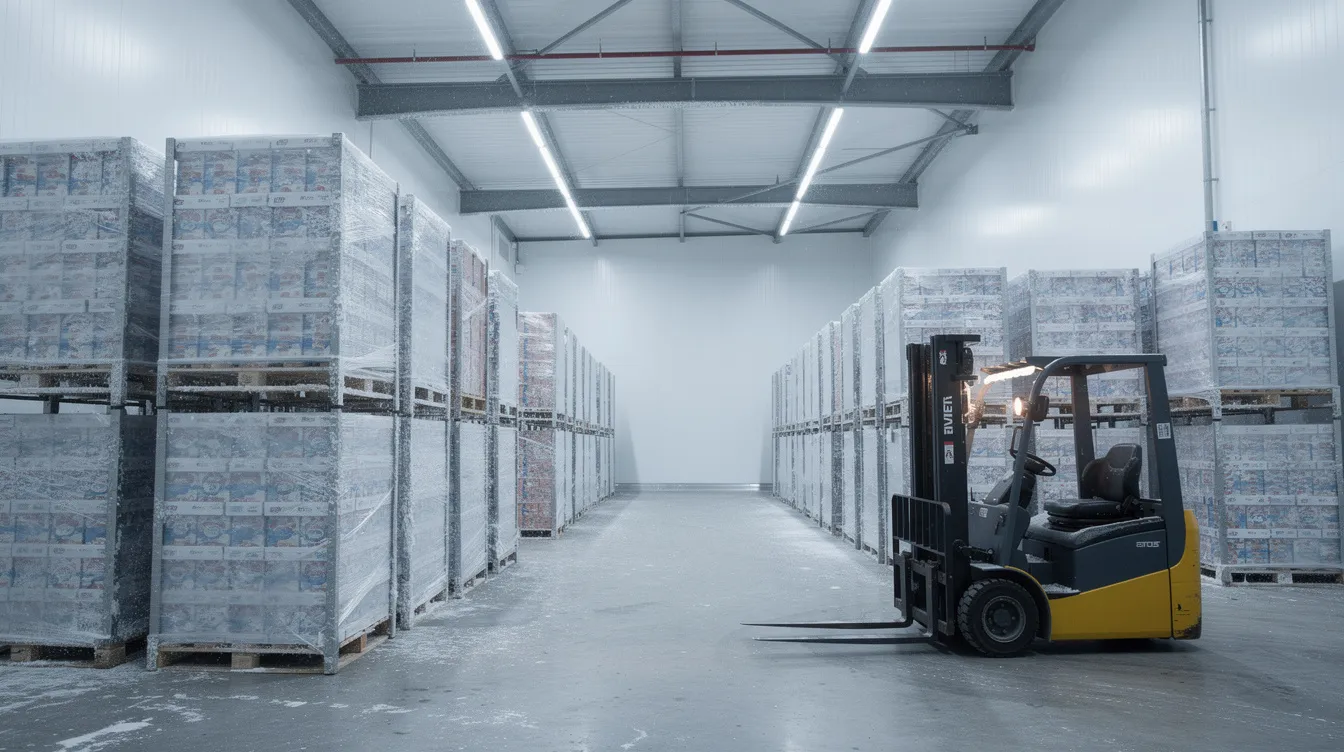
Frozen storage begins once the product is fully hardened. Finished stock holding rooms must stay at −20°C to −23°C to prevent large ice crystal growth. The focus shifts from rapid heat removal to temperature stability, energy efficiency and stock rotation. Temperature fluctuations must be minimised to prevent ice recrystallisation in ice cream, which causes grittiness and consumer complaints.
| Parameter | Initial Freezing | Hardening | Frozen Storage |
|---|---|---|---|
| Purpose | Partial freeze, overrun | Rapid core freeze | Long-term preservation |
| Equipment | Continuous/batch freezer | Hardening tunnel, blast freezer, batch room | Insulated cold room |
| Temperature range | −4°C to −7°C (discharge) | Air at −30°C to −40°C | −20°C to −25°C |
| Product residence time | Seconds to minutes | 20 minutes to several hours | Days to weeks |
| Air circulation | Internal to machine | High velocity (4–5 m/s) | Low, uniform |
| Energy intensity | Moderate | Very high | Moderate (steady state) |
| Capacity-planning basis | L/h mix throughput | Hourly packs × retention time | Total inventory × storage days |
Ice Cream Hardening Tunnel Requirements and Design Basics
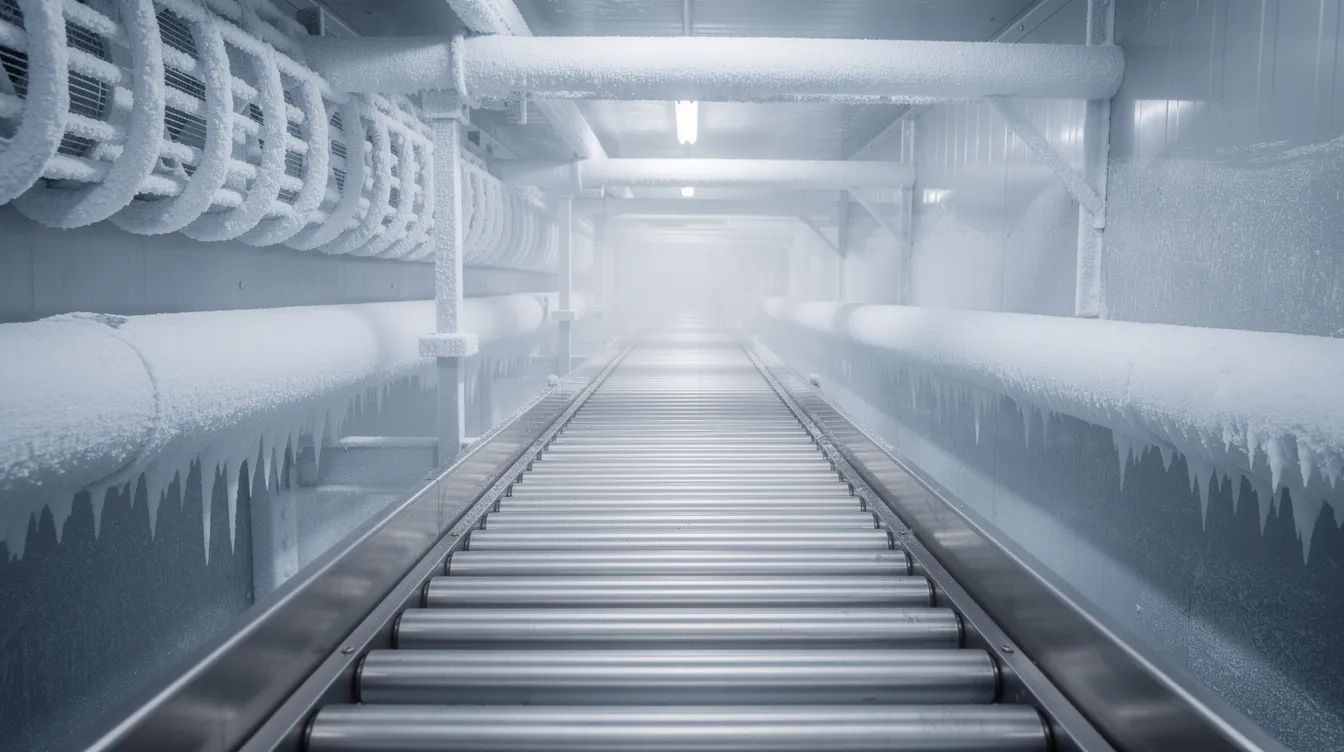
An industrial ice cream hardening tunnel is a continuously operating, insulated enclosure through which filled products move on a conveyor for rapid hardening. Ice cream hardening tunnels rapidly freeze ice cream after mixing and filling, converting the semi-frozen output of the filling line into a fully hardened, distribution-ready product.
Key components of a well-designed hardening tunnel include:
- PUF-insulated housing with stainless-steel (SS) interior surfaces for hygiene and durability
- Conveyor system (belt or tray type) with variable speed control to match line output
- Evaporator coils sized for the extremely low suction temperatures needed at −35°C to −40°C
- High-velocity fans that circulate cold air uniformly across all product surfaces-cooling fans in hardening tunnels enhance the freezing process, and efficient cooling is achieved through unique fan placement that maximises convective heat transfer
- Temperature-monitoring system with sensors at multiple points along the tunnel length
- Defrosting arrangements (electric or hot-gas defrost) to maintain coil efficiency
- Hygienic floor and drain design compliant with food-safety requirements
The product loading pattern (cones, cups, tubs, bulk packs, stick products) and the target retention time determine the required tunnel length and conveyor speed. For example, a 500 kg SS ice cream hardening tunnel is available in India, suitable for moderate-scale operations. Hardening room temperature must be maintained at −25°C to −30°C immediately after extrusion for batch-type systems.
Industrial ice cream hardening tunnel requirements must be aligned with the hourly output of the filling, extrusion or moulding line. If the tunnel cannot absorb the production rate, it becomes a bottleneck. If oversized, the specific energy consumption per litre rises, damaging unit economics.
Batch Hardening Room vs Continuous Hardening Tunnel and Blast Freezer Options
Indian ice cream plants use different types of hardening systems depending on scale, automation level, product mix and capital budget. The main options are batch hardening rooms, blast freezers, spiral hardening tunnels and straight-line continuous tunnels.
A batch hardening room involves loading racks or baskets of packed products into an insulated room with forced-air cooling. It requires more manual handling and longer cycle times but offers flexibility for multiple SKUs and seasonal operation. Capital cost is lower, making it suitable for plants in cities like Ahmedabad or smaller centres in Gujarat where moderate-capacity, multiproduct operations are common.
A blast freezer provides rapid cooling using very high air velocities in a compact chamber. It can serve as a bridge between filling and storage but is generally limited in throughput.
A spiral hardening tunnel uses a compact spiral conveyor to maximise retention time within a small footprint-well-suited for high-throughput plants with limited floor space.
A straight-line continuous hardening tunnel is designed for the highest automation levels, offering consistent freezing uniformity and production continuity, but demands significant capital investment and floor space.
| Parameter | Batch Room | Blast Freezer | Spiral Tunnel | Straight-Line Tunnel |
|---|---|---|---|---|
| Typical scale | Small to medium | Small to medium | Medium to large | Large |
| Capital cost level | Lower | Moderate | Higher | Highest |
| Automation level | Low | Low to moderate | High | High |
| Freezing uniformity | Variable | Good | Very good | Excellent |
| Energy consumption | Higher per unit | Moderate | Moderate | Lower per unit (at scale) |
| Multi-SKU flexibility | High | Moderate | Moderate | Lower |
| Expansion potential | Moderate | Limited | Moderate | Requires new line |
Final selection must involve process engineers and refrigeration consultants. The financial model in the DPR should evaluate both investment and operating cost per litre for each option, regardless of origin or brand of equipment.
Hardening Tunnel Capacity Planning and Illustrative Calculation
Hardening tunnel capacity should always be based on peak hourly production, not only on average daily output. Many planning mistakes in Indian ice cream projects originate from sizing the tunnel for average litres per day and then discovering that the hourly peak overwhelms the system during summer months.
Key planning inputs include:
- Hourly line output (L/h or kg/h)
- Mix overrun percentage
- Pack sizes, shapes and layout density on the conveyor
- Inlet product temperature (typically −5°C to −7°C from the freezer)
- Required discharge core temperature (typically −18°C to −20°C or lower)
- Target retention time per pack type (20 minutes for small novelties to 60–90 minutes for large tubs)
- Operating hours per day, including allowance for changeovers, cleaning and defrost cycles
- Seasonal peak factor and margin for future expansion
Illustrative example (not a design or quotation): Consider a plant with a filling line producing 3,000 L/h, primarily in 500 mL cups. If the average retention time is 60 minutes, the tunnel must hold at least 3,000 litres of product at any given time-equivalent to 6,000 cups of 500 mL each, arranged on trays across the conveyor. Adding a 20% margin for peak days and changeover losses, the effective tunnel capacity needed would be approximately 3,600 litres. The associated refrigeration tonnage would depend on the product pull-down load, insulation losses, fan-motor heat and defrost requirements-all of which must be calculated by a qualified refrigeration engineer.
Wrong assumptions here directly affect ice cream hardening tunnel cost in India, specific energy consumption and financial feasibility ratios like DSCR. These calculations must be validated with qualified technical experts before being incorporated into the DPR.
Cold Storage Capacity Planning for Finished Goods and Inventory Strategy
Cold storage for an ice cream manufacturing plant must be sized based on the finished-goods inventory strategy-not on a simple multiple of daily production alone. The seasonal nature of ice cream demand in India means that many plants build substantial stock ahead of the April–July peak, requiring cold rooms that can hold several weeks of production at once.
Main planning parameters include:
- Daily production during peak months (litres or kg)
- Number of production days per month
- Average and maximum inventory-holding days (often 15–30 days in peak season)
- Product density and packaging volume per unit
- Palletisation pattern and rack configuration
- Aisle space for forklift movement
- Air-circulation clearance (minimum 100–150 mm from walls and between stacks)
- Dispatch frequency and distribution logistics
Practical formula (indicative):
Required storage volume (m³) = (Peak daily production × Storage days × Volume per unit) ÷ (Capacity utilisation factor)
Where the capacity utilisation factor (typically 0.55 to 0.65) accounts for aisles, air gaps, structural columns and loading/unloading space. This must then be converted to room dimensions, pallet positions and rack levels.
Industrial ice cream cold storage capacity planning directly influences working capital, electricity bills and risk of stock-outs or forced discounts at season-end. Misunderstanding capacity can lead to either over-investment (idle space, higher capital cost and depreciation) or under-capacity (outsourced storage, product loss), both of which affect project IRR and payback period.
Cold Storage and Temperature Zones Required Within the Ice Cream Plant
An industrial ice cream factory typically needs multiple temperature zones, each optimised for a particular function while maintaining an unbroken cold chain for all products.
Raw-material chilling room (2–4°C): Stores milk, cream, butter and fruit preparations. This room must be separate from frozen finished goods, with its own refrigeration circuit and controlled access. Typical holding duration ranges from a few hours to one or two days depending on procurement cycles.
Ageing tanks and chilled process area (2–4°C): The ice cream mix is held at this temperature for 4–24 hours for fat crystallisation and flavour development. A controlled, clean environment is needed to avoid bacterial growth, which directly impacts overrun and texture in the final product.
Hardening area (air at −30°C to −40°C): This zone requires extremely low air temperatures, high air velocity, segregation from other rooms and specialised floor design. Minimising warm-air ingress during loading and unloading of ice cream and frozen desserts is critical-even brief exposure to ambient air during Indian summers (when outside temperatures can reach 45–48°C) can cause surface melting and refreezing.
Finished-goods frozen store (−20°C to −25°C): The main inventory-holding area. Must be designed for systematic stacking, FIFO movement and uniform temperature distribution. Implementing a First-In, First-Out inventory system is essential for ice cream to prevent older stock from developing quality defects.
Dispatch ante-room (−15°C to −18°C): Acts as a thermal buffer between the frozen store and the loading dock, reducing heat and moisture ingress during vehicle loading.
Controlled-temperature storage for ingredients: Chocolate coatings, inclusions, flavours and certain packaging materials sensitive to temperature or humidity may require separate storage at controlled conditions (typically 15–20°C with low humidity).
Ice Cream Cold Room and Hardening Area Design Requirements
Structural cold-room design directly impacts refrigeration load and long-term electricity cost. Every millimetre of insulation thickness and every gap in a door seal translates into kilowatt-hours of wasted energy over the project’s life.
Cold storage construction must feature proper insulation and vapor barriers to prevent heat gain. High-density polyurethane insulated panels with vapor barriers are necessary for ice cream storage. Typical frozen-zone insulation thickness is 120–150 mm for PUF or PIR panels, with proper vapour barriers on the warm side to prevent moisture migration and ice build-up within the panel.
Key design elements include:
- Floor insulation and heating: Frozen-room floors require insulation and, in many cases, under-floor heating elements to prevent frost heave
- Doors: Insulated sliding or hinged doors with proper gaskets, strip curtains or air curtains, and heated door frames to prevent frost formation
- Racking and pallet layout: Designed for forklift access, airflow and FIFO stock rotation
- Drainage: Slopes and drains for defrost water and cleaning
- Lighting: LED fixtures rated for sub-zero operation
- Emergency release: Internal door-release mechanisms and alarm buttons for personnel safety
- Temperature sensors and data logging: Multiple measurement points with automated recording
Proper airflow prevents localised warming and texture degradation in ice cream cold storage. Uniform airflow is vital in ice cream storage to ensure temperature distribution across all pallet positions. Many designs target approximately 85% to 90% relative humidity in cold storage for ice cream, and relative humidity should be kept between 85% and 90% to prevent surface desiccation (freezer burn) while avoiding excessive frost formation on coils.
Regular cleaning and sanitation schedules are necessary in cold storage areas to prevent contamination, mould growth on doors and frames, and build-up of debris near drains. Poor insulation, thermal bridges and frequent door openings drastically increase refrigeration load-precisely when demand peaks during Indian summer months.
Refrigeration Load Calculation and Refrigeration Tonnage
Refrigeration load (cooling-load calculation) is the technical foundation for sizing compressors, condensers and evaporators. It must be prepared by qualified refrigeration engineers using recognised methods such as those published by ASHRAE.
| Load Component | Description | Design / Cost Implication |
|---|---|---|
| Transmission load | Heat through walls, roof, floor | Higher with poor insulation-requires more TR |
| Product load | Heat removed from warm incoming products | Largest single load in hardening tunnels |
| Air infiltration | Warm air entering through doors | Needs ante-rooms, strip curtains |
| Packaging load | Heat in packaging material | Often underestimated for carton/corrugated |
| Occupancy / lighting | People, LED lights, forklifts | Modest but cumulative |
| Fan-motor load | Heat from evaporator fans | Significant in large rooms |
| Defrost load | Energy for coil defrosting | Affects net cooling capacity |
| Pull-down load | Initial cooling of empty room | Relevant after cleaning or power outage |
| Safety factor | Margin for peaks and degradation | Typically 10–15% added |
| Ambient impact | Higher external temperatures in summer | Increases condenser duty and total TR needed |
Understanding the difference between refrigeration tonnage (TR-approximately 3.517 kW of heat removal), electrical connected load (kW) and actual energy consumption (kWh per day) is critical for entrepreneurs and bankers interpreting equipment quotations. A compressor rated at 50 TR does not consume 175 kW continuously; actual consumption depends on loading, ambient conditions and part-load efficiency. Accurate refrigeration load calculation is essential for realistic estimation of the power requirement for the ice cream plant refrigeration system and for preparing credible financial projections.
Selection of Refrigeration System for an Industrial Ice Cream Factory
The best refrigeration system for an industrial ice cream factory depends on plant capacity, number of cold rooms, temperature levels required, operating hours, local climate and availability of skilled technical manpower.
Centralised vs decentralised: Centralised systems (common machine room serving multiple zones) offer economies of scale but require complex piping. Decentralised systems (individual units per zone) are simpler to install and maintain but may cost more in aggregate.
Single-stage vs two-stage compression: For the very low suction temperatures needed in hardening tunnels (−35°C to −40°C), two-stage compression is usually more efficient and reliable than single-stage, though it requires more equipment and higher capital investment.
Compressor type: Screw compressors are generally preferred for larger capacities due to their efficiency at partial loads, while reciprocating compressors may suit smaller installations.
Condenser type: Air-cooled condensers are simpler but less efficient in hot Indian climates. Water-cooled condensers with cooling towers offer better performance but require water supply, treatment and blow-down management.
Direct expansion vs secondary refrigerant: A glycol refrigeration system or brine circuit adds a secondary loop, reducing the refrigerant charge in occupied spaces and improving safety-particularly relevant for ammonia systems.
Automation: PLC-based controls, variable-frequency drives for fans and compressors, compressor sequencing, floating head-pressure control and remote monitoring improve energy efficiency and reliability but increase initial investment. These choices should be evaluated on lifecycle cost per litre of ice cream produced.
Ammonia vs Freon-Based Refrigeration for Ice Cream Plants
Refrigerant choice must comply with Indian safety, environmental and building regulations. Neither ammonia nor Freon-based systems are universally suitable-the decision depends on plant scale, location, technical capability and financial parameters.
| Parameter | Ammonia (R717) | Freon-Based (HFC/HFO) |
|---|---|---|
| Cooling efficiency | Excellent at high capacities | Good; slightly lower COP at very low temperatures |
| Suitability | Large industrial plants (50+ TR) | Small to medium; modular installations |
| Initial investment | Higher (safety systems, piping, machine room) | Moderate |
| Operating cost | Lower per kWh of cooling | Higher refrigerant cost, moderate energy cost |
| Safety requirements | Stringent-gas detection, ventilation, trained operators, emergency systems | Lower; non-toxic but some are mildly flammable |
| Environmental impact | Zero ODP, zero GWP | Varies; some HFCs have high GWP; HFOs are lower |
| Maintenance | Requires specialised technicians | More widely available service network |
| Regulatory trend | Favoured for large-scale; safety compliance needed | Phase-down of high-GWP HFCs under Kigali Amendment |
Promoters should evaluate both technical and financial aspects with refrigeration consultants and reflect refrigerant choice clearly in the DPR and bank-finance proposal.
Major Refrigeration Equipment and Cost Drivers
The principal categories of equipment in an industrial ice cream plant refrigeration system include:
| Equipment | Primary Function | Key Selection Basis | Major Cost Drivers |
|---|---|---|---|
| Compressors | Compression of refrigerant vapour | TR capacity, suction temperature, refrigerant | Brand, capacity, single vs two-stage |
| Evaporators | Heat absorption from product/room | Temperature, surface area, defrost type | Material (SS vs aluminium), fin spacing |
| Condensers | Heat rejection to ambient | Ambient temperature, water availability | Air-cooled vs water-cooled, size |
| Cooling towers | Water cooling for condensers | Water quality, ambient wet-bulb | Capacity, material, water treatment |
| Receivers & accumulators | Refrigerant storage and surge | System charge volume | Capacity, pressure rating |
| Expansion valves | Refrigerant flow control | Capacity, automation level | Electronic vs thermostatic |
| Control panels & PLC | Automation, monitoring, safety | Complexity, number of zones | Automation level, brand |
| Piping & insulation | Refrigerant and secondary fluid transport | Pipe size, insulation thickness | Material, length of runs, insulation quality |
| Gas detection & alarms | Safety (especially ammonia) | Regulatory requirement | Number of sensors, integration |
For a comprehensive understanding of how compressors, freezers and hardening tunnels fit into the overall machinery budget, see the guide on automatic ice cream plant machinery and equipment cost. While refrigeration plant is a large part of machinery cost, civil works, PUF panel enclosures, electrical installation and automation also contribute significantly to total investment.
Power and Utility Requirements for Ice Cream Plant Refrigeration
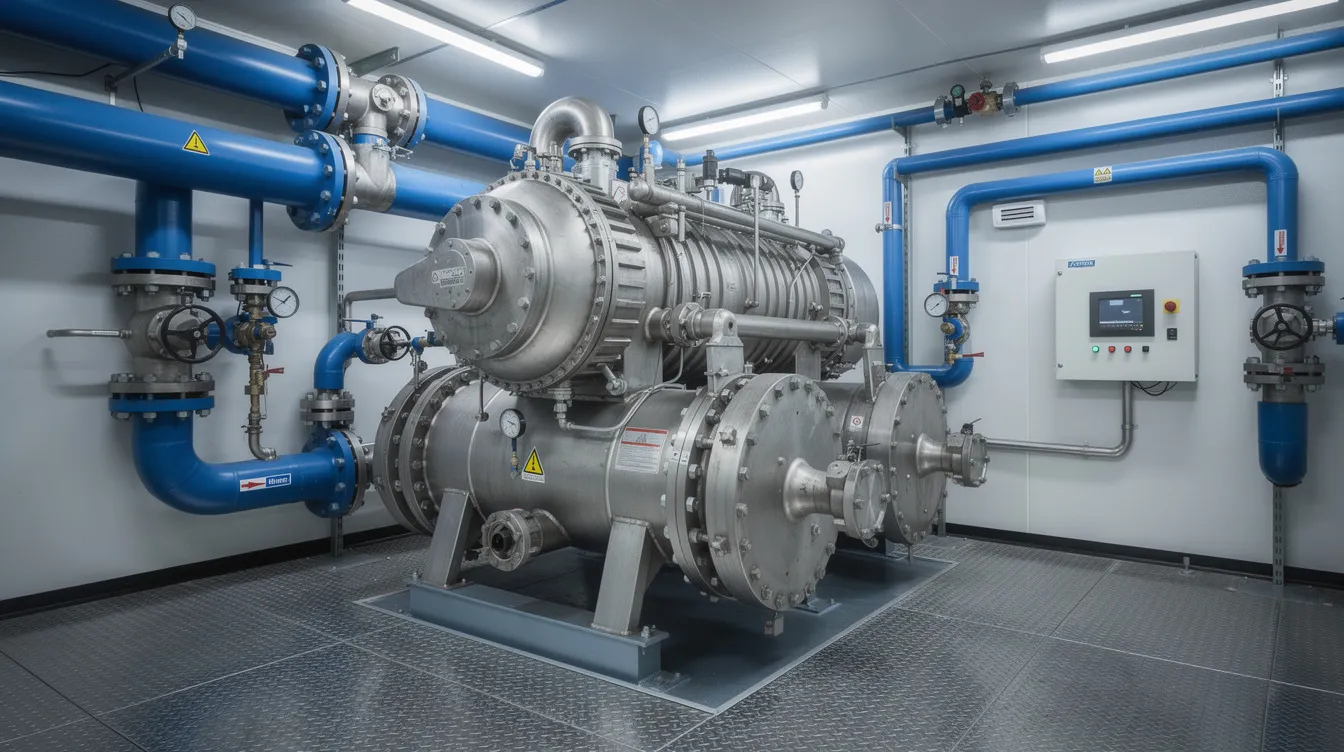
Refrigeration is typically the single largest consumer of electricity in an industrial ice cream plant, particularly during summer peak production in India. In one Indian dairy-industry study, storage and hardening accounted for over 53% of total processing cost, excluding raw materials.
Key utility aspects include:
- Connected electrical load: Compressors, evaporator fans, conveyor drives and control systems may together require several hundred kW for a medium-scale plant
- Maximum demand and transformer sizing: Must account for simultaneous operation of hardening tunnels and frozen stores during peak hours
- Backup power: Diesel generator sets or alternative sources are essential; a power outage during peak inventory can cause catastrophic losses
- Power-factor correction: Capacitor banks to avoid penalty charges from the utility
- Water requirements: Water-cooled condensers and cooling towers need reliable raw-water supply, treatment and blow-down management
- Compressor-room ventilation: Mandatory for ammonia systems, with forced ventilation and gas-detection sensors
Financial implications are significant. Industrial electricity tariffs in India vary by state, and demand charges apply regardless of actual consumption. Seasonal production patterns mean that capacity utilisation may drop below 50% in winter months, increasing specific energy cost per litre of ice cream or frozen desserts. Time-of-day tariffs, where available, can be leveraged by scheduling energy-intensive hardening operations during off-peak hours.
Energy-Efficiency Measures and Lifecycle Cost Optimisation
Energy-efficient refrigeration for an ice cream plant is not a luxury-it directly lowers cost per litre, improves margins and strengthens DSCR for lenders. A case study by Danfoss at a cold-storage facility in Sonipat demonstrated expected energy savings of 15–25% through modern controls such as VFDs and electronic expansion valves.
Modern hardening tunnels consume up to 20% less energy compared to older designs, thanks to improved insulation, optimised airflow and variable-speed fan drives.
Design measures:
- Correct sizing of compressors and evaporators-avoid oversizing, which causes short-cycling and inefficiency
- Well-insulated PUF panel cold rooms for ice cream storage with minimum 120–150 mm panel thickness
- Optimised airflow in hardening tunnels with zoned velocity control
Operational measures:
- Compressor sequencing and floating head-pressure controls to match varying loads
- Optimised defrost scheduling to minimise unnecessary energy use and frost re-formation
- Strict door-management practices: rapid-acting doors, strip curtains and training for operators
- Maintaining correct product loading density in hardening tunnels to avoid airflow short-circuiting
Monitoring and maintenance:
- Energy meters for major consumers (compressors, fans, pumps)
- Regular coil cleaning and refrigerant-leak detection
- Preventive maintenance schedules for compressors, valves and controls
Investment in energy efficiency must be evaluated on a lifecycle-cost basis in the DPR, comparing extra capital cost with savings over 8–10 years of plant operation. This analysis often reveals that the marginally more expensive system delivers significantly better IRR.
Refrigeration Backup, Risk Management and Insurance
A refrigeration failure during peak season, when finished-goods cold rooms are fully loaded with high-value ice cream inventory, can cause losses running into lakhs of rupees within hours. One major Indian ice cream brand reportedly reduced product destruction worth ₹14 crore by eliminating temperature excursions through pre-season planning, digital loggers and backup reefer arrangements.
Backup strategies needed include:
- Standby compressor capacity (typically one backup compressor for every two or three operating units)
- Redundant refrigeration circuits for critical rooms (hardening tunnel and main frozen store)
- Backup power (DG sets sized for at least refrigeration-critical loads)
- Availability of critical spare parts (expansion valves, contactors, sensors)
- Annual maintenance contracts with equipment suppliers or specialist refrigeration contractors
Risk-transfer mechanisms:
- Machinery-breakdown insurance
- Cold-storage deterioration-of-stock policies (covering spoilage due to equipment failure)
- Comprehensive fire and allied-risk coverage
These should be factored into operating cost estimates and discussed with lenders during project appraisal. Well-planned backup reduces potential write-offs, protects cash flows and maintains confidence of banks, investors and distribution partners.
Automation, Monitoring and Traceability in Cold Storage and Hardening
Modern industrial ice cream plants supplying organised retail, QSR chains and export markets are increasingly expected to demonstrate automated temperature monitoring and batch traceability.
Continuous automated data loggers must be installed for temperature monitoring across all cold zones-from hardening tunnels to dispatch ante-rooms. Automated alarms are critical to notify deviations in temperature for ice cream storage, enabling rapid corrective action before product quality is compromised.
Key automation features include:
- PLC-based refrigeration controls and SCADA systems for centralised monitoring and control
- Digital temperature recording with time-stamped logs for each cold room and hardening tunnel zone
- Automated alarm escalation via SMS and email to plant managers and maintenance teams
- Batch traceability linking production batches to specific hardening and storage conditions
- Energy-consumption tracking across hardening tunnels and cold rooms to identify inefficiencies
- Predictive maintenance tools that monitor compressor performance parameters and flag anomalies before breakdowns occur
These systems support management decisions, quality audits and customer requirements. The investment in automation also provides stronger justification in the DPR for premium pricing in B2B and modern-trade segments, where temperature compliance documentation is a contractual requirement.
Capital Cost of Cold Storage, Refrigeration and Hardening Tunnel Systems
This section discusses major cost heads without quoting specific prices, since ice cream plant refrigeration equipment cost varies significantly with capacity, technology, location and vendor. The country of origin, level of automation and brand positioning of equipment all influence the final cost.
Principal capital cost components:
- Civil and insulated structures (PUF panel rooms, foundations, flooring)
- PUF panels and cold-room doors (including ante-room doors and strip curtains)
- Refrigeration compressors, evaporators and condensers
- Hardening tunnel including conveyor and automation
- Refrigerant piping, valves and insulation
- Cooling tower and water circuits
- Electrical works (panels, cabling, transformer, DG set)
- Control systems, PLC, SCADA and instrumentation
- Installation, testing and commissioning
- Freight, taxes and duties
- Design and consulting fees
- Contingency (typically 5–10% of equipment cost)
- Pre-operative expenses (trial runs, training, interest during construction)
In a reference DPR for a 10,000–15,000 LPD ice cream plant, refrigeration and cold-chain infrastructure cost was approximately ₹2.85 crore, which included frozen storage at −25°C, deep freezers and associated plant. The 30 mould hardening tunnel costs approximately ₹6,80,000 for smaller-scale operations, while continuous tunnel systems for high-capacity plants cost substantially more.
| Cost Head | Key Drivers |
|---|---|
| Hardening tunnel | Capacity (L/h), automation, conveyor type |
| Frozen storage rooms | Volume, temperature, insulation thickness |
| Refrigeration compressors | TR, refrigerant, single/two-stage, brand |
| Condensers & cooling tower | Ambient temperature, water availability |
| Electrical & backup power | Connected load, DG capacity |
| Automation & controls | PLC complexity, number of zones, remote monitoring |
| Installation & commissioning | Piping length, structural complexity, location |
For a comprehensive view of how cold storage and refrigeration form a major part of total project investment, see the detailed breakdown of industrial ice cream plant setup cost in India.
Operating Cost of the Ice Cream Plant Refrigeration System
Operating costs of the industrial refrigeration system directly influence unit production cost and profitability. In a power-intensive sector like ice cream, refrigeration operating cost can be the single largest variable expense after raw materials.
Main operating cost elements:
- Electricity: Demand charges plus energy charges, often the dominant cost head
- Water and water treatment: For cooling towers and condensers
- Refrigerant top-ups: Ammonia or Freon replacement due to minor leaks
- Compressor oil and consumables
- Routine maintenance and spare parts
- Skilled manpower: Refrigeration operators and maintenance technicians
- Defrosting energy
- Backup-power fuel (diesel)
- Insurance premiums (machinery breakdown and stock deterioration)
- Periodic overhauls or component replacements
Energy consumption of ice cream hardening tunnels and frozen stores changes with capacity utilisation, ambient temperature and operating discipline (door openings, loading pattern, maintenance). The DPR should estimate refrigeration operating cost per litre for different utilisation scenarios-for example, first year at 50–60% capacity versus stabilised years at 80–85%.
Better cold-chain efficiency and lower specific energy consumption provide a strong competitive advantage in the Indian market. Temperature stability is more critical than absolute temperature in ice cream storage, and maintaining stable conditions without frequent cycling reduces both energy bills and product losses.
Impact on Project Cost, Means of Finance and Bankability
Cold storage, refrigeration and hardening assets substantially influence overall project cost, loan size and funding structure. These assets are classified under several project-cost heads:
- Plant and machinery: Compressors, evaporators, condensers, hardening tunnel, conveyor systems
- Building and insulation: PUF panel rooms, civil works for cold stores and machine rooms
- Electrical installation: Transformer, panels, cabling, DG sets
- Utilities: Cooling tower, water treatment, piping
- Contingency and pre-operative expenses: Trial runs, training, interest during construction
The means of finance typically includes promoter’s contribution (25–35% of project cost), term loan and separate working-capital facilities to fund inventory and receivables associated with a frozen product business. Realistic estimation of ice cream cold storage project cost in India, including related utilities, improves the quality of discussions with lenders and avoids cost overruns during implementation.
Projections and CMA data should honestly reflect the additional investment and operating cost of a robust refrigeration system rather than assuming minimal figures that are not achievable in practice. Under-stating electricity costs or maintenance provisions in the DPR may help secure a lower loan requirement initially, but creates serious repayment stress once the plant is operational.
Impact on Working Capital, Seasonality and Inventory Management
The seasonal nature of ice cream demand in India means that many plants build substantial stock during February–April for the peak selling season of May–July. This pre-season stock build-up, held in industrial ice cream cold storage, directly increases working-capital requirements.
Longer inventory-holding periods in frozen storage increase not just the funds locked in raw materials and conversion cost, but also electricity consumption and insurance premiums. These must be factored into bank working-capital limits and cash-credit utilisation plans.
Cold-storage capacity, production planning, dispatch frequency and credit terms to distributors jointly determine inventory levels, receivables and the overall working-capital cycle. Misalignment between cold-storage capacity and the sales plan can cause either underutilised freezers (wasted electricity and capital) or forced liquidation of stock at lower margins (damaging profitability and interest coverage).
Promoters should model multiple scenarios in the DPR-for example, different storage days, distribution reach in Gujarat versus national markets, or varying credit terms-to test the impact on working capital, interest cost and liquidity.
Impact on Profitability, Break-Even and Financial Feasibility
Design of the ice cream plant refrigeration system influences cost per litre, product losses, energy bills and therefore EBITDA, break-even point and DSCR. A study of Indian ice cream plants found that storage and hardening costs can exceed 50% of total processing costs-making refrigeration decisions among the most consequential for project profitability.
Inadequate or unreliable refrigeration leads to higher rejection rates, loss of finished goods, emergency logistics costs and brand damage. These risks may not be fully visible in basic financial models but are very real in practice.
While lower initial-cost systems may seem attractive, a lifecycle view is essential. Slightly higher investment in efficient compressors, better insulation and automation can reduce operating costs and improve IRR over the project life. Lenders and investors increasingly look for realistic assumptions on energy consumption, maintenance and replacement reserves in ice cream plant DPRs.
Promoters should compare options on net present value of total cost of ownership rather than only on first-cost of refrigeration equipment.
Information Required for a Bankable DPR on Ice Cream Cold Storage and Refrigeration
A credible DPR requires technical and commercial assumptions that are consistent across machinery quotations, production plan and financial projections. Inconsistency between what the equipment supplier has quoted and what the DPR assumes is one of the most common reasons for lender queries and appraisal delays.
| Category | Data Points Required |
|---|---|
| Production | Installed capacity (L/day), hourly output, product mix, pack sizes |
| Hardening | Tunnel/room capacity, retention time, inlet and outlet temperatures |
| Storage | Finished-goods storage days, cold-room volume, pallet positions |
| Refrigeration | Tonnage (TR), compressor configuration, refrigerant type |
| Power | Connected load (kW), maximum demand, electricity tariff, DG capacity |
| Water | Requirement for condensers, cooling towers, treatment |
| Operating | Annual energy consumption, maintenance cost, staffing, refrigerant losses |
| Financial | Capital cost, means of finance, seasonality, capacity-utilisation ramp-up |
| Expansion | Future plans, modular capability, standby arrangements |
This information should be backed by technical offers from suppliers and, where possible, independent refrigeration-load calculations, so that banks can rely on the DPR for sanctioning term loans and working-capital limits.
CA Manish Gugliya can help integrate these technical inputs into a coherent financial model, but final refrigeration design must be validated by qualified engineers and equipment manufacturers.
Common Planning Mistakes in Ice Cream Plant Cold Storage and Refrigeration
Many industrial ice cream projects in India face delays, cost overruns or quality issues due to avoidable planning mistakes in cold storage and hardening systems.
| Common Mistake | Likely Financial Consequence |
|---|---|
| Sizing cold rooms on nominal volume without pallet/aisle allowance | 20–30% less usable capacity than planned; need for additional room |
| Ignoring peak hourly production when sizing hardening tunnel | Production bottleneck; forced inventory at higher temperature |
| Mismatch between filling-line and hardening capacity | Line stoppages; labour idle time; higher unit cost |
| Underestimating door-opening and infiltration loads | Higher energy bills; compressor unable to maintain temperature |
| No standby compressor or backup power | Catastrophic stock loss during breakdown |
| Ignoring installation, piping and commissioning costs | 15–25% cost overrun versus budget |
| Copying supplier quotations without checking scope exclusions | Missing items discovered during commissioning |
| Inconsistency between technical data and DPR financial projections | Lender queries; delayed sanction; loss of credibility |
Early-stage engagement with both refrigeration consultants and financial advisors significantly reduces these risks.
Practical Planning Sequence for Project Promoters
For entrepreneurs, dairy companies and investors planning medium-to-large ice cream plants, the following sequence is recommended:
- Finalise product mix and packaging formats – cones, cups, tubs, sticks, bulk packs and frozen desserts each have different hardening requirements
- Determine hourly and daily production targets – based on market demand, not just equipment capacity
- Estimate hardening throughput – matched to peak hourly filling-line output with seasonal margin
- Define inventory-holding policy and distribution reach – how many days of stock, which markets, which dispatch frequency
- Calculate cold-storage capacity – using the practical formula with utilisation factors
- Obtain professional refrigeration-load calculation – from a qualified consultant, not estimated internally
- Select refrigerant and configuration – centralised ammonia or Freon-based modular system, with safety and environmental compliance
- Obtain comparable vendor quotations – at least two or three, with clear scope of supply
- Evaluate energy consumption and backup requirements – including DG sizing and fuel cost
- Integrate all technical data into the DPR and financial model – ensuring consistency across machinery, production, costs and projections
Revising refrigeration design late in the project typically leads to cost overruns or compromises in quality. These steps should be completed before civil and architectural finalisation. Promoters should revisit assumptions periodically as they receive detailed technical inputs or change their market strategy.
Role of a Detailed Project Report (DPR) in Cold Storage and Refrigeration Decisions
A professionally prepared DPR links technical choices on cold storage, hardening tunnels and refrigeration systems with financial outcomes. It does not treat refrigeration as an isolated engineering decision but connects it to everything else in the project.
The DPR should consistently connect production capacity, machinery selection, hardening and frozen-storage design, refrigeration tonnage, project cost, means of finance, electricity expenses, working capital and profitability indicators like IRR and DSCR.
Risk and sensitivity analysis-for example, testing the impact of higher-than-expected electricity tariffs or delayed capacity ramp-up-helps promoters and lenders understand project robustness under different scenarios. A good DPR supports decision-making (go/no-go, scale, technology choice) as well as bank appraisal, equity-investment discussions and internal management planning.
While technical design comes from engineers and suppliers, the DPR adds financial structure, projections and analysis prepared or reviewed by an experienced Chartered Accountant.
How CA Manish Gugliya and Project Report Bank Can Assist
CA Manish Gugliya, FCA and DISA (ICAI), is a practising Chartered Accountant with over two decades of experience in project reports, DPRs, CMA data and financial-feasibility studies for manufacturing projects, including industrial ice cream plants across India.
Key advisory services include:
- Preparation of industrial ice cream plant DPRs for bank finance and investor-ready project reports
- CMA data preparation and assistance for term-loan and working-capital proposals
- Project cost and means-of-finance structuring aligned with realistic refrigeration and cold-storage investment
- Working-capital assessment factoring in seasonal inventory build-up and cold-storage holding periods
- Break-even, DSCR, ROI, IRR and payback analysis
- Sensitivity analysis for energy costs, capacity utilisation and market scenarios
- Investor pitch decks and business-valuation advisory
Refrigeration load calculation, ice cream plant refrigeration system design and machinery specifications should be provided or confirmed by qualified technical consultants and equipment vendors. CA Manish Gugliya helps harmonise these technical assumptions with realistic financial projections, ensuring that banks receive a coherent, well-documented proposal.
Serious promoters of medium and large industrial ice cream plants may contact through www.projectreportbank.com for customised assistance.
Conclusion: Integrating Cold Storage, Refrigeration and Hardening into a Bankable Ice Cream Project
Cold storage, industrial refrigeration and hardening tunnels are core process assets that determine product quality, energy cost and profitability in an ice cream manufacturing plant. They are not items to be specified as an afterthought or squeezed into remaining budget after other machinery has been purchased.
Ice cream plant cold storage and refrigeration requirements must align with the product mix, plant capacity, inventory policy and dispatch schedule. Whether the plant is based in Ahmedabad, Gujarat, or anywhere else in India, correct sizing and configuration of the hardening tunnel, frozen storage rooms and refrigeration plant protect product quality, reduce electricity consumption, minimise production bottlenecks and support better financial ratios for lenders and investors.
The lowest initial-cost solution is rarely the lowest lifecycle-cost solution. Combining expert technical design with a robust DPR and financial feasibility study is the most reliable path to a bankable, sustainable industrial ice cream project.
For a tailored DPR, bank-finance report or financial-feasibility analysis for your proposed ice cream plant, contact CA Manish Gugliya through www.projectreportbank.com.
FAQs on Ice Cream Plant Cold Storage and Refrigeration Requirements
What temperature is ideal for ice cream cold storage in an industrial plant?
Most industrial ice cream cold rooms operate at a frozen storage temperature of −20°C to −25°C, with exact setpoints depending on formulation, pack size and supplier recommendations. Temperature stability is more critical than pursuing extremely low temperatures-frequent fluctuation or partial thawing and refreezing causes more damage than storing at the upper end of the acceptable range.
What is the purpose of a hardening tunnel in ice cream production?
A hardening tunnel rapidly removes heat from freshly filled products using very cold, high-velocity air (typically −30°C to −40°C), bringing the core temperature down quickly to minimise large ice-crystal formation and protect texture. This step converts semi-frozen ice cream into a structurally stable frozen product suitable for stacking, transport and long-term storage.
How is hardening tunnel capacity broadly estimated for a new plant?
Capacity planning starts from peak hourly output (kg/h or L/h), product types and pack sizes, expected inlet and outlet temperatures and desired retention time, then adds a margin for seasonal peaks and future expansion. Final sizing and refrigeration load must be calculated by qualified refrigeration engineers-any numerical example should be treated as an illustration, not a design or quotation.
Which refrigeration system is generally preferred for large ice cream factories in India?
Many large plants use centralised ammonia refrigeration because of its efficiency at high capacities, but modern Freon-based or glycol systems may be appropriate for smaller or modular factories. Refrigerant selection must account for safety, environmental rules, available technical manpower and total lifecycle cost, and should be finalised with a specialist refrigeration consultant.
How does cold-storage inventory affect working capital for an ice cream manufacturer?
Maintaining several weeks of finished-goods stock in frozen storage ahead of the summer season ties up funds in raw materials, packaging, conversion cost and electricity, significantly increasing working-capital needs and interest cost. Aligning cold-storage capacity, production schedule and sales plan helps optimise inventory levels, cash-credit utilisation and overall liquidity.