Key Takeaways
- A basic 10-key resort with modest amenities may require approximately ₹1.4 to ₹3 crore excluding land, while a mid-scale 20-room resort with pool, restaurant and landscaping typically falls in the ₹5 to ₹9 crore range (excluding land). Premium and luxury resorts with 30–50+ keys, extensive amenities and high-end finishes can cross ₹10 to ₹40 crore or more, all as 2026-level illustrative planning estimates.
- Total resort setup cost in India includes land cost, civil construction, cottages or rooms, amenities (swimming pool, restaurant, spa, landscaping), furniture fixtures and equipment, pre-operative expenses, contingency and initial working capital – each of which must be individually estimated for a credible project report.
- Land cost varies the most by location – from as low as ₹5 lakh per acre in remote areas to ₹2 crore or more per acre near premium coastal or hill destinations – and must be assessed separately from construction cost and hotel project cost when planning finance and DPR.
- From a DPR and bank-loan perspective, total project cost is structured into capital expenditure (fixed assets) and working capital. Banks evaluate not only cost but also projected cash flows, DSCR and break-even timelines before considering a term loan.
- Independent cottages usually cost more per key than room blocks but may support higher room rates, so the choice between cottages and rooms must be linked with feasibility analysis and market positioning rather than construction cost alone.
Explore Resort Project Report / DPR Guides
Explore our Resort Project Report and DPR guides covering setup cost, equipment, project cost, revenue, financial projections, occupancy, feasibility and bank finance.
Introduction – How Much Does It Cost to Set Up a Resort in India?
The first question almost every promoter asks when planning a resort is simple: “Kitna kharcha aayega?” How much will it cost?
And the honest answer, from a Chartered Accountant’s perspective, is that there is no single number. Setting up a resort in India involves capital expenditures dependent on location and scale, and the variation between one project and another can be enormous.
A 10-cottage nature retreat on low-cost agricultural land in a developing hill area and a 50-key luxury destination resort near a popular coastal town are both “resort projects” – but their investment requirements can differ by a factor of ten or more.
The total investment depends on land area, land cost, number of rooms or cottages, built-up area, location (hill station, beach destination, highway, near-city), construction specifications and market positioning (budget, mid-scale, luxury). It also depends on what physical components the resort includes: guest rooms, independent cottages, reception and lobby, restaurant and commercial kitchen, swimming pool, spa or gym, banquet and event lawns, landscaping, internal roads, utilities infrastructure and staff or back-of-house areas.
This article provides 2026-level planning benchmarks and methodology – not vendor quotations. All amounts discussed are indicative and must be validated through architect estimates, BOQ (Bill of Quantities) and site-specific data before being used in any financial commitment.
Why does accurate cost estimation matter so much? Because most resort promoters need to prepare a Detailed Project Report (DPR), assess resort project viability, arrange promoter equity and obtain a bank term loan. A poorly estimated project cost can lead to under-financing, cost overruns, stalled construction or a resort that opens but cannot sustain itself financially.
What Is Included in Resort Setup Cost? (Project Cost Heads)
Before discussing numbers, it helps to understand what exactly goes into the total project cost of a resort. In my experience with project-report preparation, promoters who skip this step often discover missing cost heads mid-way through construction – when it is most expensive to address them.
Here are the major cost categories that make up resort setup cost in India:
Land and Site Acquisition
- Purchase price of land or lease premium
- Stamp duty and registration (typically 5 to 7 percent of circle rate in most Indian states)
- Legal due diligence, which can cost ₹50,000 to ₹2 lakh depending on complexity
- Agricultural land conversion fees, ranging from ₹50,000 to ₹5 lakh depending on state and plot size
- Survey and demarcation
Land Development and Site Preparation
- Earthwork: cutting, filling, leveling
- Retaining walls (especially in hilly terrain)
- Drainage and storm-water management
- Boundary wall or fencing, gates
- Approach roads and internal roads
Civil Construction – Buildings and Structures
- Guest room blocks or independent cottages
- Reception and lobby building
- Restaurant and commercial kitchen
- Banquet hall or event space
- Spa, wellness or gym area
- Staff quarters and back-of-house areas
- Administrative offices
External Amenities and Infrastructure
- Swimming pool (including filtration, deck, changing rooms)
- Children’s pool or play area
- Landscaped gardens, lawns and pathways
- Parking areas
- Outdoor seating, bonfire areas, activity zones
Utilities and MEP (Mechanical, Electrical, Plumbing)
- Electrical infrastructure: transformer, panels, wiring, DG backup
- Water supply: borewell, storage tanks, pumps, distribution
- Sewage treatment plant (STP) or septic systems
- Fire-fighting systems, CCTV, Wi-Fi and networking
- HVAC (air conditioning) systems
- Solar systems where applicable
- Elevators (for multi-storey structures)
Furniture, Fixtures and Equipment (FF&E)
- Guest room furniture, mattresses, linen, lighting
- Restaurant furniture and kitchen equipment
- Outdoor furniture, reception furniture, office equipment
- IT systems, POS, reservation systems, security hardware
Pre-Operative Expenses
- Architectural and engineering fees, consultant fees
- Statutory approvals and legal fees
- Staff recruitment and training before opening
- Pre-opening marketing, OTA onboarding, photography
- Trial-run and soft-opening expenses
- Interest during construction (IDC), if term loan is drawn during the project phase
Contingency and Initial Working Capital
- Contingency buffer for price escalation, design changes and unforeseen site conditions
- Working capital to cover operating costs until the resort reaches cash flow breakeven, which typically takes 6 to 18 months
It is important to clearly differentiate capital expenditure (CAPEX or project cost) from recurring operating expenditure (OPEX). Banks consider both during appraisal – CAPEX determines the term-loan requirement, while projected OPEX affects cash-flow projections and DSCR.
Types of Resorts and Their Typical Setup Cost Range
Resort investment varies dramatically depending on the type and market positioning of the property. While there is no statutory classification, the hospitality industry generally segments resorts into broad tiers that are useful for planning purposes.
Small / Budget Resort
A small resort typically has 10 to 20 rooms or cottages, a basic restaurant, limited recreational amenities and modest landscaping. These are often positioned as weekend getaway or nature-retreat properties near cities or in developing tourism areas.
Total project cost excluding land for budget resorts of this scale often falls in the range of approximately ₹1.4 to ₹4 crore, depending on specifications and location. Budget hotels and resorts keep construction materials simple, use basic landscaping and limit common-area size.
Mid-Scale / Boutique Resort
A mid-scale resort includes better room specifications, a well-designed swimming pool, a full-service restaurant, landscaped gardens and possibly a basic event or banquet space. Key count usually ranges from 20 to 40 rooms.
Project cost excluding land for mid-scale resort projects typically moves into the ₹5 to ₹9 crore range, though higher specifications in premium locations can push this further. From a DPR perspective, the resort positioning must match expected ARR and achievable occupancy in the chosen micro-market.
Premium / Luxury Resort
Premium resorts feature 30 to 80+ keys (often villa-style cottages), multiple F&B outlets, spa and wellness facilities, destination-wedding lawns, luxury interiors and extensive landscaping. Per key cost and total development cost rise sharply.
For luxury resort projects, total investment excluding land can range from ₹10 crore to ₹40 crore or more. Per key cost in luxury hotels and resorts frequently exceeds ₹1.2 to ₹2 crore including land and high-end amenities, as evidenced by upscale resort feasibility reports where a 100-key property was estimated at approximately ₹170 crore total development cost.
These categories are commercial, not regulatory. The critical point from a DPR perspective is that the resort’s construction budget, amenities and positioning must align with realistic revenue expectations.
Resort Setup Cost Based on Number of Rooms (10, 20, 30, 50 Keys)
One of the most practical ways to think about resort investment is by room count. Below is an illustrative comparison for four common resort sizes, using 2026 planning benchmarks.
| Keys | Approx. Built-Up Area | Typical Amenities Included | Indicative Project Cost (Excl. Land) | Likely Positioning |
|---|---|---|---|---|
| ~10 | 3,000–6,000 sq ft (cottages) + small common area | Restaurant, small pool or sit-out, basic landscaping | ₹1.4 to ₹3 crore | Budget nature retreat, ARR ₹4,000–₹8,000 |
| ~20 | 10,000–15,000 sq ft (rooms/cottages + common) | Pool, restaurant, lobby, gardens, back-of-house | ₹5 to ₹9 crore | Boutique mid-scale, ARR ₹8,000–₹15,000 |
| ~30 | 15,000–25,000 sq ft | Multiple F&B, larger pool, banquet lawn, spa/gym | ₹8 to ₹15 crore | Premium resort, ARR ₹12,000–₹20,000+ |
| ~50+ | 25,000–50,000+ sq ft | Full range of amenities, luxury villas, private pool suites, destination wedding infrastructure | ₹20 to ₹40+ crore | Luxury destination resort, ARR ₹20,000+ |
All figures are illustrative 2026 estimates. Actual project cost must be validated with architect estimates, BOQs and vendor quotations.
Cost does not rise in a straight line with key count. Many common facilities – reception, kitchen, back-of-house, pool – are required even for a 10-key resort. This means the cost per room often reduces as size increases because fixed infrastructure is shared across more keys.
However, beyond 40–50 keys, additional infrastructure such as larger commercial kitchens, industrial laundry, expanded staff quarters and higher parking and utility capacity again pushes cost upwards. This non-linear relationship should be reflected in financial projections within the resort project report for bank loan.
Actual numbers must always be validated with architect estimates and BOQs before finalising any DPR.
Understanding Resort Cost Per Room (Cost per Key)
The concept of cost per key is widely used in the hotel industry and hospitality industry to benchmark resort project cost. When somebody says a resort costs “₹50 lakh per room,” what exactly does that include?
Costs in the hospitality industry are evaluated per key or per square foot. Typically, the per key figure includes the proportionate share of civil construction, public areas, MEP, interiors and FF&E. However, it often excludes land cost, statutory approvals, pre-operative expenses and working capital.
Current benchmarks from industry design guides estimate hotel development costs excluding land as follows:
- 3-star mid-scale resort: approximately ₹35 to ₹60 lakh per key
- Upscale 5-star resort: approximately ₹1.0 to ₹1.8 crore per key
- Luxury boutique or villa-style: ₹1.5 to ₹3.5 crore per key
Simple Illustrative Calculation:
Suppose a 30-room mid-scale resort has total CAPEX (excluding land) of ₹12 crore. The cost per key works out to ₹12 crore ÷ 30 = ₹40 lakh per room.
But if a nearby 30-room luxury resort with larger rooms, private decks and extensive amenities has CAPEX of ₹30 crore, its cost per key is ₹1 crore per room – for the same key count.
The difference arises from room size, bathroom specifications, balconies and verandahs, interior quality, HVAC systems, common-area ratio and amenity intensity.
For DPR and cost survey purposes, per key benchmarks are useful starting points. But banks still expect detailed head-wise project cost supported by technical estimates and quotations, not just a per-key multiplication.
Rooms vs Independent Cottages – Cost and Land-Use Comparison
This is one of the most important design and financial decisions in resort projects. Should you build multi-room blocks or independent cottages?
Room blocks (multi-storey or linear structures) generally have lower construction costs per room because walls, roofs and service shafts are shared. They also require relatively less land per key. This makes them cost-efficient and suitable for resorts in urban locations or where land is expensive.
Independent cottages, on the other hand, require individual foundations, separate roofing, dedicated plumbing and electrical runs, connecting pathways and more landscaping per unit. All of this increases per key construction cost and external development cost.
However, cottages provide higher privacy, better connection with nature and a more “resort-like” experience that guests are willing to pay premium tariffs for. This higher ARR must be reflected in financial projections and payback analysis.
| Comparison Factor | Room Block | Independent Cottage |
|---|---|---|
| Land per key | 0.05–0.10 acre | 0.15–0.30 acre |
| Structural cost per key | Lower (shared walls/roof) | Higher (individual structure) |
| MEP distribution | Cheaper (shared shafts) | Costlier (separate runs) |
| Landscaping per key | Moderate | Significant |
| Privacy and experience | Limited | High |
| Maintenance cost | Lower per key | Higher per key |
| Expected tariff (ARR) | Moderate | Higher |
From a DPR perspective, the choice between rooms and cottages should not be made purely on construction cost. It should be driven by target market, land availability, competitive positioning and projected revenue, all validated through feasibility studies.
Resort Cottage Construction Cost in India
For promoters choosing a cottage-based resort model, understanding cottage construction cost in detail is essential.
Common Cottage Types
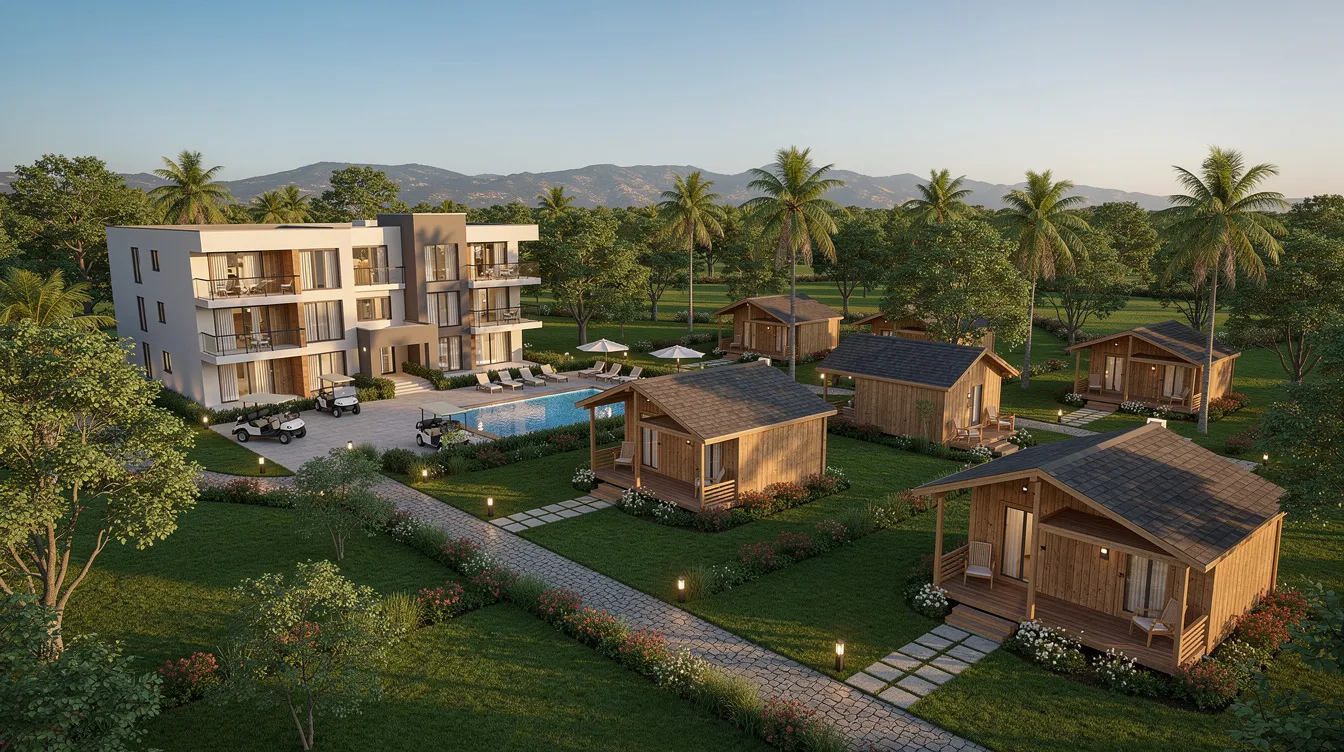
- Standard cottage: 300–400 sq ft, one bedroom with attached bath, small verandah
- Premium cottage: 500–700 sq ft, larger bedroom, better finishes, sit-out deck
- Luxury cottage: 700–1,000 sq ft, high-end interiors, possibly private plunge pool
- Family cottage: 800–1,200 sq ft, two bedrooms, living area
- Villa-style unit: 1,000+ sq ft, premium specifications, separate living/dining, private garden
Cost Components per Cottage
| Component | Share of Cottage Cost |
|---|---|
| Civil structure (foundation, walls, roof) | 35–45% |
| Flooring and finishes | 10–15% |
| Bathroom and sanitaryware | 8–12% |
| Doors, windows and joinery | 5–8% |
| Electrical and plumbing | 8–12% |
| HVAC (split AC or similar) | 3–5% |
| Interior finishes and furniture | 10–18% |
| Deck, verandah and external development | 5–10% |
Construction Material Options
RCC framed structures are common in resort construction across India. However, alternative approaches are gaining popularity:
- Prefab construction reduces costs by 10 to 25 percent and shortens timelines. Prefab cottage costs range from approximately ₹8.5 lakh to ₹30.5 lakh per cottage depending on size and specifications.
- Mud houses use natural materials for eco-friendly construction and work well in certain terrain and climate conditions.
- Bamboo houses are a sustainable construction option, particularly suited to eco-resort and nature-retreat concepts in forested or hilly locations.
- Thatch roofs, when properly treated, are fireproof and waterproof and add a distinctive visual character.
Indicative 2026 Cost Ranges
- Standard cottage (300–400 sq ft): ₹10 to ₹20 lakh per cottage
- Premium cottage (500–700 sq ft): ₹20 to ₹45 lakh per cottage
- Luxury villa-style (900+ sq ft): ₹50 lakh to ₹1.5 crore+ per unit
These figures are illustrative and location/specification dependent. In DPR preparation, each cottage type should have a separate cost line, and total resort cottage construction cost should reconcile with the architect’s BOQ and vendor quotations.
Land Requirement and Land Cost for Resorts in India
Land cost is usually the largest and most variable component of resort investment. Land prices can vary significantly based on tourism locations, and a figure that seems reasonable for one state may be completely unrealistic in another.
Typical Land Requirement
- 10-key nature resort: 2–4 acres
- 20–30 key cottage resort: 3–8 acres
- 50-key mixed room-and-cottage resort: 5–10+ acres
Villa-style or luxury resorts with lower density may require 4 to 8 keys per acre to preserve privacy and outdoor space.
Land Cost Benchmarks
Land acquisition costs range from ₹5 lakh to ₹2 crore per acre depending on location:
- Remote hill or interior areas: ₹5 to ₹25 lakh per acre for agricultural land
- Established hill stations: ₹40 to ₹200 lakh per acre
- Coastal land costs ₹50 to ₹200 lakh per acre, with premium beaches like North Goa or Alibaug touching ₹250 lakh or more
Land prices can vary radically based on tourism hub location. A plot near an upcoming highway junction may cost a fraction of what comparable acreage near an established tourist circuit would command.
Land acquisition can represent 15% to 40% of overall project cost, making it essential to evaluate land cost separately from building costs when structuring finance.
Related Acquisition Costs
Beyond the purchase price, promoters must account for:
- Stamp duty and registration: 5 to 7 percent of circle rate
- Legal due diligence: ₹50,000 to ₹2 lakh
- Agricultural land conversion (CLU) fees: ₹50,000 to ₹5 lakh depending on state
All these costs are captured under the “land and land development” head in resort project reports.
Site Development and External Infrastructure Cost
This is the cost category that promoters most frequently underestimate. The gap between raw land and a resort-ready site can be substantial, especially in hilly or remote locations.
Earthwork and Grading
- Land leveling, cutting and filling
- Retaining walls in hilly terrain (a major cost driver)
- Storm-water drainage channels
Internal Roads and Pathways
- Concrete or stone pathways to each cottage
- Vehicular circulation roads within the property
- Parking areas for guests and staff
- Access road from the main highway to the resort gate
Boundary and Security
- Boundary wall or fencing along the entire perimeter
- Gate complex with security cabin
- External lighting along pathways and perimeter
Water Infrastructure
- Borewell drilling and pump installation
- Overhead and underground water storage tanks
- Distribution pipelines to all buildings and cottages
- Rainwater harvesting systems where applicable
Sewage and Waste Management
- Septic tanks or STP (Sewage Treatment Plant)
- Storm-water drains
- Solid-waste handling areas
Infrastructure costs can exceed initial budgets by 15 to 25 percent, particularly in difficult terrain. Regulatory costs vary based on site-specific requirements and permissions – environmental clearances, CRZ compliance for coastal sites and forest-department NOCs in wildlife zones can all add time and expense.
Resort Civil Construction Cost – Buildings and Structures
Civil construction forms the backbone of resort setup cost. The standard method of estimating it is straightforward:
Total Built-Up Area × Estimated Construction Rate per sq ft
Construction costs are 45 to 60 percent of total investment in most resort projects. The rate per square foot varies based on several factors:
- City and region (construction in Goa differs from Uttarakhand or Rajasthan)
- Soil conditions and terrain
- Structural complexity (simple ground-floor cottages vs multi-storey room blocks)
- Choice of construction materials (local stone vs imported cladding)
- Earthquake and wind zone requirements
- Level of finishes (budget vs premium)
Typical Construction Rates (2026)
- Mid-range resort quality: ₹3,000 to ₹4,500 per sq ft
- Upscale quality: ₹6,000 to ₹9,000 per sq ft
- Luxury/boutique high specification: construction costs are around ₹9,000 to ₹14,000 per square foot
These rates include civil structure, finishes and bathrooms but typically do not include land, FF&E, landscape or site development.
Illustrative Calculation
Consider a mid-scale resort with 20,000 sq ft of total built-up area (cottages, restaurant, lobby, back-of-house) at an average construction rate of ₹3,500 per sq ft:
Civil construction cost = 20,000 × ₹3,500 = ₹7.0 crore
This figure covers the structures only. Site development, MEP, FF&E, amenities, pre-operative expenses and contingency are added separately to arrive at total project cost.
For DPR and bank loan purposes, the construction cost estimate should ideally be backed by architect’s estimates and BOQ-based costings rather than only thumb-rule multiplication.
Reception, Lobby and Common Areas – Impact on Project Cost
Non-revenue spaces like reception, lobby, waiting lounge, corridors, public areas, public washrooms and administrative offices can consume 15 to 25 percent of built-up area in many resort projects.
Premium resorts often allocate larger lobby volumes, double-height entrance spaces and generous lounge seating. This increases both structural and interior fit-out cost. While these common areas are critical for guest experience and brand perception, they do not directly generate room tariff revenue.
In DPR financial projections, higher investment in common areas must be justified through better ARR and positioning – not only aesthetics. A grand lobby that pushes project cost up by ₹60 lakh but does not translate into higher room rates or occupancy is simply wasted capital.
These spaces are typically grouped under “building and civil works” plus “interior finishes” in hotel project cost statements. Promoters should work with their architect to optimise these areas – impressive enough to create the right first impression, but not so oversized that they inflate the budget without proportionate revenue benefit.
Restaurant and Commercial Kitchen Setup Cost
Food and beverage is a significant component of both resort investment and resort revenue. For most Indian resorts, the restaurant is not optional – guests expect at least one full-service dining option on-site.
Physical Components
The restaurant setup includes the dining hall, buffet service area, bar (if planned), back area, cold storage, dry store, dishwashing area and service corridors. Larger resorts may need multiple F&B outlets – a coffee shop, all-day dining restaurant and a specialty or outdoor dining area.
Construction and Interior Cost
Restaurant construction and interior design costs vary widely between a basic multi-cuisine buffet hall and a themed signature restaurant. Key cost elements include flooring, wall cladding, ceiling treatment, ambient lighting, furniture and décor. These can range from ₹1,500 per sq ft for basic interiors to ₹5,000+ per sq ft for restaurants in luxury hotels.
Kitchen Equipment
Commercial kitchen setup requires exhaust and ducting systems, gas lines, refrigeration, cooking ranges, preparation tables, storage shelving and dishwashing equipment. A separate, detailed estimate of kitchen equipment and restaurant interiors should be obtained and shown under “plant & machinery” and “furniture & fixtures” in the project cost for bank appraisal.
Construction costs account for 40% to 50% of development budgets in most resort projects, and the restaurant and kitchen block form a meaningful portion of that construction budget.
Swimming Pool Cost and Its Effect on Resort Investment
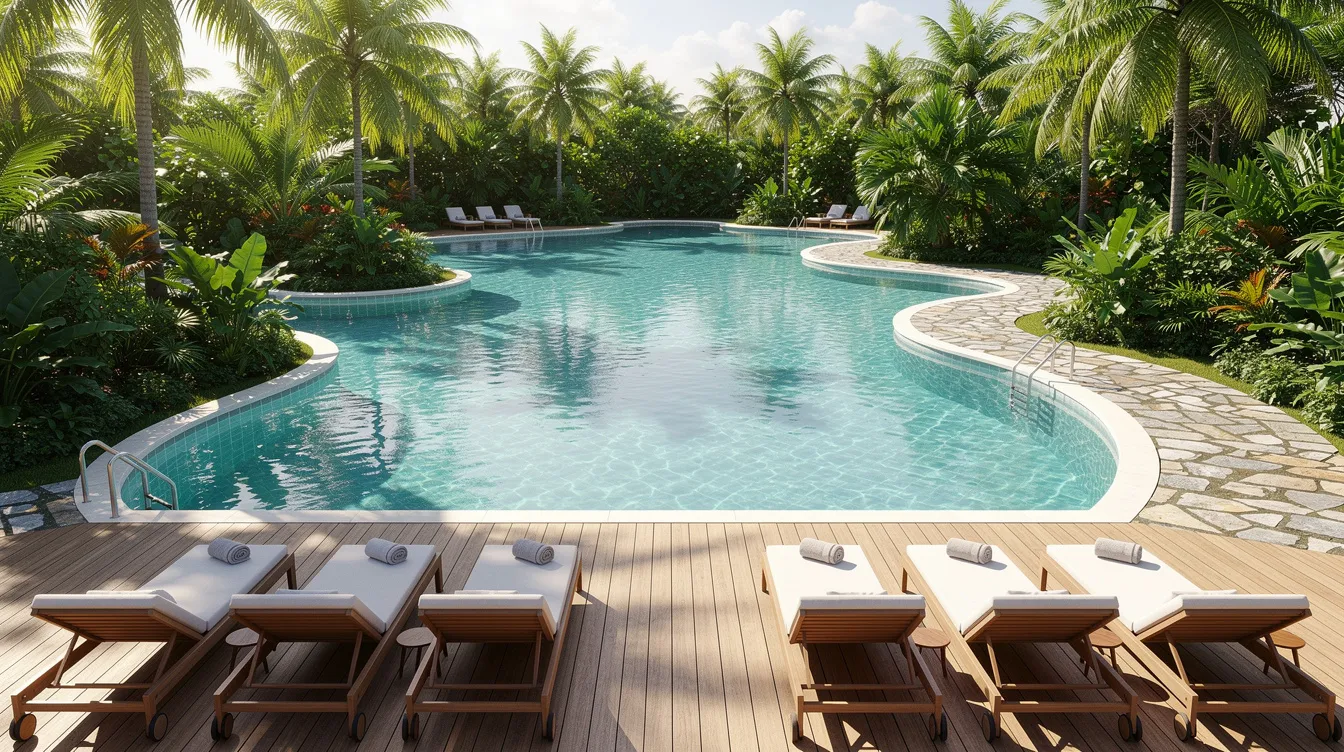
A well-designed pool is one of the most effective amenity investments for any resort. It significantly increases guest appeal, online ratings and achievable ARR. But it also adds meaningfully to both CAPEX and recurring OPEX.
Common Pool Types
- Standard rectangular leisure pool
- Children’s wading pool
- Infinity-edge pool (premium, higher cost)
- Plunge pool (smaller, often attached to villas)
- Heated indoor pool (rare but premium)
Cost Drivers
Pool cost depends on size and depth, RCC construction vs prefabricated systems, tiling quality, filtration and circulation systems, underwater lighting, deck paving, safety railings and nearby changing and shower facilities.
For a mid-sized outdoor pool (approximately 40 ft × 20 ft) in Indian conditions, planning budgets may range from ₹15 to ₹40 lakh for construction and filtration. Larger pools, infinity designs and premium finishes can push costs substantially higher.
Pool cost is normally shown as a separate asset category in the DPR – either under “civil works – swimming pool” or “amenities” – helping lenders understand its share in project cost.
The operational cost of maintaining a pool (power for pumps, chemicals, lifeguard salaries, periodic maintenance) is a recurring expense that should be factored into projected cash flow statements.
Landscaping, Outdoor Spaces and Resort Experience Cost
Well-designed landscape and outdoor amenities are not optional in resorts the way they sometimes are in city hotels. For guests, the outdoor experience often defines the difference between a “resort” and a “hotel.” This makes landscaping directly tied to guest satisfaction, online reviews and repeat visits.
Key Landscape Components
- Lawns and gardens (basic landscaping at minimum, themed gardens for premium properties)
- Native plantations and ornamental trees
- Water features, fountains, koi ponds
- Pergolas, gazebos and outdoor seating
- Bonfire pits, nature trails, jogging tracks
- Outdoor lighting and irrigation systems
Hardscape Elements
Paved pathways, stone sit-out decks, retaining walls (often serving both functional and aesthetic purposes), outdoor dining platforms and parking areas all fall under hardscape development and carry both material and labour cost.
In some nature and luxury resorts, landscaping and outdoor development can account for 8 to 15 percent of total CAPEX. From a DPR perspective, landscaping is often grouped under “land development and external works,” but detailed costing helps avoid underestimation – a mistake that occurs frequently in first-time projects.
Banquet, Lawn and Destination-Wedding Infrastructure
Many resort projects in India target the destination-wedding, corporate offsite and social-event market. This is a practical revenue strategy – but it requires dedicated infrastructure investment.
Core Elements
- Indoor banquet hall (often 2,000–5,000 sq ft or more)
- Pre-function area and green rooms
- Marriage lawn with hardscape platform for stage
- Separate washrooms for event guests
- Service corridors and dedicated event-kitchen or pantry
Infrastructure Requirements
Banquet and wedding facilities require enhanced electrical load, substantial backup power (DG sets), expanded parking capacity for large gatherings and landscape lighting for evening events. These add to the development cost.
While banquet infrastructure increases project cost, it can also provide significant ancillary revenue. However, this revenue should be justified in the DPR through realistic event-booking projections based on local market demand – not assumptions.
Not every resort requires a full banquet complex on day one. Promoters can consider phasing this investment based on market demand and cash flow, building only a basic lawn facility initially and expanding later.
Spa, Gym and Recreational Amenities – Optional vs Essential
Every resort needs some recreational offerings. But promoters must distinguish between essential core amenities and optional higher-end facilities during initial project planning.
Essential (most resorts):
- At least one restaurant
- Basic indoor games (carrom, table tennis)
- Kids’ play area
- Garden sit-outs
Optional / Phase 2 (depending on positioning):
- Spa with 2–4 treatment rooms
- Yoga pavilion
- Full gym with cardio and strength equipment
- Sports courts (badminton, volleyball)
- Adventure activities (ziplining, trekking tie-ups)
Each additional facility adds not only CAPEX but also operating cost – specialized therapists for the spa, gym equipment maintenance, activity staff – affecting project viability.
During initial DPR preparation, promoters should classify amenities into “Phase 1 essential” and “Phase 2 optional” to keep initial hotel project cost within manageable limits. Feasibility studies should align amenity investments with the expected target segment, ADR and competitive set in the chosen location.
Resort Equipment, Furniture & FF&E Cost
Furniture, Fixtures and Equipment (FF&E) is a major cost category that often gets less attention than civil construction during initial planning – and then surprises promoters when actual procurement begins.
Furniture, Fixtures and Equipment typically consume 15% to 20% of costs in most hotel projects and resort projects.
Key Categories (Summary)
- Guest-room furniture: beds, bedside tables, wardrobes, study desks, mirrors
- Mattresses, linen, pillows, towels
- Curtains, blinds, soft furnishings, artwork
- Lights, fans, mini-fridge, electric kettle
- Restaurant furniture: dining tables, chairs, buffet stations
- Outdoor furniture: pool loungers, garden seating sets
- Reception desk, office furniture, housekeeping trolleys
- Kitchen equipment, laundry machines, dishwashers
- Operating supplies, small-ware, POS systems
- IT and telecom hardware, security systems
This article does not deep-dive into individual equipment and furniture items because a separate comprehensive guide covers this topic in detail. For a complete checklist of resort equipment and furniture cost with item-wise breakdowns useful for DPR preparation and fixed-asset budgeting, refer to the dedicated article on Resort Equipment, Furniture & FF&E List with Cost.
Utilities and MEP Infrastructure (Electrical, Water, HVAC, Fire)
MEP (Mechanical, Electrical and Plumbing) infrastructure often forms 20 to 30 percent of construction and development cost in well-specified resorts. Promoters who estimate only civil construction cost and ignore MEP end up with significant funding gaps.
Electrical Systems
- Incoming HT/LT connection from the electricity board
- Transformer (if required for larger resorts)
- LT distribution panels, cabling and internal wiring
- DG sets for backup power (essential in most Indian resort locations)
- Solar PV panels and solar water heating (increasingly common)
- Street and pathway lighting
- Room electrical points, switches and fixtures
Plumbing and Water
- Water supply lines (hot and cold)
- Pumps, overhead tanks, underground tanks
- STP (Sewage Treatment Plant) – mandatory for most hotel projects
- Storm-water drainage
- Rainwater harvesting system
HVAC
Options range from individual split ACs per room (cheaper capital cost, higher operating cost) to VRV/VRF centralised systems (higher capital cost, better efficiency for larger resorts). The choice has implications for both project cost and long-term energy expenses.
Fire and Life Safety
Fire pumps, sprinkler systems, hydrant networks, smoke detectors, fire alarms, emergency lighting and evacuation signage are mandatory in most hotel projects. Obtaining fire NOC is a prerequisite for operating licences, and these systems must be budgeted from day one.
Pre-Operative and Pre-Opening Expenses
Pre-operative expenses are costs incurred before the resort becomes operational. In accounting and bank appraisal, these are capitalised into the project cost.
Project Development Costs
- Architectural and engineering design fees
- Legal fees and consultant fees (valuation, environment, structural)
- Statutory approval charges (building permission, environment, tourism registration)
- Project management fees and site supervision
- Travel and administration during construction phase
Pre-Opening Operating Costs
Pre-opening costs for a 10-cottage resort range from ₹6 to ₹18 lakh, and scale proportionally for larger properties. Typical items include:
- Staff recruitment and training: salaries during the 2–3 month soft-opening phase
- Photography and video production: ₹1.5 to ₹4 lakh for professional resort shoots
- OTA platform setup (MakeMyTrip, Booking.com, Agoda): ₹50,000 to ₹1.5 lakh
- Website development: ₹1 to ₹3 lakh
- Licences and registrations (tourism, FSSAI, health, fire): ₹50,000 to ₹2 lakh
- Pre-opening marketing campaigns, branding and PR
- Trial-run expenses and soft-opening hospitality
Interest During Construction (IDC)
If a term loan is drawn during the construction phase, the interest accruing before operations begin is capitalised as part of pre-operative expenses. IDC can be a significant amount in projects with 18–24 month construction timelines.
Under-budgeting pre-opening costs and IDC can lead to funding gaps just before launch. A realistic provision is essential for bankable project reports.
Contingency Provision in Resort Project Cost
Contingency is not “extra profit” or padding. It is a risk buffer against uncertainties that are inherent in any construction project – material price increases, design changes, unforeseen soil or site conditions, regulatory requirements discovered late and potential delays.
Contingency percentage may vary based on the project stage:
- At concept-level estimates: 15 to 25 percent may be justified
- When detailed BOQs and contractor quotations are available: 5 to 10 percent may suffice
In the DPR, contingency should be shown as a separate head, not silently embedded inside individual line items. This makes cost control easier during implementation and makes the project report more transparent for bank appraisal.
During bank appraisal, a reasonable contingency is viewed positively as prudent risk management rather than a sign of inflated project cost. However, excessive contingency without justification may invite questions.
Contingency usage should be monitored during implementation. Unused balances can later be reallocated to address actual overruns or serve as the promoter’s safety margin.
Sample Resort Project Cost Statement (Illustrative)
Below is an illustrative project cost table for a hypothetical mid-scale resort with approximately 25 rooms/cottages, a pool, restaurant, basic banquet lawn and moderate landscaping. All figures are purely educational and representative of 2026 planning estimates.
| Project Cost Head | Illustrative Amount (₹ Lakh) |
|---|---|
| Land / Lease Premium | 80.00 |
| Land Development (leveling, roads, boundary, drainage) | 55.00 |
| Civil Construction – Rooms / Cottages (25 units) | 375.00 |
| Civil Construction – Restaurant, Kitchen, Lobby, Common Areas | 120.00 |
| Swimming Pool (with filtration and deck) | 25.00 |
| Landscaping and Outdoor Development | 35.00 |
| Furniture, Fixtures & FF&E | 80.00 |
| Plant & Equipment (kitchen, laundry, DG, pumps) | 45.00 |
| Utilities & MEP (electrical, plumbing, STP, fire, HVAC) | 65.00 |
| Pre-operative Expenses (design, approvals, pre-opening, IDC) | 30.00 |
| Contingency (~10% on construction & infrastructure) | 55.00 |
| Initial Working Capital (9–12 months of operating expenses) | 85.00 |
| Total Project Cost | ₹1,050.00 (₹10.50 crore) |
These figures are illustrative only. Actual cost must be derived from project-specific architect estimates, BOQ and vendor quotations. Land cost can vary enormously by location.
This structure aligns with standard DPR formats used for hotel project cost and resort project appraisal. Each head maps to an accounting fixed-asset category, which determines depreciation rates and tax treatment in projected financial statements.
Promoters should share such a structured cost sheet with their CA and architect early so that financial projections, depreciation schedules and term-loan requirements can be planned coherently.
Example – 20-Room / Cottage Resort Cost Calculation
Let us walk through a step-by-step illustrative calculation for a 20-key cottage resort in a semi-urban tourist location with typical Indian specifications.
Assumptions
- Location: developing hill-station area, 3–4 hours from a major city
- Land: 4 acres, owned by the promoter (cost treated separately at ₹25 lakh per acre = ₹1 crore)
- Cottage type: 20 independent cottages, approx. 400 sq ft each
- Common built-up: reception, restaurant, kitchen, back-of-house: approx. 3,500 sq ft
- Amenities: medium swimming pool, basic spa (2 rooms), landscaped gardens
- Average construction rate: ₹3,500 per sq ft for cottages, ₹3,000 per sq ft for common areas
- Positioning: mid-market boutique, ARR ₹6,000–₹10,000
Cost Build-Up
| Component | Calculation | Amount (₹ Lakh) |
|---|---|---|
| Land (4 acres × ₹25 lakh) | Promoter-owned | 100.00 |
| Land development (leveling, roads, boundary, drainage, borewell) | Lump sum estimate | 45.00 |
| Cottages (20 × 400 sq ft × ₹3,500/sq ft) | 8,000 sq ft × ₹3,500 | 280.00 |
| Common areas (3,500 sq ft × ₹3,000/sq ft) | Restaurant, lobby, kitchen, back-of-house | 105.00 |
| Swimming pool (mid-sized with deck) | Lump sum | 20.00 |
| Spa (2 treatment rooms, basic fit-out) | Lump sum | 12.00 |
| Landscaping and outdoor development | Gardens, pathways, lighting | 25.00 |
| FF&E (furniture, linen, kitchen equipment, IT) | Based on FF&E budget | 60.00 |
| Utilities and MEP (electrical, STP, fire, HVAC) | Estimate | 50.00 |
| Pre-operative expenses | Design, approvals, pre-opening, marketing | 15.00 |
| Contingency (~12% on construction and infrastructure) | Buffer | 45.00 |
| Working capital (9–12 months) | Operational bridge | 70.00 |
| Total Project Cost (Including Land) | ₹827 lakh (≈ ₹8.3 crore) | |
| Project Cost Excluding Land | ₹727 lakh (≈ ₹7.3 crore) |
Total project costs typically include land costs plus construction and soft costs. In this example, the 20-key resort requires approximately ₹8.3 crore total investment including land, or about ₹7.3 crore excluding land.
Working capital provision of ₹70 lakh covers approximately 9 to 12 months of operating costs. Typical monthly operating cost for a 10-cottage resort is ₹5 to ₹12 lakh; for 20 cottages with more staff and higher utility usage, monthly costs would be proportionally higher. Working capital covers operating costs until breakeven, which typically takes 6 to 18 months.
This project cost would feed into the DPR: depreciation schedules by asset category, interest calculation on the term loan, projected income statement, cash flow projections and DSCR analysis for bank appraisal.
Example – 30-Room Resort Cost Calculation
Now consider a 30-room mid-scale resort with slightly more extensive amenities than the 20-room example.
Assumptions
- Location: established tourism zone, moderate land cost
- Mix: 20 independent cottages (450 sq ft each) + 10 rooms in a room block (350 sq ft each)
- Common areas: larger restaurant (seating 60+), lobby, kitchen, staff quarters: approx. 5,500 sq ft
- Amenities: larger pool, proper banquet lawn, enhanced spa (3 treatment rooms), gym, landscaping
- Average construction rate: ₹3,800 per sq ft (mid-to-upper range)
- Positioning: premium mid-scale, ARR ₹10,000–₹18,000
Cost Build-Up
| Component | Amount (₹ Lakh) |
|---|---|
| Land (5 acres × ₹50 lakh/acre) | 250.00 |
| Land development | 65.00 |
| Cottages (20 × 450 sq ft × ₹3,800) | 342.00 |
| Room block (10 × 350 sq ft × ₹3,200) | 112.00 |
| Common areas (5,500 sq ft × ₹3,500) | 192.50 |
| Swimming pool (larger, with kids’ pool) | 30.00 |
| Banquet lawn and infrastructure | 25.00 |
| Spa and gym | 18.00 |
| Landscaping and outdoor | 40.00 |
| FF&E | 95.00 |
| Utilities and MEP | 75.00 |
| Pre-operative expenses | 22.00 |
| Contingency (~10%) | 65.00 |
| Working capital | 90.00 |
| Total Project Cost (Including Land) | ₹1,421.50 lakh (≈ ₹14.2 crore) |
| Project Cost Excluding Land | ₹1,171.50 lakh (≈ ₹11.7 crore) |
With 30 keys, fixed costs (lobby, kitchen, pool, STP, back-of-house) are spread across more rooms. So despite higher total cost, the cost per key drops compared to the 20-room example. The feasibility model may show better DSCR and faster payback, assuming market demand exists at target occupancy and ARR.
These example calculations are for conceptual understanding only. Actual DPRs must be tailored to the project’s exact location, design, construction specifications and business model.
Resort Setup Cost – Excluding Land vs Including Land
Many industry figures for resort construction cost per room in India do not include land cost. This can mislead first-time investors who compare numbers without understanding this distinction.
Project cost excluding land is commonly used by bankers for loan calculation because the loan typically finances construction, equipment and other depreciable assets.
Total investment including land represents the promoter’s full capital exposure and is the number that matters for calculating overall return on investment, IRR and payback period.
Illustrative Comparison
Consider the same 30-key resort from the previous example:
| Scenario | Land Cost | Project Cost Excl. Land | Total Investment |
|---|---|---|---|
| Low-cost rural land (₹10 lakh/acre × 5 acres) | ₹50 lakh | ₹11.7 crore | ₹12.2 crore |
| Moderate tourism land (₹50 lakh/acre × 5 acres) | ₹2.5 crore | ₹11.7 crore | ₹14.2 crore |
| Premium coastal land (₹1.5 crore/acre × 5 acres) | ₹7.5 crore | ₹11.7 crore | ₹19.2 crore |
The construction cost is identical in all three scenarios, but total investment – and therefore the return metrics – change dramatically based on land prices.
From a DPR and bank-finance perspective, while land may not always be financed to the same extent as other assets, it forms part of the security and promoter margin evaluation.
Promoters should always calculate IRR and payback on total investment including land, even if loan eligibility is computed on project cost excluding land.
How Resort Project Cost Is Structured in a DPR
In Detailed Project Reports used for hotel development and resort projects in India, project cost is classified under standardised headings:
- Land and Land Development – purchase, conversion, site preparation
- Buildings and Civil Works – room blocks, cottages, common areas, amenities structures
- Plant & Machinery – kitchen equipment, laundry, DG sets, pumps, STP
- Furniture, Fixtures & Fittings – room furniture, restaurant furniture, soft furnishings, décor
- Other Fixed Assets – vehicles, IT hardware, security systems
- Preliminary & Pre-operative Expenses – professional fees, approvals, pre-opening, IDC
- Contingency – risk buffer
- Margin for Working Capital – operational funding until breakeven
These heads correspond to accounting fixed-asset categories, which determine depreciation rates and tax treatment in projected financial statements.
For bank appraisal, each head should be supported by reasonable assumptions, architect estimates or vendor offers – not just lump-sum guesses. In project-finance assessment, lenders review whether project cost is realistic, adequately funded and aligned with the resort’s revenue potential and repayment capacity.
Means of Finance for a Resort Project
Total project cost must equal total means of finance. This is a fundamental identity in every DPR and CMA data submission:
Total Project Cost = Total Means of Finance
Means of finance typically include:
- Promoter contribution (equity): Own funds invested by the promoter
- Bank term loan: The primary external funding source for most resort projects
- Unsecured loans: From promoters, family members or associates (acceptable to banks within limits)
- Other sources: State tourism subsidies, capital incentives (where available), angel/PE investment
In Indian banking practice, reasonable promoter equity contribution is generally expected to be 25 to 35 percent of total project cost, with banks financing 65 to 75 percent. However, actual loan eligibility depends on the bank’s policy, credit profile, collateral position and projected cash flows – not only on a fixed percentage of project cost.
Notably, 100% foreign direct investment is permitted in hotel and tourism sectors in India, which opens additional funding possibilities for resort projects with international partners.
Promoters should work with an experienced CA to structure means of finance realistically before approaching lenders with the resort project report.
Resort Project Cost and Bank Term Loan Appraisal
Banks do not evaluate resort projects merely by looking at construction cost. They assess full business viability, risk and repayment capacity.
Key Appraisal Parameters
- Promoter background and experience
- Total project cost and means of finance (debt-equity mix)
- Implementation schedule and project readiness
- Occupancy assumptions (conservative, not aspirational)
- Average Room Rate (ARR) and revenue mix (rooms, F&B, banquets, other income)
- Operating expenses and EBITDA margins
- Cash flow projections over 7–10 years
- DSCR (Debt Service Coverage Ratio)
DSCR measures whether projected cash flows can comfortably service the proposed term loan – including both principal repayment and interest. Banks typically expect DSCR of at least 1.25 to 1.50 after the initial ramp-up period.
Over-ambitious investment in luxury finishes or non-essential amenities can strain DSCR if local demand does not support required room rates. A resort that looks stunning but cannot generate sufficient occupancy at profitable tariffs will struggle to service its debt.
A professionally prepared DPR with realistic cost estimates and conservative financial projections substantially improves the quality of bank appraisal – though it does not guarantee loan sanction.
Common Cost Overruns Promoters Should Avoid
From my experience with project-report preparation, here are the most common budgeting mistakes I see in resort projects:
Underestimating Land Development Promoters often budget for construction but overlook the cost of converting raw land into a usable site – levelling, retaining walls, drainage, approach roads and utilities.
Ignoring External Infrastructure Electricity connections, transformer installation, borewell, water treatment and road access from the highway can add ₹30 to ₹80 lakh or more, depending on the site’s remoteness.
Under-Budgeting MEP and Utilities STP, electrical distribution, fire-fighting systems and HVAC are frequently treated as afterthoughts. These systems alone can represent 20 to 30 percent of development cost.
Mid-Project Specification Upgrades The temptation to upgrade flooring, sanitaryware or joinery mid-way through construction – without revising budgets – is a classic source of cost overruns. Interior and FF&E costs can overshoot initial budgets by 20 to 30 percent.
Neglecting Pre-Opening and Working Capital Pre-opening expenses range from ₹6 to ₹18 lakh for a 10-cottage property. Working capital for a 10-cottage resort is ₹45 to ₹100 lakh. Ignoring these creates beautiful properties that struggle to operate smoothly in the first year.
Inadequate Contingency Projects without contingency provisions inevitably face funding gaps when material prices move or site conditions surprise. Working capital must cover 6 to 9 months of operational expenses at minimum.
Regular cost monitoring against DPR, contingency management and timely communication with lenders can help manage overruns before they threaten project viability.
How to Optimise Resort Setup Cost Without Hurting Guest Experience
Cost optimisation does not mean building a cheaper resort. It means spending wisely on what matters and avoiding waste on what does not.
Optimise Built-Up Area Avoid unnecessarily large lobbies, corridors and back-of-house spaces. Every additional square foot of built up area adds construction cost without necessarily improving guest experience.
Phase Non-Critical Amenities A second pool, elaborate sports complex or large spa can wait until the core resort stabilises its occupancy and cash flows. Build only Phase 1 essentials initially.
Standardise Cottage Designs Using a repeatable cottage design (with minor variations) reduces architectural costs, simplifies procurement and improves construction efficiency. This approach is often cheaper than designing every cottage differently.
Value-Engineer Materials Use durable, locally available construction materials. Simple structural grids reduce wastage. Cost-effective but attractive finishes exist in every price range – the key is knowing where to invest (visible guest areas) and where to economise (service areas).
Obtain Competitive Quotations Prepare detailed BOQs and obtain at least three vendor quotes for every major package. Lock contracts early to reduce exposure to prices volatility.
Separate Essential and Optional CAPEX Create two budgets: the minimum viable resort and the enhanced version. Finance the first, and fund the second from operating cash flows.
Cost optimisation must align with target positioning. Cutting back on essentials that guests expect – comfortable beds, clean bathrooms, reliable water and power, good food – will damage long-term revenue and reputation far more than it saves on construction.
Resort Setup Cost and Project Viability
A resort project’s success depends not on how much was spent on construction, but on whether the investment generates sustainable returns.
Two resorts with identical construction cost can show very different financial outcomes based on location, management quality and marketing strategy. A ₹10 crore resort in a well-connected tourist circuit with strong demand may perform far better than a ₹15 crore resort in a remote location with weak connectivity.
Key Viability Indicators
- Break-even occupancy: The occupancy level at which revenue covers all operating expenses including debt service. For mid-market resorts, break-even is often projected at 45 to 55 percent.
- ARR and RevPAR: Revenue per available room, driven by pricing strategy and demand
- F&B contribution: Restaurant and event revenue as percentage of total income
- DSCR: Whether cash flows can service the term loan comfortably
- Payback period: Time to recover the total investment
- Project IRR: Internal rate of return based on the financial model over 10–15 years
Projected P&L, cash-flow statements and balance sheets over 7 to 10 years reflect how initial project cost flows through depreciation, interest expense and profitability. Changes in ARR, occupancy and operating expenses can dramatically alter viability.
The real objective is not merely to build a resort, but to create a financially sustainable, bankable hospitality business in the Indian market.
CA Manish Gugliya – Professional Perspective on Resort Setup Cost
In my practice of preparing project reports, DPRs, CMA data and financial projections for hospitality and MSME clients, I have observed that the most successful resort projects share certain characteristics.
First, they treat resort investment as an integrated picture of project cost, operating potential and debt-servicing capacity – not merely as a per sq ft construction budget. A promoter who fixates only on building costs without understanding what the resort can earn, at what occupancy and at what tariff, is building blind.
Second, projects that remain disciplined on initial budgets, realistic on ARR and occupancy assumptions, and conservative on borrowing tend to perform better over the long term. The hospitality industry rewards patience and consistency. Seasonal fluctuations, ramp-up periods and market cycles are inevitable – the financial plan must accommodate them.
Third, I always advise promoters to have their resort project report reviewed by both a qualified architect (for technical cost validation) and a CA (for financial viability and DPR structuring). Neither alone is sufficient.
At ProjectReportBank.com, we help promoters structure resort project cost, prepare DPRs with detailed financial projections, and present coherent proposals to banks. We do not promise loan approvals – no honest professional can. What we do provide is a well-prepared, credible project report that presents the investment and its viability in the format that banks and financial institutions expect.
The cost estimates in this guide are a starting framework. Every resort project is unique, and final investment decisions should be based on project-specific professional advice, architect estimates and market-specific feasibility analysis.
FAQs on Resort Setup Cost in India
The following answers use illustrative 2026-level assumptions. Exact project cost requires site-specific technical and financial analysis.
How much minimum capital is required to start a very small resort in India?
A basic 8 to 10 room or cottage property with modest amenities – a small restaurant, basic landscaping, minimal recreation – may still require total investment (including land) running into ₹2 to ₹5 crore depending on location and land cost. Promoters should avoid assuming that “farmhouse-style” projects can be completed on extremely low budgets.
Even a very small resort needs site development, utilities infrastructure, a functional kitchen, basic furniture and working capital for the first several months of operations. Working capital for a 10-cottage resort ranges from ₹45 to ₹100 lakh, and this figure alone rules out extremely low-budget plans for any professionally operated property.
Can I get a bank loan to construct a resort if I already own the land?
Owning land outright significantly strengthens the promoter’s equity position. Banks usually treat existing land (at fair or circle-rate valuation) as part of the promoter’s contribution or collateral for the loan.
However, term-loan eligibility is still linked to overall project cost and projected cash flows. Even with land ownership, the bank will require a properly prepared DPR showing construction cost, means of finance, revenue projections and DSCR before considering a resort term loan. Owning land helps – but it does not replace the need for a viable business plan.
How much land is typically required for a 20-room cottage resort?
For a 20-key cottage-style resort with comfortable spacing between cottages, landscaped gardens, a swimming pool and a restaurant, a land area of approximately 3 to 6 acres is commonly required. This allows adequate setbacks, pathways, outdoor activity spaces and parking.
Higher density is technically possible, but cramming 20 cottages into 1–2 acres would significantly reduce the “resort feel” and may not justify premium tariffs. The land requirement also depends on whether the terrain is flat (more efficient) or hilly (more spread out but potentially more scenic).
How long does it usually take from sanction to opening a resort?
In typical Indian conditions, the timeline from project sanction and land readiness to resort opening is approximately 18 to 30 months. This includes design finalisation (2–4 months), statutory approvals (2–6 months depending on state and site), construction (10–18 months) and pre-opening and trial operations (2–3 months).
Carrying cost during this period – including interest during construction, supervision expenses and land holding costs – must be factored into project cost. Potential delays from monsoon seasons, regulatory processes and supply-chain issues are common, making conservative timeline planning essential.
Should I prioritise cottages or room blocks for better returns?
Cottages usually mean higher land cost and construction cost per key, but they can support higher tariffs and differentiated positioning in the market. Room blocks are more cost-efficient per key and require less land but may command lower tariffs in a resort context.
The best choice depends on the target market, land characteristics, competitive landscape and viability analysis in the DPR. In remote locations with ample cheap land, cottages often make more sense. In locations where land is expensive or limited, room blocks optimise capital investment. Many successful resorts use a mix – room blocks for standard inventory and a few premium cottages for higher-yield guests.
Continue Exploring Our Resort Project Finance Guides
Continue with our detailed Resort DPR resources for project planning, investment estimation, financial analysis, feasibility and bank loan appraisal.
Conclusion – Putting Resort Setup Cost in the Right Perspective
Resort setup cost in India cannot be estimated merely by multiplying the number of rooms by a generic construction rate. The real figure is the sum of carefully estimated components: land cost, built-up area and civil construction, the choice between cottages and rooms, amenities, specifications, MEP and utilities infrastructure, furniture and equipment, pre-operative expenses, contingency and initial working capital.
Each of these components varies by location, terrain, market positioning and design decisions. A 20-room boutique resort in a developing hill station and a 30-key destination resort in an established coastal market will have fundamentally different investment profiles – even if they share the same number of guest rooms.
For entrepreneurs seeking a bank term loan, a project-specific DPR with realistic capital expenditure estimates, conservative revenue assumptions and demonstrable repayment capacity is not optional – it is essential. Banks do not finance resort concepts. They finance bankable projects with credible numbers.
Approach resort investment with financial discipline, proper planning and professional guidance. The most successful resorts are not always the most expensive ones – they are the ones where every rupee of investment was thoughtfully allocated toward creating a sustainable, revenue-generating hospitality business.
CA Manish Gugliya ProjectReportBank.com