Introduction

Applying for a Mudra Loan is an important step for entrepreneurs, small business owners, startups, and self-employed individuals looking to finance or expand their businesses. During the application process, many borrowers are offered insurance products along with their loan. While insurance can provide valuable financial protection, many applicants are unsure whether accepting it is optional or compulsory. This confusion often leads to unnecessary concerns and poor financial decisions. Understanding how insurance and cross-selling work can help borrowers make informed choices and avoid unexpected problems during the loan journey.

Why Do Banks Recommend Insurance with Mudra Loans?

Banks often recommend insurance to protect both the borrower and the financed business against unexpected risks. Depending on the type of business and loan, borrowers may be offered products such as Credit Life Insurance, Asset Insurance, or other loan-related insurance policies. These products are designed to provide financial security in situations like accidental death, disability, or damage to business assets. In many cases, the recommendation is made because insurance can reduce financial risk, not because it is always mandatory.

Recommendation vs. Compulsion: Understand the Difference

One of the most common misconceptions is that insurance is compulsory with every Mudra Loan. In reality, there is a clear difference between a bank recommending an insurance product and forcing a borrower to purchase it. A recommendation allows the applicant to understand the benefits and decide voluntarily whether the insurance suits their needs. Compulsion occurs when borrowers are pressured, misled, or made to believe that loan approval depends on buying insurance. Knowing this distinction helps applicants protect their rights and make confident financial decisions.

What Is Cross-selling in Banking?

Cross-selling is a common banking practice where customers are offered additional financial products or services along with their primary banking requirement. During the Mudra Loan process, banks may recommend insurance, savings products, or other financial services that could benefit the borrower. When these products are explained transparently and offered without pressure, cross-selling is considered a legitimate business practice. However, borrowers should always evaluate whether the additional product is suitable before accepting it.

When Does Insurance Become Mis-selling?

Insurance becomes mis-selling when it is sold without proper disclosure, informed consent, or transparent communication. This may happen if insurance is added to the loan without the borrower’s knowledge, important terms and charges are not explained, or applicants are incorrectly told that purchasing insurance is compulsory for loan approval. Such practices can result in unnecessary financial costs and confusion. Recognizing these warning signs helps borrowers identify unfair practices and take appropriate action.

Why Every Mudra Loan Applicant Should Know Their Rights

Awareness of borrower rights is one of the best ways to prevent misunderstandings during the loan process. Every applicant has the right to receive clear information about insurance products, understand the premium amount and policy benefits, ask questions before signing documents, and make decisions without undue pressure. Being informed enables borrowers to distinguish between genuine recommendations and unfair sales practices while ensuring greater transparency throughout the loan journey.

What You Will Learn in This Complete Guide

This cluster guide brings together every important topic related to Mudra Loan Insurance & Cross-selling Issues in one place. You will learn why banks recommend insurance, understand different types of loan-related insurance, identify hidden charges and insurance mis-selling, recognize forced cross-selling practices, know whether insurance can be refused, and understand your rights as a borrower. By the end of this guide, you will be better equipped to make informed decisions, avoid unnecessary expenses, and confidently handle insurance-related discussions during your Mudra Loan application process.

📘 What You Will Learn

This comprehensive guide will help you understand every important aspect of insurance and cross-selling during the Mudra Loan process.

✅ Why banks recommend insurance with Mudra Loans
✅ Whether insurance is compulsory or optional
✅ Different types of insurance offered with Mudra Loans
✅ Hidden insurance charges and premium deductions
✅ How to identify insurance mis-selling practices
✅ Warning signs of forced cross-selling by banks
✅ Whether you can refuse insurance without affecting your loan
✅ Your rights as a Mudra Loan borrower
✅ When cross-selling is legal and when it becomes unfair
✅ Practical steps to avoid insurance-related disputes and make informed decisions

📚 Quick Navigation

Choose your specific insurance or cross-selling issue below to read the complete expert guide.

1. Hidden Insurance Charges

Learn how to identify undisclosed insurance deductions, premium charges, and unexpected costs that may increase your Mudra Loan amount.

Read Complete Guide →

2. Insurance Premium Included in Loan

Understand whether insurance premiums can legally be financed within your Mudra Loan and how they affect your loan amount.

Read Complete Guide →

3. Insurance Added Without Consent

Know what to do if insurance was added to your Mudra Loan without your knowledge or written approval.

Read Complete Guide →

4. Warning Signs of Forced Cross-selling

Recognize common warning signs that indicate a bank may be pressuring you to purchase unnecessary financial products.

Read Complete Guide →

5. Identify Insurance Mis-selling

Discover how to identify insurance mis-selling practices and protect yourself from misleading information during loan processing.

Read Complete Guide →

6. Credit Life Insurance vs Asset Insurance

Compare Credit Life Insurance and Asset Insurance to understand which policy protects you and your business.

Read Complete Guide →

7. Types of Insurance Offered

Explore the different insurance products commonly offered with Mudra Loans and understand their purpose and benefits.

Read Complete Guide →

8. Why Banks Recommend Insurance

Understand the reasons banks recommend insurance with Mudra Loans and when those recommendations are appropriate.

Read Complete Guide →

9. Can You Refuse Insurance?

Learn whether you can refuse optional insurance during the Mudra Loan application process and its possible implications.

Read Complete Guide →

10. Is Cross-selling Legal?

Understand when cross-selling is a legitimate banking practice and when it may become an unfair or misleading sales practice.

Read Complete Guide →

Understanding Insurance & Cross-selling in Mudra Loans

When applying for a Mudra Loan, many borrowers focus primarily on loan eligibility, documentation, interest rates, and repayment terms. However, during the application process, banks often discuss insurance products and other financial services alongside the loan. For first-time applicants, this can be confusing because they may not know whether these products are optional, beneficial, or compulsory. Understanding how insurance and cross-selling work can help borrowers make informed financial decisions and avoid misunderstandings during the loan process.

Insurance itself is not a negative concept. In fact, the right insurance policy can protect both the borrower and the business from unexpected financial losses. Similarly, cross-selling is a common banking practice that allows customers to access additional financial products that may be useful. Problems arise only when borrowers are not given complete information, are pressured into buying products, or believe they have no choice but to accept them. Knowing the difference between genuine recommendations and unfair selling practices is essential for every Mudra Loan applicant.

What Is Loan-linked Insurance?

Loan-linked insurance refers to an insurance policy that is offered in connection with a loan. Its purpose is to provide financial protection against specific risks that may affect the borrower or the financed business. Depending on the nature of the business and the loan, banks may recommend different types of insurance, such as Credit Life Insurance, Asset Insurance, or other business-related insurance policies.

For example, Credit Life Insurance may help repay the outstanding loan if the borrower dies during the loan tenure, reducing the financial burden on the family. Asset Insurance may protect machinery, equipment, vehicles, or other business assets financed through the loan against risks such as fire, theft, or natural disasters.

Loan-linked insurance is intended to reduce financial risk rather than replace the borrower’s responsibility to repay the loan. Whether a particular insurance policy is suitable depends on the borrower’s business, financial situation, and personal requirements.

Why Do Banks Recommend Insurance?

Banks recommend insurance for several practical reasons. From the borrower’s perspective, insurance provides financial protection against unforeseen events that could affect loan repayment or business continuity. For businesses that depend on expensive equipment or valuable assets, insurance can help reduce losses caused by accidents or damage.

From the bank’s perspective, insured borrowers and insured assets generally represent lower financial risk. If a major unforeseen event occurs, insurance may help minimize the impact on both the borrower and the lender. As a result, many banks encourage applicants to consider suitable insurance products during the loan process.

In addition to risk management, banks may also offer insurance as part of their broader financial services portfolio. This is a standard practice across the banking industry and, when handled transparently, can help customers access products that complement their financial needs.

Is Insurance Mandatory with a Mudra Loan?

One of the most common questions asked by borrowers is whether insurance is compulsory when applying for a Mudra Loan. Many applicants assume that accepting insurance is necessary for loan approval simply because it is discussed during the application process.

In practice, borrowers should clearly understand whether a particular insurance product is being recommended or whether there is any specific requirement related to the financed asset or business. Recommendations should allow the borrower to make an informed choice after understanding the policy’s benefits, coverage, exclusions, and premium.

Applicants should never assume that every insurance product presented during the loan process must be accepted automatically. Before signing any documents, borrowers should carefully review all charges, ask questions about optional products, and ensure they understand what they are agreeing to purchase.

What Is Cross-selling in Banking?

Cross-selling is a business practice in which banks offer additional financial products or services alongside the primary product requested by the customer. During the Mudra Loan process, a borrower may be offered insurance policies, savings accounts, digital banking services, payment solutions, or other financial products that could complement the loan.

When cross-selling is carried out transparently, it benefits both the customer and the bank. Customers become aware of products that may improve their financial security, while banks expand their range of services. The key principle is that the customer should receive complete information and have the freedom to decide whether the additional product meets their needs.

Cross-selling becomes valuable only when the borrower fully understands the product and voluntarily chooses to purchase it.

Understanding the Difference Between Various Selling Practices

Many borrowers use terms like recommendation, cross-selling, forced selling, and mis-selling interchangeably. However, these concepts have different meanings, and understanding the distinction helps applicants identify whether a banking practice is fair and transparent.

Genuine Advice

Genuine advice occurs when a bank employee explains the features, benefits, costs, and limitations of an insurance product without placing any pressure on the borrower. The customer receives complete information, has enough time to evaluate the product, and remains free to accept or decline it. The final decision always belongs to the borrower.

Cross-selling

Cross-selling is the process of offering additional products that may benefit the customer alongside the primary banking service. The borrower is informed about the product, understands that it is an additional offering, and voluntarily decides whether to purchase it. There is no pressure, misleading information, or implication that the loan depends on accepting the product.

Forced Selling

Forced selling occurs when a borrower feels compelled to purchase an insurance product or another financial service because they believe refusing it could affect their loan approval or processing. Pressure may be created through verbal statements, indirect suggestions, or by presenting the product as unavoidable. Such situations reduce the borrower’s freedom to make an independent decision.

Mis-selling

Mis-selling occurs when an insurance product is sold through misleading information, incomplete disclosure, hidden charges, or without obtaining proper informed consent. Examples may include failing to explain important policy terms, adding insurance without adequate disclosure, or creating confusion about whether the product is optional. Mis-selling prevents borrowers from making informed financial decisions and may lead to unnecessary costs.

Common Misconceptions About Mudra Loan Insurance

Many misunderstandings arise simply because borrowers are unfamiliar with banking and insurance terminology. Some applicants believe that every Mudra Loan automatically includes insurance, while others assume that refusing insurance will result in immediate loan rejection. Another common misconception is that every insurance premium is compulsory or that all insurance products provide the same level of protection.

Some borrowers also believe that every product recommended by a bank employee must be accepted without question. In reality, applicants should carefully review every document, understand each charge, ask for clarification whenever required, and make decisions based on their own financial needs rather than assumptions.

Understanding how loan-linked insurance, cross-selling, and borrower rights work together helps applicants approach the Mudra Loan process with greater confidence. An informed borrower is better prepared to evaluate insurance products, recognize transparent recommendations, identify unfair practices, and make decisions that support both business growth and long-term financial security.

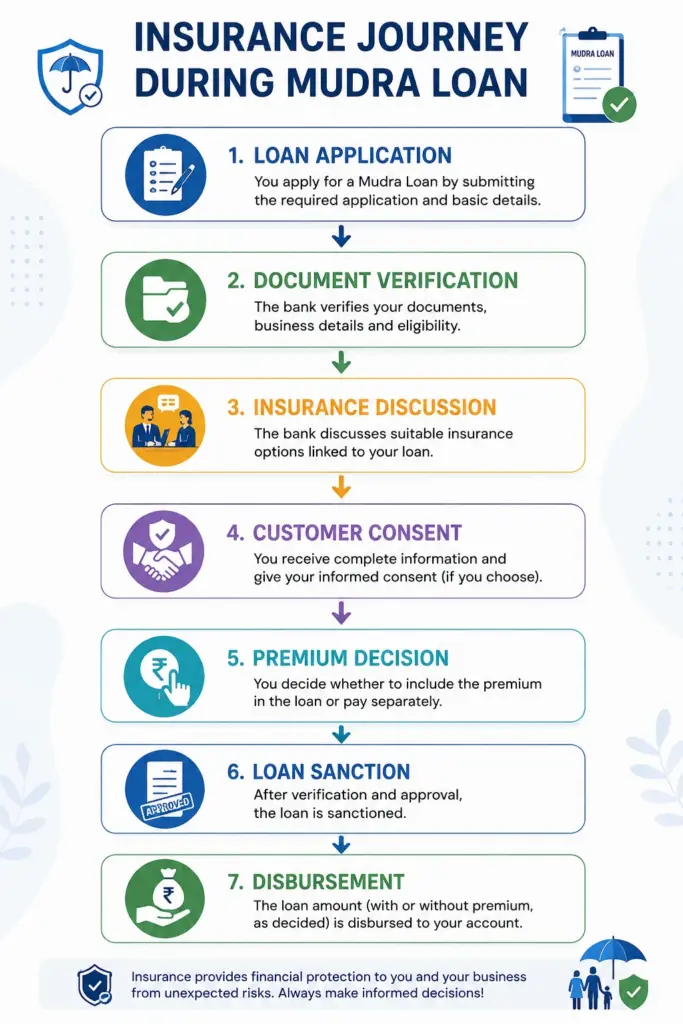
Insurance Journey During Mudra Loan

Insurance Journey During Mudra Loan flowchart showing the complete process from loan application and document verification to insurance discussion, customer consent, premium decision, loan sanction, and disbursement.

Loan Application

The insurance journey begins when you submit your Mudra Loan application along with the required documents and business details. At this stage, the bank records your financial requirements and starts evaluating your eligibility. Insurance is generally not finalized during the application stage but may be discussed later in the process.

Document Verification

The bank verifies your identity, address, business details, financial information, and other supporting documents to assess your eligibility. If the loan involves business assets or equipment, the bank may also evaluate whether insurance could help protect the financed assets against potential risks.

Insurance Discussion

After reviewing your application, the bank may explain various insurance options related to your loan or business. The purpose is to inform you about available coverage, policy benefits, premium costs, and protection offered. This discussion should help you make an informed decision without unnecessary pressure.

Customer Consent

Before any insurance policy is issued, you should receive complete information about its terms, coverage, exclusions, and premium. You should have the opportunity to ask questions and provide informed consent only after fully understanding the product and deciding whether it meets your requirements.

Premium Decision

If you decide to purchase insurance, the premium payment method is finalized at this stage. Depending on the policy and lender’s process, the premium may be paid separately or, where applicable, financed as part of the loan. Borrowers should clearly understand how the premium will be charged before proceeding.

Loan Sanction

Once document verification and internal approval are completed, the bank sanctions the Mudra Loan. If insurance has been selected, the approved loan documents generally include the relevant insurance details, premium information, and any applicable terms agreed upon during the application process.

Disbursement

After completing all formalities, the sanctioned loan amount is disbursed to the borrower’s account. If an insurance policy has been purchased, borrowers should verify the final disbursed amount, review the policy documents carefully, and retain copies of all loan and insurance records for future reference.

Complete Insurance Knowledge Library

Below is a pillar-page style library section where each topic briefly introduces the issue and encourages readers to explore the dedicated article for detailed guidance.


Hidden Insurance Charges in Mudra Loan

Hidden insurance charges can increase the total cost of your Mudra Loan without you fully realizing it. Sometimes borrowers notice insurance deductions only after the loan amount is disbursed or while reviewing loan documents. Understanding where these charges appear, why they are added, and how to verify them helps you avoid unexpected financial burdens and maintain complete transparency throughout the borrowing process.

👉 Read Complete Guide:
https://projectreportbank.com/hidden-insurance-charges-mudra-loan/


Can Insurance Premium Be Included in Mudra Loan?

Many applicants are unsure whether the insurance premium can legally be included in the sanctioned loan amount. The answer depends on the type of insurance, lender practices, and the borrower’s informed decision. Understanding how premium financing works helps you calculate your total borrowing cost, repayment obligation, and overall financial commitment before accepting any insurance product.

👉 Read Complete Guide:
https://projectreportbank.com/can-insurance-premium-included-mudra-loan/


Insurance Added Without Consent During Mudra Loan

Some borrowers discover that an insurance policy has been attached to their loan even though they do not remember approving it. This situation creates confusion and raises important questions about consent and transparency. Understanding how insurance should be offered and documented helps borrowers identify potential issues and take appropriate action if necessary.

👉 Read Complete Guide:
https://projectreportbank.com/insurance-added-without-consent-mudra-loan/


Warning Signs of Forced Cross-selling by Banks

Cross-selling is a common banking practice, but borrowers should know how to recognize the difference between a genuine recommendation and unnecessary pressure. Certain warning signs may indicate that additional financial products are being promoted inappropriately. Learning these signs helps applicants make independent decisions and avoid purchasing products that do not meet their actual needs.

👉 Read Complete Guide:
https://projectreportbank.com/warning-signs-forced-cross-selling-banks/


How to Identify Insurance Mis-selling During Mudra Loan Processing

Insurance mis-selling often occurs when important policy details, charges, or conditions are not explained properly before purchase. Borrowers who understand the common indicators of mis-selling can better evaluate insurance offers and avoid unnecessary expenses. Awareness also helps applicants ask the right questions before signing any loan or insurance documents.

👉 Read Complete Guide:
https://projectreportbank.com/identify-insurance-mis-selling-mudra-loan/


Credit Life Insurance vs Asset Insurance: Which One Is Needed?

Credit Life Insurance and Asset Insurance serve different purposes, yet many borrowers confuse them during the loan process. One primarily protects the outstanding loan liability, while the other protects financed business assets. Understanding their differences enables borrowers to choose suitable insurance coverage based on their business requirements and financial priorities.

👉 Read Complete Guide:
https://projectreportbank.com/credit-life-insurance-vs-asset-insurance/


Types of Insurance Offered with Mudra Loans

Banks may offer different insurance products depending on the borrower’s business activity and the type of financed asset. Understanding the purpose, benefits, and limitations of each insurance option helps applicants evaluate whether a particular policy provides meaningful protection or is simply an optional financial product being offered during the loan process.

👉 Read Complete Guide:
https://projectreportbank.com/types-of-insurance-offered-with-mudra-loans/


Why Banks Recommend Insurance with Mudra Loans

Many borrowers wonder why insurance is frequently discussed during the Mudra Loan process. Banks often recommend insurance to reduce financial risks and improve protection for both borrowers and financed assets. Understanding the reasons behind these recommendations allows applicants to distinguish between genuine financial advice and optional product promotion.

👉 Read Complete Guide:
https://projectreportbank.com/why-banks-recommend-insurance-mudra-loans/


Can You Refuse Insurance While Applying for a Mudra Loan?

One of the most frequently asked questions by borrowers is whether they can refuse insurance without affecting their loan application. Knowing when insurance is optional, what questions to ask, and how to communicate your decision confidently helps you make informed financial choices while maintaining transparency throughout the loan process.

👉 Read Complete Guide:
https://projectreportbank.com/can-you-refuse-insurance-mudra-loan/


Is Cross-selling During Mudra Loan Legal?

Cross-selling itself is a legitimate banking practice when carried out transparently and with the borrower’s informed consent. However, applicants should understand where the line is drawn between lawful product recommendations and practices that may become misleading or unfair. This guide explains the legal aspects of cross-selling and the rights of borrowers during the loan process.

👉 Read Complete Guide:
https://projectreportbank.com/cross-selling-mudra-loans-legal/

Which Guide Should You Read?

Find your exact Mudra Loan insurance or cross-selling problem and open the most relevant detailed guide.

If Your Problem Is Read This Guide
Hidden insurance deductions or unexpected premium charges Hidden Insurance Charges in Mudra Loan
Insurance added without your knowledge or permission Insurance Added Without Consent During Mudra Loan
Unsure whether insurance is compulsory or optional Can You Refuse Insurance While Applying for a Mudra Loan?
Insurance premium included in the sanctioned loan amount Can Insurance Premium Be Included in Mudra Loan?
Pressure to purchase insurance or another banking product Is Cross-selling During Mudra Loan Legal?
Suspected insurance mis-selling or misleading information How to Identify Insurance Mis-selling During Mudra Loan Processing
Confusion between Credit Life Insurance and Asset Insurance Credit Life Insurance vs Asset Insurance: Which One Is Needed?
Need information about available insurance products Types of Insurance Offered with Mudra Loans
Want to understand why banks recommend insurance Why Banks Recommend Insurance with Mudra Loans
Warning signs of forced selling or unfair cross-selling Warning Signs of Forced Cross-selling by Banks

Types of Problems Borrowers Face

Mudra Loan applicants may face different insurance and cross-selling problems during application, sanction, or disbursement. Understanding these issues helps borrowers identify the exact problem and take informed action.

💳

Hidden Charges

Insurance premiums or related charges may appear in the loan account, sanction terms, or disbursement statement without being clearly explained beforehand.

⚙️

Insurance Added Automatically

Some borrowers discover that an insurance policy has been attached to the loan process even though they did not knowingly select or request it.

🔄

Cross-selling

The bank may offer insurance or other financial products along with the Mudra Loan. The problem begins when the borrower does not clearly understand that these are additional products.

⚠️

Mis-selling

Mis-selling occurs when important policy terms, exclusions, premium costs, or the optional nature of insurance are not explained correctly.

No Consent

A borrower may not have given clear, informed, or written consent before the insurance premium was charged or the policy was issued.

🛡️

Wrong Insurance

The policy offered may not match the borrower’s actual need, business risk, financed asset, loan amount, or expected protection.

📄

Confusing Documentation

Loan forms, insurance declarations, sanction letters, and premium details may be difficult to understand, especially when information is spread across several documents.

📦

Bundled Premium

The insurance premium may be combined with the loan amount or deducted from disbursement, making it difficult for borrowers to identify the actual insurance cost.

Your Rights Regarding Insurance

Understanding your rights is one of the best ways to make informed decisions during the Mudra Loan process. While banks may recommend insurance products to protect borrowers and financed assets, every applicant has the right to receive complete information before accepting any insurance policy. Being aware of these rights helps prevent misunderstandings, improves transparency, and enables borrowers to choose insurance based on their actual needs rather than assumptions or pressure.

Right to Know the Insurance Premium

Before agreeing to any insurance policy, you have the right to know the exact premium amount that will be charged. The bank should clearly explain how much the insurance costs, whether it is a one-time or recurring premium, and how the payment will be made. Understanding the premium helps you calculate the total cost of your borrowing and avoid unexpected expenses.

Right to Refuse Optional Insurance

If an insurance product is optional, you have the right to decide whether you want to purchase it. A recommendation should never be confused with a compulsory requirement. Before making your decision, you should understand the policy’s benefits, coverage, and costs so you can determine whether it suits your financial needs and business requirements.

Right to Receive the Insurance Policy Copy

Whenever you purchase an insurance policy, you should receive a complete copy of the policy document or certificate of insurance. The policy should contain important information such as coverage details, premium amount, policy period, exclusions, and claim procedures. Keeping a copy of the policy allows you to understand your protection and refer to it whenever required.

Right to Ask Questions Before Signing

You should never feel hesitant to ask questions before signing any loan or insurance document. If you do not understand the purpose of an insurance policy, premium calculation, coverage, exclusions, or payment terms, you have the right to request clarification. Asking questions before signing helps you make informed decisions and reduces the risk of future misunderstandings.

Right to Give Informed Written Consent

Insurance should be issued only after you clearly understand the product and voluntarily agree to purchase it. Your consent should be based on complete information about the policy rather than assumptions or incomplete explanations. Reading every document carefully before signing ensures that your decision is informed and well considered.

Right to Raise a Complaint

If you believe that insurance-related information was not explained properly or you have concerns about the way a policy was offered, you have the right to use the bank’s grievance redressal process. You can request clarification, seek a review of the issue, and follow the appropriate complaint mechanism whenever you believe your concerns have not been addressed satisfactorily.

Right to Transparent Charges and Documentation

Every insurance-related charge connected with your Mudra Loan should be communicated clearly. Premium amounts, payment methods, policy details, and any related costs should be disclosed transparently before the loan is finalized. Carefully reviewing the sanction letter, loan agreement, and insurance documents helps ensure that you understand every charge associated with your loan.

Protect Yourself by Staying Informed

The best way to protect your interests is to stay informed throughout the loan process. Read every document carefully, understand each insurance product before accepting it, maintain copies of all loan and insurance records, and seek clarification whenever something is unclear. An informed borrower is better equipped to make confident financial decisions and avoid unnecessary disputes during the Mudra Loan journey.

Insurance vs Cross-selling vs Mis-selling

Understand the difference between a genuine insurance recommendation, normal cross-selling, forced selling, mis-selling, and hidden insurance charges during the Mudra Loan process.

Topic Meaning Generally Acceptable?
Insurance Recommendation The bank suggests a suitable insurance product, clearly explains its benefits and costs, and allows the borrower to decide voluntarily. ✔ Yes
Cross-selling The bank offers an additional financial product along with the loan, while leaving the final decision with the customer. ✔ Usually
Forced Cross-selling The customer is pressured to buy insurance or another product, or is made to believe that refusal could affect loan approval. ✘ No
Mis-selling The insurance product is sold using incorrect, incomplete, or misleading information about its cost, benefits, exclusions, or necessity. ✘ No
Hidden Charges An insurance premium or related cost is charged, financed, or deducted without being clearly disclosed to the borrower beforehand. ✘ No

Important: Whether a particular insurance requirement is applicable may depend on the financed asset, policy terms, lender conditions, and the facts of the individual loan. Borrowers should request written clarification before accepting or refusing any product.

Common Mistakes Borrowers Make

Many insurance-related problems arise because borrowers sign documents quickly, rely on verbal explanations, or fail to verify charges. Avoiding the following mistakes can improve transparency and reduce future disputes.

✍️

Signing Without Reading

Signing loan or insurance documents without reading them may result in accepting premiums, declarations, or policy terms that you did not fully understand.

💰

Not Asking the Premium Amount

Some borrowers accept insurance without confirming the exact premium, payment method, policy period, or effect on the total loan cost.

📄

Ignoring the Policy Copy

Failing to collect and review the insurance policy makes it difficult to verify coverage, exclusions, nominee details, premium, and claim conditions.

🗣️

Accepting Verbal Assurances

Verbal statements may later be difficult to prove. Important details about insurance, charges, or optional products should be confirmed in writing.

🔍

Not Checking the Sanction Letter

The sanction letter may contain important information about deductions, financed premiums, repayment terms, and other conditions that should be reviewed carefully.

⚠️

Believing Every Insurance Policy Is Compulsory

Borrowers sometimes accept insurance automatically because they assume all policies are mandatory. They should ask whether the product is required or optional.

🗂️

Not Keeping Documents

Losing copies of signed forms, sanction letters, premium receipts, emails, and policy documents can make future clarification or complaint handling more difficult.

✔ Prevention Checklist

Before Signing Any Loan or Insurance Documents

Use this simple checklist before accepting any insurance product during the Mudra Loan process. Spending a few extra minutes reviewing these points can help you avoid misunderstandings, unexpected charges, and future disputes.

☑ Read the loan sanction letter carefully.
☑ Ask for the exact insurance premium amount.
☑ Confirm whether the insurance is optional or mandatory.
☑ Collect a copy of the insurance policy or certificate.
☑ Verify that your consent has been obtained correctly.
☑ Preserve all loan and insurance documents safely.
☑ Compare available insurance policies before deciding.
☑ Ask for written clarification if anything is unclear.
Expert Tip: Never rely solely on verbal explanations. Always review the loan documents, insurance details, premium amount, and policy terms before signing. Keeping written records can help protect your interests if questions arise later.

Expert Guidance by CA Manish Gugliya

As a Chartered Accountant with over 20 years of practical experience in Project Reports, MSME Finance, Business Loans, and Mudra Loan consultancy, I have interacted with thousands of entrepreneurs seeking finance to start or expand their businesses. One common observation is that most insurance-related disputes do not arise because insurance itself is bad—they arise because borrowers do not fully understand what they are accepting. A few simple precautions before signing loan documents can save both money and unnecessary stress later.

Read Every Document Carefully

Never treat loan documents as routine paperwork. Before signing, carefully read the sanction letter, loan agreement, insurance proposal form, and any declarations attached to your application. Pay special attention to premium amounts, insurance coverage, policy duration, and repayment implications. If any clause is unclear, request an explanation before proceeding. Spending a few extra minutes reviewing documents can help prevent misunderstandings and unexpected financial obligations.

Never Sign Blank or Incomplete Forms

One of the biggest mistakes borrowers make is signing blank or partially completed forms because they trust that the remaining information will be filled correctly later. Every form should be completely filled before your signature is placed on it. Verify the details carefully, especially where insurance declarations, nominee information, premium amounts, or policy selections are mentioned. Your signature should always reflect your informed approval of the completed document.

Request Written Clarification Whenever Insurance Is Recommended

If a bank representative recommends an insurance policy, ask for the explanation in writing whenever possible. Written information helps you understand the policy’s purpose, coverage, exclusions, premium amount, and payment method. It also reduces the possibility of confusion arising from verbal discussions. A transparent explanation allows you to evaluate whether the insurance genuinely meets your business and financial needs.

Verify How the Insurance Premium Will Be Paid

Many borrowers focus only on the loan amount and overlook how the insurance premium will be collected. Before accepting any policy, confirm whether the premium is payable separately, deducted from the disbursed amount, or financed as part of the loan where applicable. Understanding the payment method helps you calculate the actual borrowing cost and avoid surprises after loan disbursement.

Compare Policy Benefits Before Making a Decision

Do not assume that the first insurance policy offered is automatically the most suitable. Different policies may provide different coverage, exclusions, claim conditions, and premium structures. Compare the available options carefully and choose the one that best matches your business requirements, financial capacity, and risk profile. An informed comparison often leads to better financial protection and greater value.

Keep Copies of Every Signed Document

Maintain a complete record of all documents related to your Mudra Loan and insurance policy. These records should include the loan application, sanction letter, insurance proposal form, policy document, premium receipt, consent forms, and any written communication received from the bank. Organized documentation becomes extremely valuable if you later need clarification, submit a claim, or resolve a dispute.

Raise Concerns Immediately If You Notice Unexplained Charges

After loan sanction or disbursement, carefully review the final loan statement and all related documents. If you notice insurance charges, premium deductions, or any other entries that were not explained to you earlier, contact the bank immediately and request clarification. Addressing concerns promptly often helps resolve misunderstandings quickly and prevents minor issues from becoming larger disputes.

Follow the Proper Complaint Process Before Escalating

If your concern is not resolved through normal communication with the branch, use the bank’s official grievance redressal process before approaching higher authorities. Clearly explain the issue, attach supporting documents, and maintain copies of all correspondence. Following the proper complaint procedure demonstrates that you have attempted to resolve the matter responsibly and helps create a documented record of your communication.

My Final Advice to Every Mudra Loan Applicant

Insurance should always be viewed as a financial protection tool rather than an automatic requirement. Make every decision based on clear information, written documentation, and your actual business needs. Never hesitate to ask questions, seek clarification, or take time to understand the policy before signing any document. A well-informed borrower is better equipped to distinguish between helpful financial advice, optional product recommendations, and practices that require further clarification. By staying informed, maintaining proper records, and communicating openly with the bank, you can complete your Mudra Loan journey with greater confidence, transparency, and peace of mind.

Frequently Asked Questions (FAQs)

1. Is insurance compulsory with a Mudra Loan?

Insurance may be recommended during the Mudra Loan process, but borrowers should clearly understand whether a particular policy is optional or required for their specific loan or financed asset. Always ask the bank to explain the purpose of the insurance before making a decision.


2. Can banks force me to buy insurance?

Banks may recommend insurance products, but borrowers should receive complete information and have the opportunity to make an informed decision. If you feel pressured, ask for written clarification before signing any document.


3. Can I refuse insurance while applying for a Mudra Loan?

If an insurance policy is optional, you may decide whether to purchase it after understanding its benefits, coverage, and costs. Always discuss your decision with the bank and seek clarification if you have any doubts.


4. Can the insurance premium be included in the loan amount?

Depending on the lender’s process and the insurance product, the premium may sometimes be financed as part of the loan or collected separately. Always confirm how the premium will be paid before accepting the policy.


5. What is Credit Life Insurance?

Credit Life Insurance is designed to help repay the outstanding loan amount if the insured borrower dies during the loan tenure, subject to the policy’s terms and conditions.


6. What is Asset Insurance?

Asset Insurance protects business assets such as machinery, equipment, vehicles, or other financed property against covered risks like fire, theft, or accidental damage, depending on the policy.


7. How can I know whether insurance has been added to my loan?

Review your sanction letter, loan agreement, insurance documents, premium receipts, and final disbursement statement. These documents usually indicate whether an insurance policy has been included.


8. What should I do if insurance was added without my knowledge?

Immediately contact the bank, request a written explanation, and review all signed documents carefully. Keep copies of every communication for future reference.


9. Can I cancel an insurance policy after purchasing it?

The cancellation process depends on the terms and conditions of the specific insurance policy. Contact the insurer or the bank to understand the applicable procedure and available options.


10. Will refusing optional insurance affect my loan approval?

Loan approval depends on several factors, including eligibility, documentation, repayment capacity, and the bank’s assessment. If you have concerns, ask the bank to explain the role of the insurance product in your specific application.


11. What insurance-related documents should I collect?

You should keep copies of the insurance policy, premium receipt, proposal form, consent declaration, sanction letter, and any written communication regarding the insurance.


12. Can I complain about cross-selling practices?

Yes. If you believe an insurance or financial product was not explained properly or you have concerns about the sales process, you can use the bank’s official grievance redressal mechanism.


13. What are hidden insurance charges?

Hidden insurance charges are costs or premium deductions that borrowers may not have clearly understood or noticed before loan sanction or disbursement. Always review loan documents carefully to identify all charges.


14. Can banks deduct the insurance premium automatically?

The method of premium collection depends on the policy and loan arrangement. Before signing, ask the bank how the premium will be paid and whether it affects the sanctioned loan amount or disbursement.


15. Which insurance is most useful for a Mudra Loan borrower?

The appropriate insurance depends on your business, financed assets, financial responsibilities, and personal circumstances. Evaluate the policy benefits and your actual needs before making a decision.


16. Is cross-selling legal?

Cross-selling is a common banking practice when additional products are offered transparently and borrowers are free to decide whether to purchase them.


17. What is insurance mis-selling?

Insurance mis-selling occurs when important information about the policy, premium, coverage, exclusions, or optional nature of the insurance is not explained accurately or completely before purchase.


18. Can insurance increase my EMI?

If the insurance premium is financed along with the loan, it may affect the total borrowing amount and repayment obligation. Always confirm the financial impact before accepting the policy.


19. What should I do if I have already signed the documents?

Review the documents you signed, collect copies of all loan and insurance records, and contact the bank if you need clarification regarding any policy, premium, or charge.


20. How can I verify my insurance policy?

Check the policy document, certificate of insurance, premium receipt, coverage details, policy number, and insurer’s information. Verify that the details match what was explained before you signed.


21. Should I rely only on verbal explanations from the bank?

No. Always request written information about the insurance policy, premium amount, coverage, and important terms. Written documentation helps avoid misunderstandings later.


22. How can I avoid insurance-related disputes during the loan process?

Read every document carefully, ask questions, understand the premium and policy terms, keep copies of all records, and seek written clarification whenever something is unclear.


23. Why do banks recommend insurance with Mudra Loans?

Banks may recommend insurance to provide financial protection to borrowers and, where applicable, to safeguard financed assets against unforeseen risks. Understanding the purpose of the recommendation helps you decide whether the coverage is suitable for your needs.


24. What is the difference between insurance recommendation and forced selling?

An insurance recommendation provides information and allows you to decide voluntarily. Forced selling occurs when a borrower feels pressured or believes that purchasing insurance is necessary for loan approval without having a genuine choice.


25. How can I make an informed decision before purchasing insurance?

Take time to compare available policies, understand the coverage and exclusions, verify the premium amount, ask questions, and ensure you are comfortable with the policy before giving your consent.

Conclusion

Understanding Mudra Loan Insurance & Cross-selling Issues is an important part of making informed financial decisions during the loan application process. Insurance itself is not something borrowers should automatically avoid. When selected voluntarily and after understanding its purpose, the right insurance policy can provide valuable financial protection for both the borrower and the business. Whether it is protecting business assets or reducing financial risk in unforeseen circumstances, insurance can be beneficial when it aligns with the borrower’s actual needs and is supported by complete information.

At the same time, every borrower should understand the difference between a genuine recommendation and a compulsory requirement. Banks may recommend insurance or other financial products as part of their overall services, but borrowers should never assume that every recommendation must be accepted without question. Before agreeing to any insurance product, applicants should understand the premium amount, policy benefits, exclusions, payment method, and how the insurance affects the overall loan cost. Taking a few extra minutes to ask questions and review the documents can prevent confusion and unnecessary expenses later.

Transparency and informed consent play a vital role in a smooth loan experience. Carefully reading the sanction letter, loan agreement, insurance documents, and premium details helps borrowers identify any unexpected charges before signing. Collecting policy copies, preserving important records, and requesting written clarification whenever something is unclear are simple yet effective practices that reduce the risk of hidden charges, insurance mis-selling, and future disputes. An informed borrower is always in a stronger position to make confident financial decisions.

If you are facing a specific insurance or cross-selling issue during your Mudra Loan journey, use the navigation and comparison sections in this guide to quickly identify the topic that matches your situation. Each detailed guide explores a particular issue in depth, providing practical explanations and step-by-step guidance to help you understand your options and make informed decisions. By improving your awareness of insurance, borrower rights, and responsible banking practices, you can approach the Mudra Loan process with greater confidence, transparency, and peace of mind.

Mudra Loan Insurance & Cross-selling Issues: Complete Guide to Your Rights and Safe Borrowing

Mudra Loan Insurance & Cross-selling Issues: Complete Guide to Your Rights and Safe Borrowing

Introduction Applying for a Mudra Loan is an important step for entrepreneurs, small business owners, startups, and self-employed individuals looking to finance or expand their businesses. During the application process, many borrowers are offered insurance products along with their loan. While insurance can provide valuable financial protection, many applicants are unsure whether accepting it is […]
Hidden Insurance Charges in Mudra Loans: How to Spot Them

Hidden Insurance Charges in Mudra Loans: How to Spot Them

Key Takeaways Introduction: Why Hidden Insurance Charges Matter in Mudra Loans Most Mudra loan borrowers focus on three things: the loan amount, the interest rate, and the monthly EMI. That makes sense. You want to know how much money you are getting and how much you have to pay back. But many applicants forget to […]

Can Insurance Premium Be Included in Your Mudra Loan Amount?

Can Insurance Premium Be Included in Your Mudra Loan Amount?

Key Takeaways Introduction: Why Mudra Loan Amount and Insurance Premium Confuse Borrowers In my 20+ years as a Chartered Accountant helping MSMEs with project reports and business loans, I have seen one situation repeat itself hundreds of times. An entrepreneur applies for a ₹5,00,000 Mudra loan under PMMY, gets approval, celebrates – and then sees […]
What to Do If Insurance Was Added Without Your Consent in a Mudra Loan

What to Do If Insurance Was Added Without Your Consent in a Mudra Loan

Key Takeaways Many Mudra loan borrowers later discover an insurance premium deducted from their account without clear consent. This article explains exactly what to do, step by step. Introduction: When You Discover Insurance Added Without Consent Imagine this. In June 2025, a small kirana shop owner in Jaipur applies for a ₹3,00,000 Kishore Mudra loan. […]
Warning Signs of Forced Cross-selling by Banks

Warning Signs of Forced Cross-selling by Banks

Key Takeaways Introduction: Why You Must Recognize Forced Cross-selling in 2026–2027 Cross selling in banking simply means a bank offering extra financial products-like life insurance, credit cards, mutual funds, or a new savings account-to existing customers when they come in for a basic service such as a loan or account opening. Banks use customer data […]
How to Identify Insurance Mis‑selling During Mudra Loan Processing

How to Identify Insurance Mis‑selling During Mudra Loan Processing

Key Takeaways Introduction: Why Mudra Borrowers Must Watch for Insurance Mis‑selling In my 20+ years as a Chartered Accountant handling project reports, CMA data, and Mudra loan consultancy, I have met hundreds of small entrepreneurs who walked into a bank for financial assistance and walked out with an insurance policy they never asked for. This […]
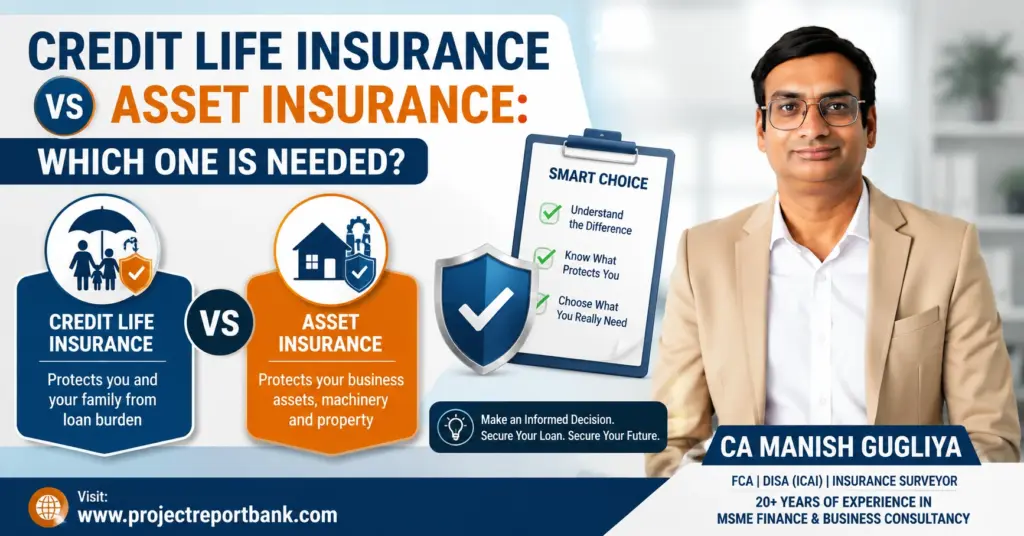
Credit Life Insurance vs Asset Insurance: Which Is Better for Mudra Loan Borrowers?

Credit Life Insurance vs Asset Insurance: Which Is Better for Mudra Loan Borrowers?

A bank sanctions your Mudra Loan and presents two insurance products at the counter. One is called credit life insurance. The other is asset insurance. The loan officer tells you both are “recommended.” You are not sure what either one does, whether you actually need them, or whether you can refuse. Most borrowers sign without […]

Types of Insurance Offered with Mudra Loans Explained

Types of Insurance Offered with Mudra Loans Explained

Key Takeaways When you walk into a bank or financial institution to apply for a Mudra loan, there is a good chance the staff will present you with one or more insurance products alongside your loan paperwork. Many borrowers feel confused or pressured during this step and end up buying policies they do not fully […]

Why Do Banks Recommend Insurance with Mudra Loans?

Why Do Banks Recommend Insurance with Mudra Loans?

Key Takeaways Introduction: Mudra Loan Approved, But Bank Is Pushing Insurance – Why? Imagine this: you fill out the mudra loan application form for a ₹3 lakh loan at your nearest branch. The bank approves your loan amount – but then staff say you must buy an insurance policy “otherwise the loan will not be […]

Facebook
Twitter
LinkedIn