Key Takeaways
- Under Pradhan Mantri Mudra Yojana (PMMY), most insurance products sold alongside mudra loans are optional, not automatically compulsory for every borrower.
- Borrowers can usually refuse credit life or personal accident insurance, and the bank should generally not reject a genuine loan application only for that reason. Declining optional life insurance does not affect loan application eligibility under PMMY.
- Asset insurance (for vehicles, machinery, shop stock, etc.) can be legitimately required when those capital assets are financed and hypothecated as security for the mudra loan. Some banks may require asset insurance for secured business assets purchased with the loan.
- If bank staff insist “loan will not be sanctioned without this policy,” ask for written proof, escalate to the Branch Manager, and if needed, use the bank’s grievance redressal and RBI complaint routes.
- If life insurance is declined, a lender cannot reject the loan application solely for that reason.
Introduction: Mudra Loans, Insurance Confusion, and Your Rights
I am CA Manish Gugliya (FCA), and over my 20+ years of work in MSME finance, business loans, project reports, and mudra loan consultancy, I have personally seen hundreds of small entrepreneurs walk into a bank branch for financial assistance and walk out confused about insurance policies they never asked for.
Let me set the context. Pradhan Mantri Mudra Yojana (PMMY) is a government scheme designed to provide collateral-free business loans for micro and small non-farm enterprises. The scheme covers shops, traders, services sectors units, food processing businesses, and small manufacturing setups. MUDRA Yojana supports micro and small businesses across various sectors, and MUDRA loans are available through banks and NBFCs. You can apply for a MUDRA loan online or offline. The maximum loan amount under MUDRA is ₹20 lakh, and MUDRA Yojana offers collateral-free loans up to ₹20 lakh. Applicants must be aged between 18 to 65 years, and the scheme is available for non-farm businesses only. Eligible businesses include vendors, small producers, and service providers.
Here is what typically happens. You fill your mudra loan application at the branch. Your documents are in order. The loan officer reviews your business plan. Then, just before things move forward, a separate form appears. “Sir, please sign this also. This is compulsory. Without this insurance policy, your loan will not pass.”
This moment creates enormous confusion, especially for first-time entrepreneurs and individual borrowers who do not know the difference between the loan itself and an insurance product being offered alongside it.
The central question is simple: can you refuse insurance while applying for a mudra loan?
In this article, I will give you a practical, experience-based answer. You will learn what types of insurance are linked to mudra loans, what is mandatory versus optional, how your refusal affects loan approval, how to identify mis-selling, and what to do step by step if you are pressured. This guidance comes from actual banking practice, RBI circular logic, and real mudra loan files handled through ProjectReportBank.com.

Table of Contents
What Is Loan Insurance in the Context of Mudra Loans?
“Loan insurance” is not one single product. It is a group of insurance covers that banks commonly bundle with business loans, including mudra loans. Let me break down each type so you have full knowledge before you visit a branch.
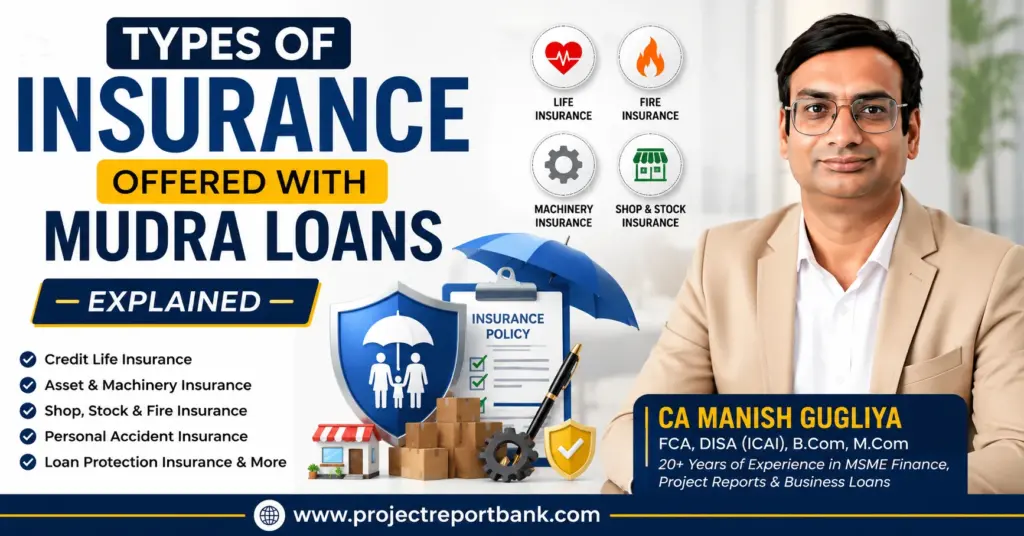
Credit Life Insurance This is a policy that repays the outstanding loan if the borrower dies during the loan tenure. The premium is usually a one-time payment, and in many cases, banks quietly add it to the loan amount itself. So instead of receiving ₹5 lakh in hand, you might only receive ₹4.85 lakh because ₹15,000 was deducted for credit life cover. Banks may bundle optional insurance to protect their interests in exactly this manner.
Personal Accident Insurance This covers disability or accidental death of the borrower. Banks often club this with credit life for small ticket loans under Shishu, Kishor, and Tarun categories. It is usually optional, though staff may present it as part of a “package.”
Asset Insurance This covers the financed asset – a commercial vehicle, machinery, equipment, or shop stock. Where an asset is hypothecated to the bank (meaning the bank has a claim on it until the loan is repaid), insuring that asset is standard banking practice and often genuinely required.
Business or Shop Insurance Covers fire, burglary, or other risks to business premises or stock that might be financed under PMMY. This is generally advisable for any enterprise but not automatically mandatory for every mudra loan.
Optional Riders and Add-ons Critical illness cover, hospital cash, and other extras are purely optional products. These should never be shown as a condition for your mudra loan approval.
Is Insurance Mandatory Under Pradhan Mantri Mudra Yojana?
This is where most confusion sits. Let me be direct.
PMMY guidelines focus on funding small businesses across three main categories: Shishu loans offer up to ₹50,000 for startups, Kishore loans range from ₹50,000 to ₹5 lakh, and Tarun loans provide ₹5 lakh to ₹10 lakh for established businesses. There is also the Tarun Plus category with loans ranging from ₹10 lakh to ₹20 lakh. According to PMMY FAQs published by Invest India, life insurance is not required for loans under PMMY.
The objective of mudra yojana is to provide collateral-free credit to non-corporate small businesses and micro enterprises engaged in trading, manufacturing, and services. It is not designed to sell insurance products. Loan approval and insurance purchase are conceptually separate decisions.
No general RBI circular says “insurance is compulsory for each mudra loan.” The Reserve Bank of India emphasizes that insurance should be sold only with the borrower’s consent. However, RBI does encourage banks to offer suitable insurance protection to small borrowers.
Here is the important distinction:
- Mandatory asset insurance: When a specific asset financed under the loan is kept as primary security. For example, a ₹3 lakh Kishor category loan for buying a delivery vehicle may justifiably require comprehensive vehicle insurance naming the bank as hypothecation holder.
- Optional credit life or PA cover: A ₹2 lakh working capital mudra loan for a tailoring shop without any fixed asset financed usually cannot be forced with mandatory life insurance.
Individual banks may have internal risk policies recommending insurance for certain ticket sizes. Some state-level SOPs, like Rajasthan’s, mention “comprehensive insurance for stocks/equipment with bank’s clause” under Kishore and Tarun categories. But these policies must still respect RBI’s rules on customer choice. MUDRA loans are collateral-free for amounts up to ₹10 lakh.
If staff claim “PMMY rules make this insurance compulsory,” ask them to show you the relevant written bank circular. No circular, no compulsion.
Can You Refuse Insurance While Applying for a Mudra Loan?
In most normal cases, yes, you can decline optional insurance like credit life or personal accident cover, and your mudra loan application should still be processed on its own merits. Declining optional life insurance does not affect loan application eligibility under PMMY.
You are entitled to know:
- The product name and insurer name
- The premium amount
- The coverage and tenure
- Whether buying the policy is mandatory or optional
For purely unsecured working capital mudra loans – say ₹1 to ₹5 lakh for traders or service providers with no specific asset financed – life or PA insurance is generally optional. Banks should not deny the loan solely for refusing it. No collateral is required for MUDRA loans up to ₹10 lakh, and the scheme is designed to help eligible borrowers access credit without unnecessary barriers.
The exception: Where the mudra loan funds a particular asset (shop machinery, commercial vehicle, or other hypothecated items), the bank can reasonably require insurance on that asset as part of loan terms. Even then, the borrower can usually choose the insurer, subject to the bank’s minimum coverage conditions.
How to refuse practically:
- Politely tell the staff you understand the benefit but do not wish to buy the policy.
- Ask them to process the loan application without the insurance.
- If needed, give a written declaration that you are voluntarily declining optional cover.
Refusal of optional insurance should not by itself lower the sanctioned loan amount, delay sanction, or change the interest rate. If such changes are threatened, this is a red flag for mis-selling. Keep written proof (email, application copy, or a note in the sanction letter) showing that insurance was offered but refused. Interest rates for MUDRA loans are generally lower than traditional loans, and this should remain unaffected by your insurance decision.

Why Do Banks Recommend Insurance with Mudra Loans?
Banks are not always wrong to suggest insurance. There are both genuine risk-management reasons and sales-related motivations behind these offers. Let me give you a balanced view.
Genuine reasons:
- Risk protection for families: If the mudra borrower dies or faces disability, credit life or PA insurance ensures the bank recovers the loan and the family is not suddenly burdened with EMIs.
- Asset protection: For loans funding vehicles, machinery, or shop assets created with the loan, banks rely on those assets as primary security. Insuring them protects both the borrower’s business and the bank’s recoverability.
- Regulatory encouragement: RBI and IRDAI encourage responsible selling of suitable insurance to under-served segments. Banks use mudra loans as an opportunity to close the protection gap for small entrepreneurs. MUDRA Yojana enhances access to funds for small entrepreneurs, and linking insurance can complement that financial support.
Business motives:
- Cross-selling targets set by bank management
- Commission income on insurance policies
- Staff performance incentives and appraisal metrics
From my experience across many districts, frontline staff are under pressure to achieve both mudra loan and insurance numbers. This sometimes results in them presenting insurance as “compulsory” even when it is not.
My advice: listen to the reasons, evaluate the benefit for your family and business, but treat the final decision to buy or refuse optional cover as your own – not the banker’s.
Mandatory vs Optional Insurance: How to Tell the Difference
Many misunderstandings arise because borrowers do not know how to distinguish between genuinely mandatory insurance conditions and optional value-added products. This table should help.
| Factor | Mandatory Insurance | Optional Insurance |
|---|---|---|
| Purpose | Protect a specific asset financed by the loan (vehicle, machinery, stock) | Additional cover for borrower’s life, accident, health |
| Legal Basis | Loan agreement clause, sanction letter condition, bank’s security interest | Separate insurance proposal form, no link in loan sanction terms |
| Borrower’s Choice | Limited – must insure the asset, but can often choose insurer | Full – borrower can accept or decline freely |
| Effect on Mudra Loan | Loan may not be disbursed until asset cover is in place | Loan should be sanctioned/disbursed regardless of decision |
| Documentation | Mentioned in sanction letter, hypothecation agreement | Separate consent form, policy proposal, key fact statement |
| Premium Payment | Usually paid by borrower directly or via loan amount | Should only be deducted with clear, written consent |
| Examples | Comprehensive vehicle insurance for a financed delivery van; fire insurance on mortgaged shop | Credit life on ₹8 lakh Tarun working capital loan; bundled PA policy on Shishu loan |
The practical test: If the bank or financial institution cannot show a written rule, policy, or clause in the sanction letter calling the cover “compulsory,” it should be treated as optional.
Always check whether you are signing a loan document or an insurance proposal form. This is where mandatory versus optional status becomes visible.
Can the Bank Reject Your Mudra Loan If You Refuse Insurance?
A genuine mudra loan application that meets eligibility criteria, documentation norms, and credit norms should not be rejected only because the borrower declined optional insurance.
Banks are allowed to assess risk based on business stability, cash flow, CIBIL score or satisfactory credit track record, existing loans, and whether the applicant has successfully repaid previous loans. But they are not permitted to make unrelated product purchases a hidden condition for basic credit access. If life insurance is declined, a lender cannot reject the loan application solely for that reason.
The nuance: If the loan structure itself assumes a particular cover (for example, a group credit life scheme built into a pre-designed bundled product), the bank may insist on that scheme. But this feature must be transparently disclosed in the product brochure and sanction terms.
From my field experience: A borrower applied for an ₹8 lakh mudra loan under the Tarun category, fully unsecured, where the branch hinted that sanction would be “easier” if credit life was taken. This is a soft pressure tactic, not a formal rejection ground.
If a bank officer says “Loan will be rejected if you don’t buy this policy,” calmly ask for this condition in writing on bank letterhead or in the loan sanction note. In practice, such written statements are rarely given.
If the application is later declined and “refusal to take insurance” appears as a reason, this can be challenged through the bank’s grievance redressal system and, if needed, with the RBI Integrated Ombudsman Scheme.
However, if asset insurance is declined, the lender may deny the loan due to internal risk policies – and that is a different, legitimate situation where the security itself is at stake.
Borrowers can escalate issues regarding forced insurance purchases. Document every conversation – date, time, name of official – so that any unfair linkage between mudra loan approval and insurance purchase can be proved if a formal complaint becomes necessary.
Warning Signs of Insurance Mis-selling in Mudra Loans
While many bankers act ethically, some cases of insurance mis-selling happen in mudra loans, especially to first-time borrowers and women entrepreneurs who may not be familiar with financial jargon. According to IRDAI’s Annual Report 2024-25, there were 26,667 complaints of mis-selling and unfair business practices – a 14% increase year-on-year.
Watch out for these red flags:
- Statements like “Insurance is compulsory for every mudra loan” without showing any circular or letter
- Threats that “loan will not be approved” if you refuse
- Refusal to accept a loan application unless insurance forms are also signed
- Premium amount not disclosed clearly before you sign
- Insurance charges quietly added to the loan amount or processing fees
- No copy of the policy or key fact statement given after issuance
- Forced signatures on blank or partly filled forms – “sign here quickly, we will fill the rest later”
- Including borrowers as members of a group insurance plan without their informed consent
- Sanction letters showing a higher disbursed loan amount than the cash actually credited because a portion was used to pay an insurance premium without properly explaining this deduction
Whenever you feel rushed, confused, or not allowed to read documents peacefully, pause the process. Ask for clarification before signing. You have every right to read every form and understand every detail before you submit anything.

What Should You Do If Bank Staff Force Insurance with Your Mudra Loan?
Here is a clear step-by-step action guide you can follow while sitting in the branch.
Step 1: Stay calm and polite. Do not argue emotionally. Firmly state that you want to understand whether the insurance is compulsory under PMMY or just recommended by the bank.
Step 2: Ask the official to show you the written rule – a bank circular, product brochure, or PMMY guideline – that says the specific insurance is mandatory for your loan type and loan amount.
Step 3: If they still insist, request a written note on branch letterhead (or email) stating that the mudra loan application will not be accepted or sanctioned without buying that particular policy. In practice, such written notes are rarely given because staff know the requirement is not official.
Step 4: Read every document before signing. Refuse to sign blank or partially filled insurance forms. Ensure the proposal form clearly mentions sum assured, premium, tenure, and your correct contact details. Check your identity proof and other documents are correctly reflected.
Step 5: Keep photocopies or scanned copies of all forms you sign, including insurance-related documents. Verify later that you actually receive the policy document or e-policy from the insurer.
Step 6: If pressure continues, escalate politely to the Branch Manager, then to the bank’s regional office or customer care. If still unresolved, use the bank’s grievance mechanism and then the RBI Integrated Ombudsman Scheme, clearly explaining that you are facing forced cross-selling tied to a mudra loan. Borrowers can escalate issues regarding forced insurance purchases through these channels.
When Can Insurance Actually Be Useful for Mudra Borrowers?
Although mis-selling is a real issue, appropriate insurance can genuinely protect small business owners and their families, especially for loans in the Kishor and Tarun categories up to 10 lakh.
Credit life insurance on a mudra loan can ensure that, in case of the borrower’s sudden death, the outstanding loan is repaid by the insurer. This prevents legal recovery action against the family and protects the borrower’s credit record. For individual borrowers whose families depend entirely on their income, this is a legitimate form of security.
Asset insurance is clearly helpful in scenarios like:
- A fire in a small manufacturing unit destroying assets created with the loan
- Theft of stock from a retail shop
- Accident damage to a commercial vehicle purchased under mudra yojana
In each case, the claim amount can help the business restart instead of shutting down.
For women entrepreneurs or first-generation business owners with no other savings, a reasonably priced life or accident cover linked to a ₹5–₹8 lakh mudra loan can act as basic financial protection until the enterprise stabilizes.
Before deciding, compare:
- Premiums across providers
- Whether the policy is reducing-cover (linked only to outstanding loan) or level-cover (fixed sum assured)
- The claim process and settlement ratio
- Whether a simple term policy outside the bank might suit you better
Treat insurance as a separate, thoughtful decision. Take a day to think and discuss with your family or a trusted advisor. Do not buy just to “get the loan fast.” Accepting or rejecting optional insurance should follow what is best for your financial situation, not what makes the loan officer happy.
Common Myths and Facts About Insurance with Mudra Loans
Based on typical doubts I encounter while helping clients with mudra loan documentation across various banks, here is a myth-versus-fact clarification.
| Myth | Fact |
|---|---|
| Insurance is compulsory for every mudra loan. | PMMY does not make life insurance compulsory for all. Asset insurance may be required only when a financed asset is hypothecated. |
| Bank will automatically reject my loan if I don’t take insurance. | Banks should assess loan applications based on credit parameters – business viability, credit requirement, previous loans history – not on policy purchase. If life insurance is declined, a lender cannot reject the loan application solely for that reason. |
| Every borrower up to ₹10 lakh Tarun category has to buy life insurance from the bank’s tied insurer. | Borrowers often have freedom to choose their insurer, especially for optional covers. |
| Insurance is always a waste of money. | Properly chosen insurance can be very useful in case of death, disability, fire, or theft – especially for micro enterprises with no other financial cushion. |
| Bank employees earn huge commissions, so they always force policies. | While branches may get incentives on cross-selling, this does not legally allow them to force products or hide information. The proposed Insurance Bill 2025 further tightens commission disclosure norms. |
| If I refuse insurance, the bank will give me a higher interest rate. | Optional insurance refusal should not change the interest rate on your mudra loan. If it does, demand the written sanction terms showing this linkage. |
For deeper reading, explore related guides on Mudra Loan Applicant Rights and Cross-Selling in Mudra Loans: What Is Legal and What Is Not? on ProjectReportBank.com.
Practical Example: Refusing Insurance on an ₹8 Lakh Mudra Tarun Loan
Let me walk you through a realistic scenario based on cases I have handled.
The borrower: Ramesh, a small manufacturing entrepreneur running a steel fabrication workshop. In 2026, he applies for an ₹8 lakh mudra loan under the tarun category to purchase equipment and manage working capital for expanding his enterprise.
The application process: Ramesh fills the PMMY form at a public sector bank branch. He submits his project report and CMA data (prepared with support from ProjectReportBank.com), along with his business registration documents, rent agreement for the workshop, proof of identity, educational qualification certificates, and other documents required by the bank. His proposed activity and business plan are assessed based on his cash flow projections and necessary skills.
The insurance offer: The loan officer reviews everything and then brings out a credit life insurance proposal form worth ₹8 lakh with a one-time premium of about ₹18,000, to be added to the loan amount. The officer says, “Everyone takes this policy. Without this, HO may not approve your file.”
What Ramesh does (using the knowledge from this article):
- He asks: “Is this insurance compulsory under mudra yojana, or is it optional?”
- He asks: “Can I buy similar cover from another insurer?”
- He asks: “How much premium will be deducted from my loan amount?”
- He asks: “Will refusal affect the sanction or interest rate?”
Two possible outcomes:
- Outcome A: Ramesh understands the benefits, evaluates the premium against his budget, and knowingly decides to take the policy. He signs the proposal form after reading every detail. This is an informed, voluntary purchase – perfectly fine.
- Outcome B: Ramesh gives a written refusal for optional insurance. The bank processes his ₹8 lakh mudra loan based on financial viability alone, since he is an eligible applicant with a viable credit requirement and his proposed activity is sound. Approval for MUDRA loans can take a few days, and his loan is sanctioned without the insurance. Loans under MUDRA Yojana are approved quickly without collateral.
A professional advisor like a CA can help in reading sanction letters and ensuring no hidden insurance charges are built into the final loan amount or EMI schedule. The loan extended should match exactly what was sanctioned, minus only legitimate bank charges.

Expert Tips from CA Manish Gugliya for Mudra Loan Applicants
Here are 15 practical tips drawn from my 20+ years of experience preparing project reports and assisting in MSME and mudra loan sanctions.
- Separate the loan and the insurance in your mind. They are two different financial products governed by different guidelines and different regulators.
- Never sign anything you have not read. Whether it is a loan form or an insurance proposal – read every word before you sign.
- Always ask: “Is this mandatory or optional?” Get the answer before picking up the pen.
- Get every important condition written into the sanction letter. Verbal promises mean nothing in banking.
- Calculate your total cost of borrowing. Add up principal, interest, processing fees, and any insurance premium that may be financed from the loan amount. Know your real effective cost.
- Maintain a small file with copies of your loan application, sanction letter, insurance proposal (if any), and policy schedule. This helps resolve any later disputes.
- Verify how much cash you actually received versus the sanctioned loan amount. If there is a gap, find out exactly what was deducted and why.
- Compare insurance options. If you decide insurance is useful, get quotes from at least two providers. You are not obligated to buy only from the bank’s partner, especially for optional covers.
- Know the free-look period. Most policies allow cancellation within 15 days of receiving the policy document if you change your mind.
- For Tarun category loans close to 10 lakh, take a local CA, financial advisor, or experienced entrepreneur into confidence before signing, especially when multiple add-on products are being offered.
- Understand your eligibility criteria clearly. Mudra loans are available for micro enterprises, small enterprises, and small businesses. A valid business plan, proof of identity, business registration, and relevant other documents are what matter – not insurance purchase.
- Use a mudra card for tracking and managing working capital drawdowns if your bank offers one. This keeps your credit needs and fund usage transparent.
- Remember that mudra stands for Micro Units Development and Refinance Agency. It is a refinance agency that supports banks and financial institutions in covering loans to beneficiary micro unit borrowers – the scheme is designed for your benefit.
- Do not feel shy about asking questions. Mudra loans are a government scheme meant to provide financial support to small businesses. You are not taking a personal favour. The bank receives funding and subsidy support for lending under this scheme.
- Use detailed guides available on ProjectReportBank.com about Mudra Loan Illegal Bank Practices and How to Identify Illegal Bank Practices During Mudra Loan Processing to stay informed before visiting the branch.
Conclusion
The answer to whether you can refuse insurance while applying for a mudra loan is clear: for optional products like credit life or personal accident insurance, yes, you can refuse, and your loan should still be processed on merit. For asset insurance on financed and hypothecated items, banks can legitimately require coverage, but you often retain the right to choose your insurer.
Understanding the difference between mandatory and optional insurance puts you in control. Read every document before signing. Ask questions whenever something is unclear. Do not make financial decisions under pressure.
Mudra yojana was created to empower micro enterprises and small businesses with accessible finance. As a borrower and an eligible applicant, you have rights – exercise them confidently.
For comprehensive guidance on mudra loan documentation, project reports, CMA data, and borrower rights, explore the resources at ProjectReportBank.com.
Frequently Asked Questions
Can I cancel the insurance policy later if I realise it was optional?
Most insurers offer a “free-look period” – usually 15 days from receiving the policy document – during which you can cancel the policy if you feel it was mis-sold. You may face minor deductions for stamp duty or risk premium for days already covered. If the premium was funded from the mudra loan amount, cancelling the policy will not automatically reduce the outstanding principal. The refund goes to the loan account and reduces the balance, but EMIs may only be recalculated if the bank agrees. If you discover within a few days that you never wanted the cover, write immediately to both the bank and the insurance company, and to the other legal entity that issued the policy.
Can I buy required insurance from another company instead of the one suggested by the bank?
For optional covers, borrowers generally have the freedom to choose any insurer. The bank will naturally promote its tie-up partner, but the RBI Master Circular on Para-banking Activities prohibits banks from forcing customers to use only one insurer. For mandatory asset insurance, banks may insist on certain minimum features (sum insured, hypothecation endorsement, etc.) but cannot usually force a single company if equivalent cover from another legal entity is available. If you want to use another insurer, provide the draft policy or cover note to the bank so they can confirm their security interest – for example, marking the bank as “loss payee” – is properly recorded. Some bank-designed bundled mudra products build group insurance into the scheme; in such cases, ask if a plain-vanilla mudra loan without the bundle is availed separately.
What if I discover an insurance premium added to my Mudra loan after disbursal?
Check the loan account statement, sanction letter, and any policy documents received to confirm whether an insurance premium was debited from the loan amount without your clear consent. Meet or email the Branch Manager with copies of documents, stating that you were not informed or did not voluntarily opt for the cover, and ask for reversal or cancellation within the insurer’s allowed time limits. If the bank is uncooperative, escalate via the bank’s grievance redressal system, then the RBI Integrated Ombudsman, specifically citing “insurance mis-selling” linked to a mudra loan.
Does refusing insurance affect my CIBIL score or future loans?
No. Simply refusing optional insurance has no direct impact on your CIBIL score. CIBIL mainly tracks how you repay loans and credit cards, not whether you buy insurance products suggested by the bank. What can hurt your credit score is defaulting on EMI payments, not rejecting credit life or personal accident cover. Focus on choosing an affordable loan amount with a realistic repayment schedule. If a bank unofficially dislikes your refusal, they may be less enthusiastic about cross-selling in future, but they cannot legally reduce your credit score for this reason.
If asset insurance is mandatory, can the bank still give me a Mudra loan without it?
When an asset like a commercial vehicle or machinery is financed and hypothecated to the bank, standard practice is to ensure it is insured from the date of disbursal. Many banks will not disburse until they see a valid insurance cover note. In such cases, the bank is not forcing “extra” insurance but protecting its security and the assets created with the loan. However, the borrower can often arrange the required policy themselves from any financial institution offering insurance, provided coverage starts on time and includes the bank’s interest as loss payee. If immediate insurance is not arranged, some banks may temporarily issue the policy through their tie-up insurer at disbursal and let the borrower change provider at renewal. Some banks may require asset insurance for secured business assets purchased with the loan, and this is a standard, legitimate practice. MUDRA loans can be applied for online or offline, but the insurance requirement for financed assets remains consistent regardless of channel.
- Mudra Loan Insurance & Cross-selling Issues: Complete Guide to Your Rights and Safe Borrowing

- Hidden Insurance Charges in Mudra Loans: How to Spot Them
- Can Insurance Premium Be Included in Your Mudra Loan Amount?
- What to Do If Insurance Was Added Without Your Consent in a Mudra Loan
- Warning Signs of Forced Cross-selling by Banks
- How to Identify Insurance Mis‑selling During Mudra Loan Processing
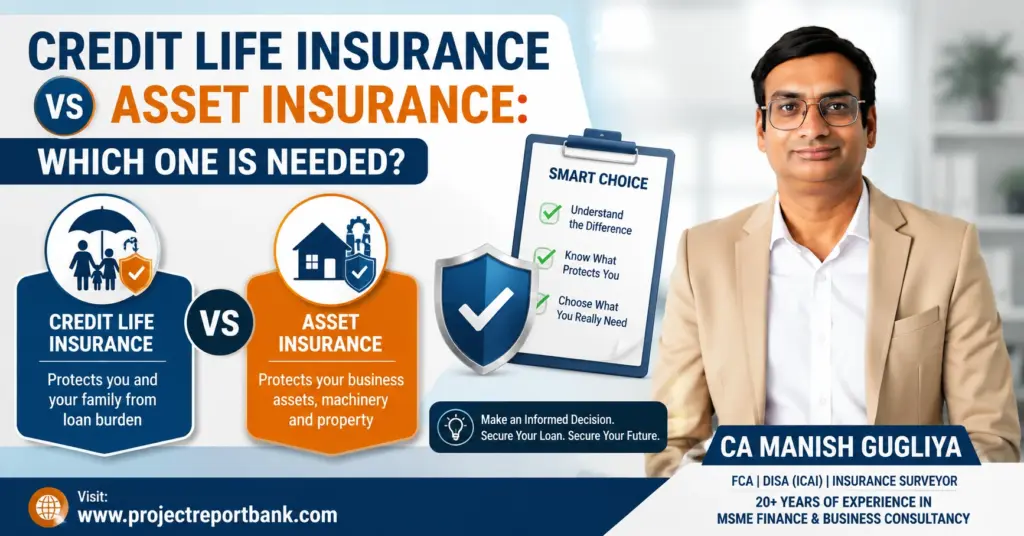
- Credit Life Insurance vs Asset Insurance: Which Is Better for Mudra Loan Borrowers?
- Types of Insurance Offered with Mudra Loans Explained
- Why Do Banks Recommend Insurance with Mudra Loans?