Key Takeaways
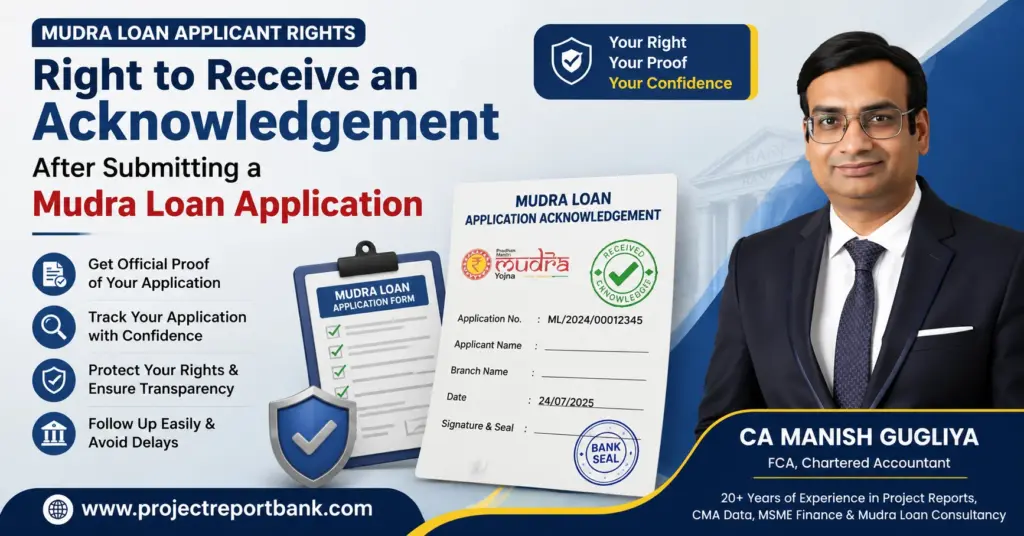
Every Mudra loan applicant should ask for a written or digital acknowledgement slip the moment their application is submitted. This slip is the first official proof that the bank or financial institution has accepted your application under Pradhan Mantri Mudra Yojana (PMMY) and is the foundation for everything that follows-tracking, follow-up, and grievance redressal.
- A proper mudra loan application acknowledgement should contain the date of submission, applicant name, mudra loan application reference number, branch seal, and the receiving officer’s name and signature. Without these details, tracking your mudra loan application status becomes unnecessarily difficult.
- RBI’s Fair Practices Code expects banks to acknowledge all loan applications for amounts up to ₹2 lakh and indicate a processing timeline. This covers most Shishu loans (upto rs 50,000) and many Kishore loans (₹50,001 to ₹5 lakhs) under the pradhan mantri mudra yojana scheme.
- PMMY categorises loans into four categories: Shishu, Kishore, Tarun (₹5 lakhs to ₹10 lakhs), and Tarun Plus (up to ₹20 lakhs for those who have successfully repaid previous loans under Tarun). The Mudra Yojana provides loans up to Rs. 20 lakhs, and no collateral is required for loans up to Rs. 10 lakhs.
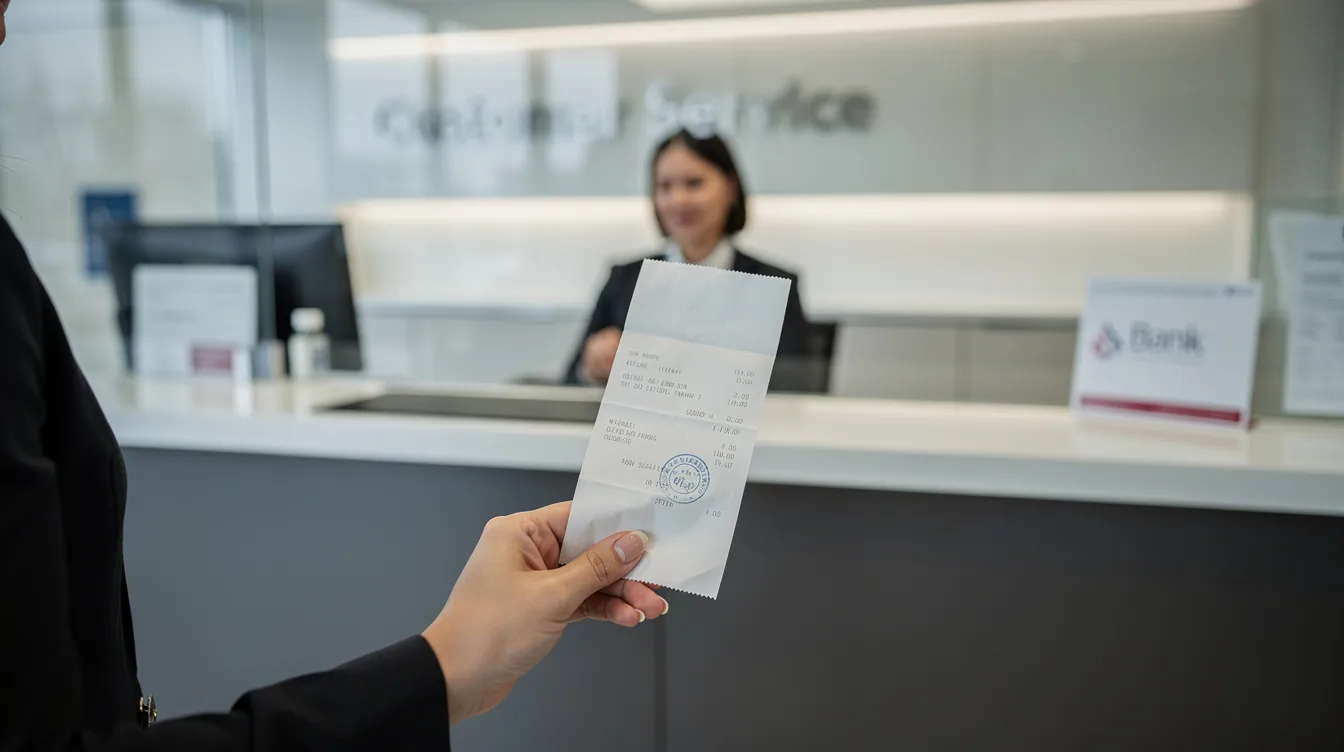
- Never leave the branch without some form of mudra loan acknowledgement receipt-whether it is the printed applicant slip on the PMMY form, a stamped copy of the application, an email confirmation, or an SMS with a reference number.
- If a bank refuses to issue an acknowledgement, politely escalate to the Branch Manager, then to the bank’s grievance cell, and finally to the RBI Integrated Ombudsman. Keep any proof of submission you have-photos, emails, even the name of the officer you spoke with.
Table of Contents
Introduction: Why Mudra Loan Application Acknowledgement Matters
Imagine this: a shopkeeper in Jaipur submits a ₹3 lakh Kishore mudra loan application at his local branch. He hands over his filled form, KYC documents, passport size photograph, and project report. The officer says, “We will call you.” Thirty days pass. When the shopkeeper returns, the officer has been transferred and the branch claims it never received any application. Without any acknowledgement slip or reference number, the shopkeeper has zero proof that the bank ever saw his papers.
This situation is far more common than banks will admit-and it is entirely avoidable.
A mudra loan application acknowledgement is the first official proof that a borrower has applied under the mantri mudra yojana pmmy, whether for a Shishu, Kishore, or Tarun category loan. The acknowledgment provides proof of submission for the loan application. It does not mean approval. It simply confirms that the bank has received the application and entered it into its system.
Banks typically issue acknowledgement in one of these forms:
- The detachable applicant slip printed on the standard PMMY application form
- A stamped photocopy of the application’s first page
- A computer-generated receipt with an application number
- A confirmation email or SMS with a reference number
Mudra Yojana was launched on April 8, 2015, to provide financial assistance to micro enterprises in the non farm sector. It supports income generation and employment creation by covering loans extended through commercial banks, small finance banks, and other financial institutions. Loans are available for micro enterprises in non-farm sectors, and eligible borrowers for the Pradhan Mantri Mudra Yojana include individuals and business entities.
The rest of this article covers your rights, what the receipt should contain, what to do if a bank refuses, and practical tips from my two decades of handling MSME finance as a Chartered Accountant.

Why an Acknowledgement is Important in Mudra Loan Processing
Most mudra loans-especially Shishu and Kishore-are small-ticket MSME loan applications. Because the loan amount is modest, banks sometimes treat documentation casually. But the applicant should never follow suit. The acknowledgement slip is where proper documentation begins.
Here is why it matters:
1. Official proof of Mudra loan submission with exact date
The acknowledgment document includes an application reference number and the submission date. This becomes your reference point if there is ever a dispute about when the application was filed. Loan applications for amounts up to ₹5 lakh must be processed within 2 weeks as per banking norms, and without a dated acknowledgement, you cannot hold the bank accountable for delays.
2. Application enters the bank’s formal records
Once acknowledged, the mudra loan application enters the branch’s inward register or loan processing software. An application number is generated after submitting the loan application. This trackable number is what makes follow-up meaningful instead of guesswork.
3. Protection against lost or misplaced forms
In busy branches handling dozens of applications daily, physical forms get misplaced. Your acknowledgement slip is independent proof that you submitted your application, regardless of what happens to the branch’s internal file.
4. Easier tracking and follow-up
With a proper acknowledgement, you can:
- Ask the branch about expected processing time
- Call customer care and quote the exact reference number
- Escalate delay complaints with documented evidence
- Prove that your application was submitted before any change in interest rates or scheme guidelines
5. Accountability and transparency
RBI’s Fair Practices Code expects banks to acknowledge loan applications up to ₹2 lakh and indicate the time frame within which they will be processed. Since PMMY has sanctioned over 52 crore accounts totalling ₹33.19 lakh crore since inception, the sheer volume makes documentation critical.
6. Discourages middlemen and informal dealings
An acknowledged application with a proper reference number discourages “cash-based” dealings with middlemen. PMMY does not permit agents, and a clean paper trail starting from the acknowledgement protects the applicant from scams. Verification of the application is necessary to avoid scams.
Does Every Mudra Loan Applicant Have the Right to Receive an Acknowledgement?
Indian banking law does not use the word “acknowledgement” in every rule. But RBI’s Fair Practices Code and standard PMMY documentation together create a strong practical right for every applicant.
What does RBI’s Fair Practices Code say?
The RBI Master Circular on Fair Practices Code requires every bank to adopt a Board-approved Fair Practices Code covering loan application processing, appraisal, and disbursement. Specifically, for small borrowers seeking loans up to ₹2 lakh, banks must give an acknowledgement of receipt and mention the time frame within which the application will be disposed of.
Most Shishu loans (upto rs 50,000) and a significant portion of Kishore loans fall within this ₹2 lakh threshold. This means that for the vast majority of mudra loan applicants, banks should invariably issue an acknowledgement.
What does the PMMY application form say?
The standard PMMY application form-used by banks like Punjab & Sind Bank, United Bank of India, and others-includes a detachable acknowledgement slip. This slip is meant to be stamped, signed by the branch official, and handed back to the applicant as a mudra loan acknowledgement receipt.
RBI has also issued specific circulars directing banks to mandatorily acknowledge all loan applications submitted by MSME borrowers and record a running serial number on both the application form and the receipt.
Who is eligible to apply?
Individuals can apply for mudra loans. Proprietary concerns are eligible for mudra loans. Partnership firms can apply for mudra loans. Non corporate and non farm sector business enterprises, including those in trading, manufacturing, and services, are eligible. The applicant must not be a bank defaulter.
Is every refusal automatically illegal?
Not necessarily. Sometimes staff are unaware of the requirement, or the branch is overwhelmed. But if you are refused, it is a violation of good banking practice. Applicants should treat acknowledgement as a practical right: insist politely, and if refused, record names, date, and time, and escalate.
For a deeper understanding of what information banks owe you during the mudra loan application process, read this guide on Mudra loan applicant rights and bank information sharing.
What Information Should a Mudra Loan Acknowledgement Receipt Contain?
Every bank has its own format, but certain details are non-negotiable if you want the acknowledgement to be useful during follow-up, complaints, or escalation. A typical acknowledgment includes submission date and applicant name, but a good one contains much more.
Here is a sample reference line from an actual PMMY acknowledgement: Application No. PSB/PMMY/SHISHU/2026/001234 dated 28-07-2026 received at Jaipur Main Branch.
Application status can be tracked using this acknowledgment/reference number in all future correspondence.
Comparison: Minimum vs Ideal Acknowledgement Details
| Minimum Details (Basic Acknowledgement) | Ideal Details (Recommended by CA Manish Gugliya) |
|---|---|
| Applicant name | Applicant name + business/trade name |
| Date of receipt | Date and time of receipt |
| Application number (manual or system-generated) | System-generated application/reference number |
| Bank name | Bank name, branch name, and branch address |
| Stamp or seal | Branch seal + receiving officer’s name and signature |
| – | Loan category (Shishu / Kishore / Tarun / Tarun Plus) |
| – | Proposed loan amount requested |
| – | Contact details: branch phone, email, or helpline |
| – | Expected processing timeline (for loans up to ₹2 lakh) |
For digital submissions through portals like JanSamarth, the acknowledgement (SMS, email, or PDF) should display at least the reference number, bank name, and submission date. The application process includes generating an OTP for verification, and after the final submission, the portal generates a confirmation. Always save screenshots and printouts for your mudra loan file.
Before leaving the branch, verify:
- Spelling of your name
- Correct loan amount
- Correct mudra loan category
- That the branch seal and officer’s signature are present
Errors on the acknowledgement can cause confusion during loan tracking later.
Benefits of Keeping the Acknowledgement Safe
Many small entrepreneurs carelessly tuck the acknowledgement slip into a bag and forget about it. When delays or rejections happen weeks later, they have nothing to show.
Here is why preserving your mudra loan application acknowledgement matters at every stage of growth development and funding:
- Status enquiry: The acknowledgement slip can be used for checking application status or responding to additional document requests. Quote the reference number every time you call or visit.
- Complaint filing: If you need to file a written complaint about undue delay, the acknowledgement with its date and reference number is your primary evidence.
- RBI Ombudsman: If the matter escalates to the reserve bank’s Integrated Ombudsman, attaching the acknowledgement slip with your complaint significantly strengthens your case.
- Avoiding duplicate applications: If you consider applying at another bank, having a clean trail with acknowledgements prevents confusion on your CIBIL report from multiple enquiries.
Practical backup advice:
Keep at least three copies:
- Original physical slip in a dedicated Mudra loan file
- A scanned copy saved to email or cloud storage
- A photo on your mobile phone, clearly named with date and bank name
Can You Track Your Mudra Loan Without an Acknowledgement?
Tracking a mudra loan without any acknowledgement or reference number is technically possible but highly inconvenient and uncertain in practice.
Without a mudra loan application receipt, you are forced to rely on:
- The name of the dealing officer (who may have been transferred)
- Your approximate submission date (which the bank may dispute)
- Informal verbal assurances (which carry zero weight in complaints)
Example: A woman entrepreneur applies for a ₹8 lakh Tarun loan for her boutique. After 25 days, a new officer joins the branch. Without an application number, the new officer cannot easily locate the file in the loan origination software. Fresh delays begin, and the borrower has to resubmit other documents.
Some banks can search by PAN, mobile number, or Aadhaar in their systems, but this only works if the application was formally logged. If the acknowledgement was never issued, there is a real risk that the application was never entered into the system at all.
If you have already applied without receiving an acknowledgement:
Visit the branch immediately. Request the application number in writing or by SMS or email. Note it in your mudra loan tracking records. Going forward, treat every communication like you would for an income-tax case-no verbal follow-ups without a written reference.
What Should You Do if the Bank Refuses to Give an Acknowledgement?
Many beneficiary micro unit entrepreneurs-especially first-time borrowers-feel hesitant to insist on their rights. Branch staff sometimes say, “We don’t give slips, just wait for SMS.” Do not accept this.
Step-by-step action plan:
- Politely ask for the official PMMY acknowledgement slip – the detachable portion on the application form. If the form does not have one, request a stamped copy of the first page.
- Request the application reference number in writing – even on a plain piece of paper with the officer’s signature and branch seal.
- Note the dealing officer’s name and designation – this becomes your witness record.
- Mention RBI Fair Practices Code – for loans up to ₹2 lakh, the bank is expected to give acknowledgement. Most branch managers are aware of this.
- Send an email the same day – write to the branch’s official email ID summarising that you submitted documents for a Mudra loan of ₹X under [Shishu/Kishore/Tarun] category on [date]. Attach scanned copies of your application. This email becomes dated evidence.
- Use the bank’s internal grievance system – complaint form, toll-free number, or online portal.
- Approach the RBI Integrated Ombudsman – only after giving the bank at least 30 days to respond. Enclose copies of your complaint, acknowledgement (if any), and follow-up emails.
If you feel the branch is handling your application unfairly, this article on fair treatment during Mudra loan processing provides additional guidance.
Common Reasons Banks May Delay Issuing an Acknowledgement
Not every delay is malicious. Understanding why banks hesitate can help you respond effectively.
| Reason | What You Should Do |
|---|---|
| Incomplete documents (missing ID proof, address proof, GST, shop licence, or project report) | Ask for a written checklist of pending documents |
| Mudra loans require ID proof and address proof documents, and applicants must provide a passport size photograph-if any of these are missing, the bank may hold off | Complete all requirements and resubmit same day if possible |
| Bank wants to check CIBIL/credit history before formally logging application | Ask whether application has been officially received or only “pre-screened” |
| Heavy rush at month-end or quarter-end | Visit during quieter hours (mid-month, early morning) |
| Server or system downtime | Request manual acknowledgement with officer’s signature |
| Staff misunderstanding that PMMY acknowledgements are optional | Politely mention RBI MSME borrower circular |
Important: Never leave your original documents (such as property papers, original invoices, or ownership certificates) with the bank without any written proof of receipt. If the bank wants to retain additional documents, insist on a separate document receipt listing each item.
Mistakes Applicants Should Avoid Regarding Acknowledgement
Even experienced business owners repeat the same errors. Here are the most common ones:
| Common Applicant Mistake | Better Practice |
|---|---|
| Leaving the branch without any bank acknowledgement receipt | Insist on acknowledgement slip with stamp and signature before leaving |
| Not checking that the Mudra loan category and loan amount are correctly written | Verify Shishu/Kishore/Tarun and exact amount on the spot |
| Failing to keep photocopies or scans of the full application set | Make two photocopies of everything before submission |
| Not noting the receiving officer’s name and contact number | Write down name, designation, mobile/extension |
| Trusting verbal promises of fast sanction | Rely on written timelines printed on the acknowledgement |
| Not reading the small print on timelines or conditions | Read every line on the acknowledgement before pocketing it |
| Submitting incomplete forms and hoping the bank will “adjust” | Fill every field; attach all required documents including the project report |
For digital submissions through JanSamarth or bank portals:
- Always save the final submission confirmation screen-take a screenshot immediately
- Check your email inbox and spam folder for the confirmation email
- Download the PDF mudra loan application receipt and store it in your cloud drive
Good record-keeping-from acknowledgement to sanction letter-improves your credibility if you later seek higher loan amounts, a term loan top-up, or other legal forms of MSME finance from the same lender.

Expert Tips from CA Manish Gugliya for Managing Your Mudra Loan Acknowledgement
In my practice as a Chartered Accountant, I have seen hundreds of Mudra loan applications across Shishu, Kishore, and Tarun categories. The entrepreneurs who maintain clean documentation from Day 1 almost always have smoother experiences. Here are my practical recommendations:
- Pre-fill the PMMY form neatly before visiting the bank. Incomplete or messy forms are the number one reason for delays.
- For Kishore and Tarun categories, always attach a proper project report and CMA data. Banks assess based on these documents for higher amounts.
- Carry two photocopy sets of everything – one for the bank, one to get stamped as “received” for your records.
- Ask the bank to mention expected processing time on the acknowledgement slip itself. For loans up to ₹2 lakh, many banks will indicate this.
- Quote the exact mudra loan application reference number in every SMS, email, or letter to the branch.
- Scan and store the acknowledgement in at least two locations – email and cloud. Rename the file clearly, for example: “SBI_PMMY_Kishore_Ack_28-07-2026.”
- Share a copy with your CA or consultant who prepared your project report, so they can follow up if needed.
- If delays extend beyond the indicated timeline, write a polite letter to the branch manager citing the acknowledgement date and referencing RBI fair practice guidelines. Read this guide on timely communication rights for Mudra loan applicants for specific language you can use.
- Maintain a dedicated Mudra loan folder containing: project report, KYC copies, bank statement for the last six months, financials, acknowledgement slip, any bank queries, your replies, sanction letter, and disbursement proof.
- For repeat borrowers looking to move to the next phase – say from Kishore to Tarun or Tarun Plus – a clean file with all previous acknowledgements and repayment records shows a satisfactory credit track record and helps build credibility.
- Never submit documents through middlemen or agents. PMMY is a flagship scheme of the government, and applications must be submitted directly by individual borrowers to the bank.
- If the bank demands forced insurance or hidden processing charges, your acknowledgement slip with the stated loan amount and category is evidence that the original terms were different.
- Educational qualification requirements depend on the proposed activity, not on a fixed degree. Do not let anyone tell you that you need a specific educational qualification to apply for Mudra loans-what matters is that you have the necessary skills and knowledge to undertake your proposed activity.
Frequently Asked Questions
These FAQs address practical doubts that Mudra loan applicants face at the branch level and during follow-up.
1. Is a Mudra loan acknowledgement compulsory for every loan amount?
RBI’s Fair Practices Code specifically mandates acknowledgement for loan applications up to ₹2 lakh, which covers all shishu loans and many Kishore applications. For higher amounts, it is strongly expected as good banking practice but not always explicitly mandated by a single rule.
2. Does acknowledgement mean my Mudra loan is approved?
No. Acknowledgement only confirms that the bank has received your application. Approval depends on eligibility checks, credit history, the nature of the proposed activity, and the quality of your project report and other documents.
3. Can an SMS or email act as a valid acknowledgement?
Yes, provided it contains the application reference number, bank and branch name, and submission date. Save the SMS and email-do not delete them until the loan is fully repaid.
4. What if my acknowledgement does not show any application number?
Visit the branch immediately and request the number in writing. An acknowledgement without a reference number has limited value for tracking or complaints.
5. How long should I keep the acknowledgement slip?
Until the loan is fully repaid and the bank issues a No Dues Certificate. For practical purposes, keep it for at least three years after final repayment.
6. What if I lose my Mudra loan acknowledgement receipt?
Visit the branch with your ID proof and request a duplicate or at least a written confirmation of your application number and submission date. Check your email and phone for any digital acknowledgement.
7. Can I apply to another bank if I already have an acknowledgement from the first bank?
You can, but it is risky. Multiple credit enquiries on your CIBIL report may raise red flags. Read this detailed article on applying to another bank while a Mudra loan is pending before deciding.
8. Can acknowledgement help if bank staff demand illegal charges or force insurance?
Absolutely. Your acknowledgement slip records the original loan amount and category. If someone later demands undisclosed facility charges, the acknowledgement is proof of what was originally sought and accepted.
9. What is Mudra’s role – does it directly give loans?
No. Mudra is a refinancing agency that provides funds through banks or NBFCs. Your application is submitted to a specific bank or financial institution, not to Mudra directly. The bank is the lender; Mudra provides refinance support.
10. What categories does the Mudra loan scheme have?
The Mudra loan scheme categorizes loans into Shishu (upto rs 50,000), Kishore (₹50,001 to ₹5 lakhs), Tarun (₹5 lakhs to ₹10 lakhs), and Tarun Plus (up to ₹20 lakhs for borrowers who have availed and successfully repaid under Tarun). These represent the stage of growth development and funding needs of the beneficiary micro unit.
11. What documents are needed along with the application?
Mudra loans require ID proof (Aadhaar, PAN, passport, etc.), address proof (utility bills, residence certificate), a passport size photograph, bank statement for the last six months, and business-related documents such as GST registration, shop act licence, and ownership or rental proof. A project report is strongly recommended for Kishore and Tarun categories.
12. Do I need any specific educational qualification to apply?
No. Educational qualifications depend on the proposed activity. There is no minimum degree requirement under PMMY. What matters is your ability to run the business and your credit profile.
13. Can acknowledgement help me track the loan status online?
Many banks allow you to check your mudra loan application status on their website or app using the application reference number from your acknowledgement. Without this number, online tracking is usually not possible.
14. How does acknowledgement protect my privacy?
A formal acknowledgement means your application is in the bank’s official system, subject to data protection policies. Applications handled informally-without acknowledgement-carry a higher risk of personal data being misused.
Conclusion
The mudra loan application acknowledgement is the applicant’s first and most important protection in the entire loan journey. It is not just a formality-it is the foundation for every follow-up, every complaint, and every escalation you may ever need to make.
To summarise:
- Acknowledgement proves timely submission of your PMMY application
- It enables reliable tracking through a unique reference number
- It supports grievance redressal if the bank delays or acts unfairly
- It encourages banks to follow transparent, documented processes
As a practising Chartered Accountant, I always tell my clients: treat your Mudra loan file like your business licence-keep it complete, keep it safe, and keep it updated from acknowledgement to final repayment. Whether you are seeking a Shishu loan for a small trading unit or a Tarun facility for a manufacturing setup, the discipline of proper documentation starts the moment you hand over your application and receive that stamped acknowledgement.
Explore more resources on Mudra loan applicant rights and fair treatment during processing at ProjectReportBank.com to strengthen your understanding before you visit the bank.
Preserve your acknowledgement and all related Mudra loan documents until the loan is fully repaid and the bank issues a No Dues Certificate. Your future self will thank you.
About the Author:
CA Manish Gugliya (FCA) is a Chartered Accountant with 20+ years of practical experience in Project Reports, CMA Data, MSME Finance, Business Loans, and Mudra Loan consultancy across sectors like trading, manufacturing, and services. Through ProjectReportBank.com, he and his team prepare bank-ready project reports, guide entrepreneurs on choosing the right Mudra loan category and loan amount, and help them understand banking procedures, interest rates, documentation, and follow-up strategies. His hands-on experience interacting with branch managers, credit officers, and regional offices allows him to share practical insights on topics like mudra loan application acknowledgement, applicant rights, and fair treatment. Explore other detailed guides on ProjectReportBank.com to improve your chances of quick and successful Mudra loan sanction under Pradhan Mantri Mudra Yojana.
- Does the Bank Have to Explain Why Your Mudra Loan Was Rejected?


- Right to Receive an Acknowledgement After Submitting a Mudra Loan Application

- Your Right to Fair and Non-Discriminatory Treatment in Mudra Loan Processing
- Can Bank Ask for Extra Documents in Mudra Loan? (Practical Guide by a CA)

- Mudra Loan Processing Charges: Your Right to Transparent Fees Under PMMY

- Can a Bank Force You to Buy Insurance with a Mudra Loan?

- Right to Timely Communication During Mudra Loan Processing

- Mudra Loan Privacy Rights: How Banks Should Handle Your Information
- Mudra Loan Applicant Rights: Information Banks Must Share (Practical Guide by CA Manish Gugliya)