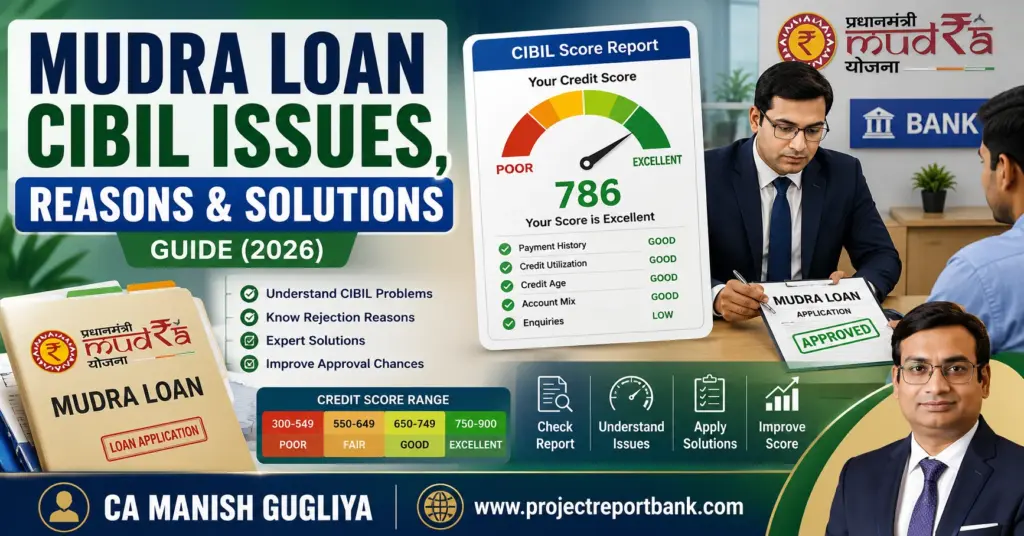
Your CIBIL score is one of the key factors banks consider while evaluating a Mudra Loan application, as it reflects your credit discipline and repayment behaviour. However, a good CIBIL score alone does not guarantee loan approval, and a low CIBIL score does not automatically result in rejection. Banks also assess your business profile, project report, repayment capacity, existing EMIs, banking transactions, and the overall viability of your business before making a lending decision.
Many applicants are surprised when their Mudra Loan is rejected despite having a strong CIBIL score, while others with a limited or even no credit history receive approval. This happens because banks evaluate multiple financial and business-related factors rather than relying only on your credit score.
In this comprehensive guide, CA Manish Gugliya explains every major CIBIL-related issue that can affect Mudra Loan approval. You will learn how low CIBIL scores, poor credit history, multiple loan enquiries, credit card defaults, settled loan accounts, existing EMIs, CIBIL report errors, and even the absence of a CIBIL score influence your application. You’ll also find practical solutions, expert tips, and links to detailed guides that can help you strengthen your profile and improve your chances of securing a Mudra Loan.
Before applying for a Mudra Loan, it is important to understand what CIBIL is and how it influences your loan application. While many applicants believe that only the CIBIL score determines loan approval, banks actually consider several financial and business factors together.
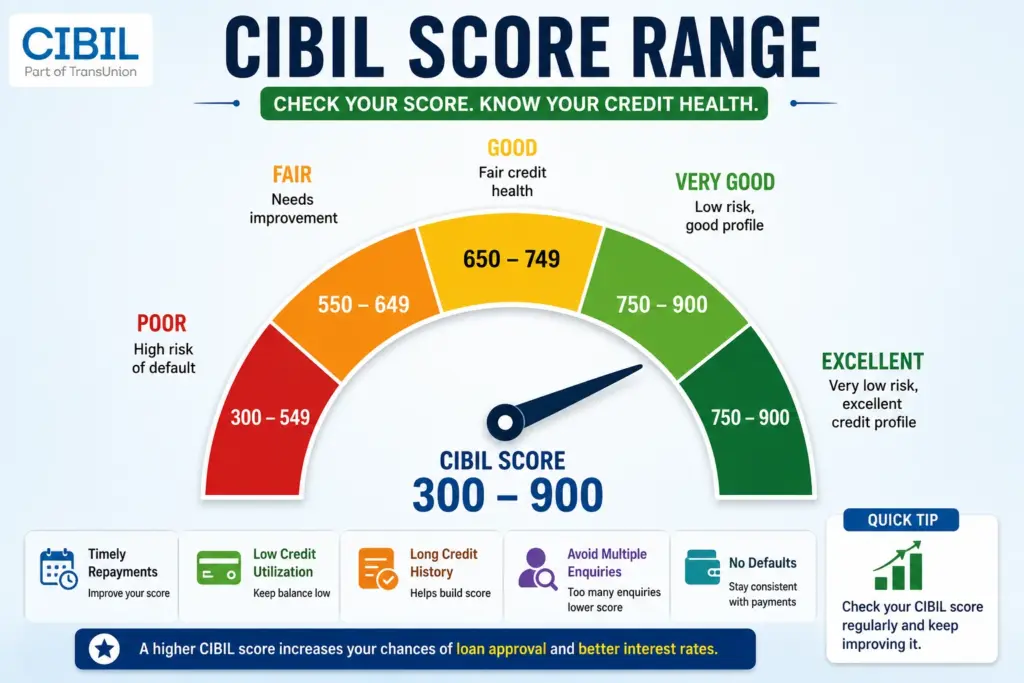
CIBIL (Credit Information Bureau (India) Limited) is India’s leading credit bureau that maintains the credit records of borrowers. Based on your repayment history, loans, credit cards, and other credit activities, it generates a credit score between 300 and 900, which helps banks assess your credit behaviour.
Banks use your CIBIL report to evaluate your repayment discipline, existing loan obligations, credit card usage, and overall credit risk. A healthy credit profile increases lender confidence, but it is only one part of the loan assessment process.
A good CIBIL score can improve your chances of approval, but it does not guarantee a Mudra Loan. Similarly, a low score does not always result in rejection. Banks also evaluate your business viability, project report, repayment capacity, banking history, and supporting documents before making a final decision.
In the following sections, you’ll learn how different CIBIL-related issues affect Mudra Loan approval and explore practical solutions to improve your chances of getting approved.
A low CIBIL score signals higher credit risk to lenders, making Mudra Loan approval difficult. Scores below 650 often lead to outright rejection or stricter terms. Learn why your score matters and how to address this issue. Read more
Even with a good CIBIL score, Mudra Loan applications can be rejected due to other factors like recent credit activity or lender-specific policies. Discover hidden reasons behind such rejections and how to overcome them. Read more.....
A history of late payments, defaults, or settlements can negatively impact your CIBIL report. Lenders view poor credit history as a red flag, reducing your chances of Mudra Loan approval. Find out how to repair your credit profile. Read more......
Having multiple ongoing EMIs increases your debt burden and lowers your Mudra Loan eligibility. Lenders may worry about your repayment capacity. Learn how to manage EMIs to improve your approval odds. Read more.....
Frequent loan enquiries in your CIBIL report can signal credit-hungry behavior to lenders. This may lead to Mudra Loan rejection or lower loan amounts. Understand how to limit enquiries and protect your score. Read more...
Defaults on credit card payments severely damage your CIBIL score and credibility. Lenders see this as a sign of financial stress, making Mudra Loan approval unlikely. Learn steps to recover from defaults. Read more....
Settling a loan for less than the full amount is marked in your CIBIL report and can hurt your Mudra Loan chances. Lenders may view settlements as inability to repay. Find out how to handle settled accounts. Read more...
Mistakes in your CIBIL report, such as incorrect personal details or loan records, can lead to wrongful Mudra Loan rejection. Learn how to spot and correct errors for a fair assessment. Read more.....
If you have no credit history, your CIBIL score may be unavailable. Lenders may hesitate to approve Mudra Loans without a track record. Discover ways to build your score from scratch. Read more...
Improving your CIBIL score increases your Mudra Loan eligibility and helps secure better terms. Explore proven strategies to boost your score and maintain healthy credit habits. Read more
A low CIBIL score is one of the most common reasons banks hesitate to approve a Mudra Loan. It may indicate past repayment issues or high credit risk. However, a low score does not always result in rejection if your business profile, repayment capacity, and project report are strong. Banks consider multiple factors before making a decision.
Banks review your complete credit history, not just your current CIBIL score. Missed EMIs, loan defaults, delayed payments, and frequent overdue accounts can negatively impact your loan application. A healthy repayment history builds trust and improves the chances of approval.
High existing EMI obligations can reduce your repayment capacity and increase your financial burden. Even with a good CIBIL score, excessive monthly commitments may affect your Mudra Loan approval. Banks assess whether you can comfortably manage another loan.
Credit card payment defaults are reflected in your credit report and may reduce the bank’s confidence in your repayment behaviour. Regular overdue payments or unpaid balances can negatively impact your application. Timely repayments help strengthen your credit profile.
Applying for several loans within a short period creates multiple hard enquiries on your CIBIL report. Banks may interpret this as financial stress or urgent credit requirements. It is advisable to avoid unnecessary loan applications before applying for a Mudra Loan.
A loan marked as “Settled” instead of “Closed” indicates that the loan was not repaid in full. This may negatively affect your credit profile, even if the account is no longer active. Banks often review such entries carefully during loan assessment.
Incorrect information in your CIBIL report, such as wrong loan details, payment records, or personal information, can affect your loan application. Reviewing your credit report regularly and correcting errors before applying can improve your chances of approval.
Many first-time borrowers or new entrepreneurs do not have a CIBIL score. This does not automatically disqualify them from getting a Mudra Loan. Banks may evaluate business viability, banking transactions, income, and other financial indicators instead.
A good CIBIL score alone does not guarantee Mudra Loan approval. Banks also evaluate your business model, project report, documents, banking behaviour, repayment capacity, and overall credit risk. Weaknesses in these areas can still lead to rejection.
Improving your CIBIL score requires consistent financial discipline. Paying EMIs on time, reducing outstanding debt, correcting report errors, and avoiding unnecessary credit enquiries can gradually strengthen your credit profile. Taking these steps before reapplying increases your chances of Mudra Loan approval.
👉 Follow our complete guide to improve your CIBIL score and prepare a stronger Mudra Loan application.
One of the most common questions among applicants is whether a CIBIL score is mandatory for getting a Mudra Loan. The simple answer is No—not in every case. While many banks review the applicant’s CIBIL report as part of their credit assessment, the final decision depends on several factors, including the nature of the business, repayment capacity, and the bank’s internal lending policy.
For existing businesses, banks generally check the applicant’s CIBIL score and credit history to understand past repayment behaviour and existing loan obligations. A healthy credit profile can strengthen the application, but the business’s financial performance and repayment capacity are equally important.
Applicants starting a new business or applying for their first loan may not have a CIBIL score or any credit history. In such cases, banks often evaluate the business idea, project report, promoter profile, and other supporting documents instead of relying only on a credit score.
The Pradhan Mantri Mudra Yojana (PMMY) guidelines do not prescribe a minimum CIBIL score for loan eligibility. However, the banks and financial institutions implementing the scheme are responsible for assessing the applicant’s creditworthiness and repayment ability. As a result, different banks may follow different credit assessment practices, and CIBIL may carry varying levels of importance depending on the case.
Key Takeaway: A CIBIL score is an important assessment factor, but it is not the sole criterion for Mudra Loan approval. Banks consider your overall financial profile, business viability, project report, and repayment capacity before making a lending decision.
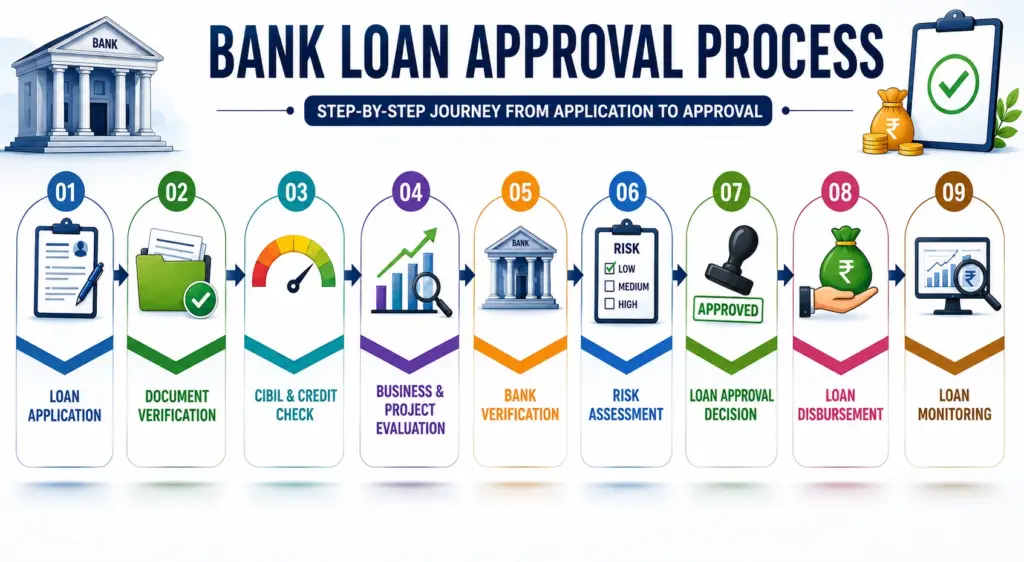
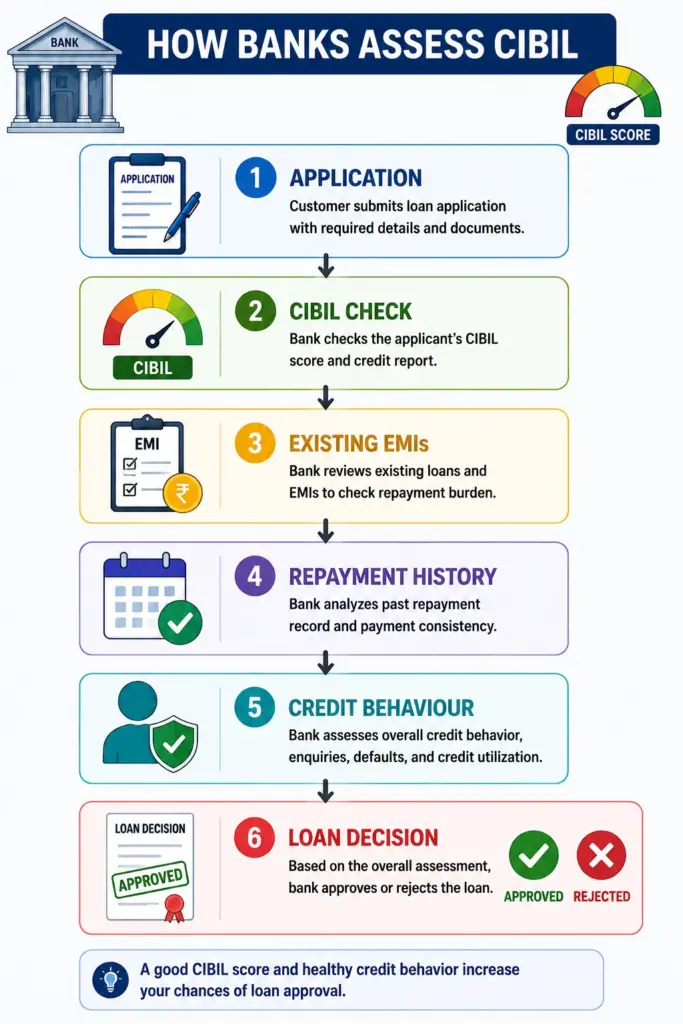
Banks do not approve or reject a Mudra Loan based only on your CIBIL score. They review your complete credit profile, including repayment history, existing EMIs, loan enquiries, credit card usage, and overall financial behaviour. Along with CIBIL, banks also evaluate your business profile, project report, income, and repayment capacity before making the final loan decision.
Note: A good CIBIL score improves your chances of approval, but it does not guarantee approval. Likewise, a low CIBIL score does not always result in rejection if your overall business profile is strong.
💡 Expert Tip 1: Check your CIBIL report before applying for a Mudra Loan. Identifying credit issues in advance gives you time to correct them and submit a stronger application.
💡 Expert Tip 2: Avoid applying for multiple loans within a short period. Frequent loan enquiries can negatively impact your credit profile and may concern banks.
💡 Expert Tip 3: Never ignore overdue EMIs or credit card payments. Timely repayments help build a healthy credit history and improve your loan approval chances.
💡 Expert Tip 4: Review your CIBIL report for errors. If you find incorrect loan details or payment records, raise a dispute and get them corrected before applying.
💡 Expert Tip 5: Don’t assume a high CIBIL score guarantees approval. Banks also assess your business viability, repayment capacity, documents, and project report.
💡 Expert Tip 6: Prepare a professional project report and complete financial documents. A well-prepared application creates confidence and improves your chances of approval.
💡 Expert Tip 7: Maintain healthy banking habits. Regular account transactions, stable cash flow, and proper financial discipline strengthen your overall loan profile.
💡 Expert Tip 8: Identify the actual reason for any previous rejection before reapplying. Correct the weaknesses instead of submitting the same application again.
💡 Expert Tip 9: Reduce existing debt whenever possible. Lower financial obligations improve your repayment capacity and make your application more attractive to banks.
💡 Expert Tip 10: Focus on your complete financial profile, not just your CIBIL score. Strong business documents, accurate information, and financial discipline often play an equally important role in Mudra Loan approval.
Most banks prefer a CIBIL score above 650 for Mudra Loan approval. A higher score increases your chances, but some lenders may consider applicants with lower scores. For detailed eligibility criteria, check our complete guide.
Yes, it’s possible, but approval is harder. You may need to provide additional documents or collateral. Explore our guide for alternative solutions and tips to improve your chances.
A good CIBIL score can help you secure lower interest rates. If your score is low, lenders may charge higher rates or offer smaller loan amounts. Learn more about rate calculations in our detailed guide.
Common reasons include low score, recent defaults, or multiple loan inquiries. Review your credit report and address errors. For step-by-step solutions, visit our guide on Mudra Loan rejections.
You can check your CIBIL score online for free once a year. Visit the official CIBIL website or use trusted financial portals. Our guide explains the process in detail.
Timely repayment of Mudra Loan can positively impact your CIBIL score. Missed payments or defaults will lower it. Read our guide for tips on maintaining a healthy credit profile.
Dispute errors directly with CIBIL by submitting supporting documents. Correcting mistakes can boost your score. Find step-by-step instructions in our guide on CIBIL corrections.
Improvement depends on your repayment habits and error corrections. Usually, it takes 3–6 months to see noticeable changes. For faster results, follow our actionable tips in the guide.
Yes, frequent loan inquiries can lower your score. Apply only when you’re ready and eligible. Learn how to manage applications wisely in our comprehensive guide.
Explore our complete guide for expert advice, step-by-step solutions, and practical tips to resolve CIBIL-related Mudra Loan problems. Click through for in-depth information on each topic.
Your CIBIL profile plays an important role in Mudra Loan approval, but it is not the only factor banks consider. They also evaluate your business viability, repayment capacity, project report, financial documents, banking behaviour, and overall credit risk before making a lending decision.
The good news is that most CIBIL-related issues can be corrected with proper planning and financial discipline. Whether your concern is a low CIBIL score, poor credit history, existing EMIs, credit card defaults, report errors, or no credit history, there are practical steps you can take to strengthen your application.
Before submitting a fresh Mudra Loan application, identify your specific CIBIL issue and resolve it wherever possible. Use the detailed guides linked throughout this page to understand each problem, learn the available solutions, and improve your chances of securing Mudra Loan approval.